LayerZero ATLAS Sends ZRO Higher: What the Exchange-Backend Launch Means for Volatility
Direct answer: LayerZero announced ATLAS on August 25, 2026 as a headless exchange backend built on its Zero blockchain. The system is designed to combine matching, clearing, settlement and risk for open and institutional trading venues. CoinDesk reported that ZRO rose roughly 30% after the announcement. The move shows that traders are pricing a possible new source of token utility—but it does not yet prove that ATLAS has live adoption, recurring fee volume or durable buy-and-burn demand.
Key takeaways
- ATLAS is infrastructure, not a consumer exchange app. Trading venues are expected to build their own frontends and distribution.
- LayerZero says ATLAS will support crypto-native and institutional markets, with spot, perpetuals, tokenized assets and other market types among the possible use cases.
- The official announcement describes 200,000 transactions per second at launch provisioning and sub-millisecond performance claims in its current environment. These are LayerZero’s product claims, not independently verified production results in this article.
- LayerZero links ZRO to Zero staking, gas, governance, venue rebate tiers and a stated buy-and-burn mechanism.
- The volatility question is whether the announcement becomes measurable usage. Until then, ZRO’s repricing remains a high-beta expectations trade.
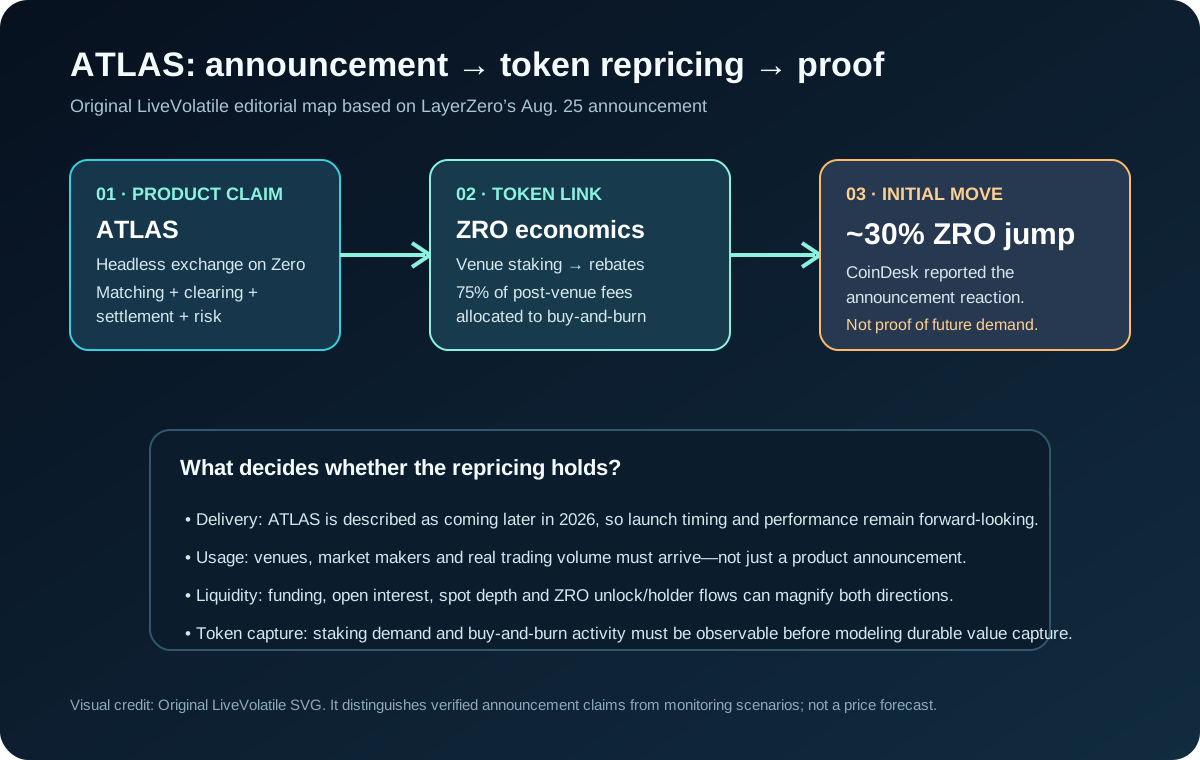
Visual credit: Original LiveVolatile SVG created from LayerZero’s ATLAS announcement and ATLAS product page, with CoinDesk’s reported market reaction. The visual separates verified claims from scenarios and is not a price forecast.
What is LayerZero ATLAS?
ATLAS stands for Aggregated Trading Liquidity and Settlement. LayerZero describes it as a universal backend, or “headless exchange,” running on Zero. Unlike a conventional exchange brand, ATLAS is not intended to own a retail interface or directly acquire end users. Instead, trading venues can connect to the engine, choose or create markets, and retain the customer experience.
That design matters for market structure. A venue using ATLAS would not necessarily need to build its own matching, clearing, settlement and risk stack from scratch. Institutional users could configure market rules while using the same underlying engine. In theory, this lowers the cost of launching new venues and could make more tokenized assets tradable around the clock.
In practice, the announcement is a product roadmap and launch claim. LayerZero’s ATLAS page says the product is coming later this year. The difference between an announced backend and a liquid, trusted market is the central execution risk for ZRO holders.
Why did ZRO react?
The token received a new narrative: activity on a market-infrastructure layer could potentially feed back into the asset securing and powering that layer. LayerZero says ZRO will serve as Zero’s delegated-proof-of-stake and gas asset, while also governing upgrades and Zones. For ATLAS specifically, venues can stake ZRO to qualify for higher fee rebates.
LayerZero also states that, after venue rebates, 25% of the remaining economics goes to market creators and 75% goes to buying and burning ZRO. That is a proposed or stated economic design, not the same thing as realized fee revenue. A burn mechanism has no measurable price effect until there is actual trading activity, fees, execution and transparent implementation.
CoinDesk reported a roughly 30% ZRO surge after the announcement and described the broader institutional context around Zero. That market reaction is useful evidence of immediate sentiment, but it is not evidence that ATLAS has already generated the volume needed to support the valuation.
The volatility transmission channels
| Channel | Bullish interpretation | Risk that can reverse the move |
|---|---|---|
| Venue staking | Trading venues may acquire or lock ZRO to access higher rebates. | Venues may delay integration or require less ZRO than expected. |
| Fee capture | Real volume could create buy-and-burn demand. | No production volume means no realized fee capture. |
| Institutional markets | Tokenized stocks, commodities or bonds could expand the addressable market. | Compliance, custody, market-making and settlement requirements can delay adoption. |
| Performance claims | High throughput and low latency could attract builders. | Test or simulated results may not match public, adversarial workloads. |
| Narrative momentum | A new market-infrastructure story can attract speculative capital. | Thin liquidity, leverage or profit-taking can amplify a fast drawdown. |
Use the LiveVolatile markets monitor, liquidations dashboard and volatility tools to place ZRO’s move beside broader market stress. The useful question is not simply whether ZRO is green; it is whether spot demand, liquidity and open interest are expanding together.
What is verified—and what is still forward-looking?
The verified announcement layer is relatively clear: LayerZero published the ATLAS introduction on August 25; it describes ATLAS as a headless exchange on Zero; it gives performance and fee-design figures; and its product page presents the system as intended for open and institutional markets.
Several more ambitious conclusions remain unverified:
- ATLAS has not yet demonstrated sustained public-market volume in the sources reviewed for this article.
- The announcement does not establish that major institutions have committed to launch markets on ATLAS.
- Product specifications do not guarantee that ZRO demand will track total market volume one-for-one.
- The reported ZRO price reaction does not establish a new fair value or a permanent trend.
This distinction is especially important after a sharp token move. Traders often convert a system’s total addressable market into an implied token valuation before the system has users. That is a narrative shortcut, not a verified cash-flow model.
The checkpoints that matter next
- Launch timing: Look for testnet, mainnet, documentation and security milestones. The official product page currently frames availability as coming later in 2026.
- Integrations: Identify named venues, market creators and market makers that actually connect to the system.
- Observable volume: Track executed trades, fees, settlement activity and liquidity—not announced capacity alone.
- ZRO mechanics: Verify staking requirements, rebate tiers, governance changes and any executed buy-and-burn transactions.
- Market quality: Compare spot volume with perpetual open interest, funding rates, order-book depth and liquidation clusters.
- Competitive pressure: Assess whether venues choose ATLAS over existing centralized, decentralized or specialized market infrastructure.
A durable repricing would normally need several of these signals at once. If the token continues higher while usage evidence remains absent, volatility risk rises because expectations have moved faster than fundamentals.
FAQ
What is ATLAS?
ATLAS is LayerZero’s announced headless exchange backend, built on the Zero blockchain. It is designed to provide matching, clearing, settlement and risk infrastructure to trading venues rather than operate its own consumer frontend.
Why is ZRO connected to ATLAS?
LayerZero says ZRO secures Zero, pays gas, participates in governance, qualifies venues for fee rebates and is linked to a stated buy-and-burn allocation from ATLAS economics.
Did ATLAS already launch with live trading volume?
The sources reviewed confirm the announcement and product design, but not sustained public-market trading volume. LayerZero’s ATLAS page says the product is coming later in 2026, so adoption remains a milestone to verify.
Is the ZRO rally guaranteed to continue?
No. CoinDesk’s reported roughly 30% reaction measures initial market sentiment. Future direction will depend on liquidity, leverage, implementation, integrations and realized usage.
What should volatility traders monitor?
Watch ZRO spot volume, perpetual open interest, funding, liquidation clusters, order-book depth, venue integrations, staking demand and any transparent buy-and-burn activity. Also separate official claims from independently observable production data.
Conclusion
ATLAS gives LayerZero a more direct market-infrastructure narrative and gives ZRO a possible connection to venue staking and future trading economics. That explains why the announcement could produce a sharp repricing. It does not eliminate execution risk.
For LiveVolatile readers, the disciplined stance is to treat the move as an expectations shock until ATLAS demonstrates users, liquidity and fees. The next volatility event may come not from another headline, but from a mismatch between promised capacity and delivered market activity. Monitor the milestones, avoid treating a theoretical burn as realized demand, and size risk for the possibility that the narrative outruns the product.
Risk disclaimer: This article is for informational and educational purposes only. Crypto assets are highly volatile and may lose some or all of their value. Nothing here is financial, legal or investment advice.
Sources
- LayerZero — Introducing ATLAS — published August 25, 2026; official announcement and product/economic claims.
- LayerZero — ATLAS product page — accessed August 26, 2026; product positioning, performance figures and later-2026 availability language.
- CoinDesk — LayerZero unveils trading infrastructure for crypto and tokenized markets, ZRO surges — published August 25, 2026; independent reporting on the announcement and reported token reaction.
Image credits: Original LiveVolatile SVG at /images/articles/2026-08-26-layerzero-atlas-zro-volatility.svg; created from the cited official LayerZero sources and CoinDesk market-reaction reporting. No third-party image is reproduced.
— LiveVolatile Research Desk