MANTRA Chain Halt: How Frozen Transfers Can Amplify OM Volatility
Direct answer: MANTRA Chain halted its mainnet on August 21, 2026, after identifying a security incident involving an upstream software dependency. The chain’s official status page says the mainnet remains halted while a patched release is tested and validators are coordinated for a restart. It also says the incident affected two MANTRA-managed wallets and that there is no indication that user, exchange, or partner funds were affected. The immediate market risk is therefore not a confirmed loss of user funds; it is the combination of frozen on-chain transfers, temporarily paused deposits and withdrawals, uncertain restart timing, and thinner or fragmented price discovery for OM.
Key takeaways
- MANTRA Chain stopped mainnet activity and froze endpoints and transactions as a precaution while investigating the incident.
- MANTRA’s status page says the event affected two MANTRA-managed wallets and reports no indication that user, exchange, or partner funds were affected.
- The team says it is validating a patched release on the DuKong testnet and will not give a restart time until testing is complete.
- CoinDesk reported that OM fell from about $0.005060 to a record low near $0.004126 around the time block production stopped, with volume surging; exact market conditions can change quickly.
- Paused deposits and withdrawals can separate exchange trading from the ability to move OM on the affected network. That can widen spreads, concentrate liquidity, and increase gap risk.
- A restart announcement is not the same as proof that liquidity, bridges, validators, or all transfer rails have fully normalized.
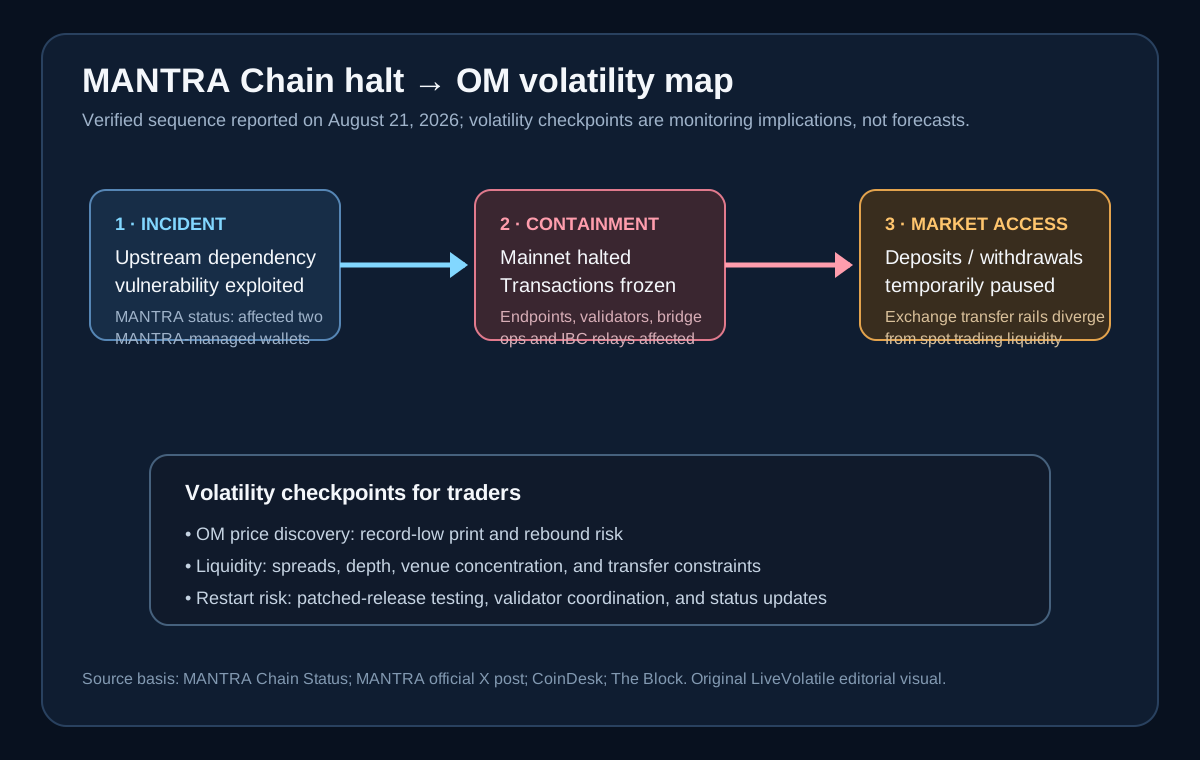
Visual credit: Original LiveVolatile editorial diagram, created from MANTRA’s official status page and X update, plus corroborating CoinDesk and The Block reporting. It explains the mechanism and is not a price forecast.
What happened to MANTRA Chain?
MANTRA’s official X update said at 00:10 UTC on August 21 that the team was aware of an incident affecting MANTRA Chain and had halted the chain as a precaution. The post said all endpoints and transactions were frozen, temporarily affecting deposits and withdrawals to and from MANTRA Chain. It told users to hold off on transactions until verified information was available.
The MANTRA Chain Status page later described the mainnet as still halted. It said the team was preparing and testing relevant remediations, validating a patched release on the DuKong testnet, and coordinating with validator partners. The status page said the incident affected two MANTRA-managed wallets and that there was no indication that user, exchange, or partner funds were affected. It also said the team would not provide a restart time until testing was complete.
That distinction matters. “Security incident,” “attempted exploit,” and “user funds were stolen” are not interchangeable descriptions. The available official information supports a chain halt and a contained incident assessment, but it does not support a claim that user funds were lost.
Why the halt can matter even without confirmed user-fund losses
A blockchain is not only a ledger. It is also a set of services that allow users and market makers to observe balances, submit transactions, bridge assets, stake, and move tokens between venues. When those services stop, the market can keep repricing the token while the underlying transfer rails are unavailable or impaired.
The Block reported that the incident was related to MANTRA’s Cosmos EVM module and that the team later said it had identified the root cause, contained the immediate threat, and found no user funds exploited. CoinDesk reported that the chain stopped producing blocks, that public endpoints, validators, bridge operations, and MANTRA-managed links were affected, and that the team was preparing a patched release. These details should be read alongside the official status page rather than replacing it.
The market-structure consequences are conditional:
| Condition | What is verified | Why it can affect OM volatility |
|---|---|---|
| Mainnet halt | MANTRA says mainnet remains halted | New on-chain price and transfer information may arrive more slowly or unevenly |
| Frozen endpoints and transactions | Confirmed by MANTRA’s official update and status page | Traders may lose normal access to balances, execution, or settlement on the affected chain |
| Deposits and withdrawals paused | MANTRA says transfers to and from the chain are temporarily affected | Exchange prices can diverge from the practical ability to move OM through the network |
| Restart under testing | Patched release is being tested on DuKong and validators are being coordinated | Restart headlines can create gap risk before operational capacity is proven |
| No indication of user/exchange/partner funds affected | MANTRA’s status page makes this statement | It reduces the basis for claiming a confirmed user-fund loss, but does not remove operational or market risk |
The table separates reported facts from their possible market channels. None of the channels predicts whether OM will rise or fall next.
OM’s sharp move was a liquidity signal, not a complete damage report
CoinDesk reported that OM fell from approximately $0.005060 to an all-time low near $0.004126 around 11:10 p.m. UTC, before recovering toward $0.0044. It also reported that 24-hour volume rose nearly 600% to about $24 million at the time of publication. Those figures are time-stamped secondary reporting, not a permanent record of current market conditions.
The useful takeaway is the interaction between price and access. A sharp move in a token whose network is halted can reflect several forces at once:
- Risk repricing: Traders discount the possibility of a longer outage, a wider incident, or an uncertain restart.
- Venue fragmentation: Some centralized exchanges may continue spot trading while deposits and withdrawals remain paused.
- Thin effective liquidity: Even when quoted volume is high, market makers may widen spreads or reduce depth around an unresolved incident.
- Forced or precautionary selling: Holders may reduce exposure because they cannot verify transfer functionality or settlement timing.
- Headline gaps: A status update, exchange notice, or restart announcement can move price faster than normal because participants are waiting on the same discrete information.
This is why a volume spike should not automatically be interpreted as healthy demand or a confirmed recovery. Volume, spread, order-book depth, and transfer availability need to be viewed together.
The restart is the next volatility event—but not the only one
MANTRA says it is testing a patched release and coordinating with validators before restarting mainnet. That creates a sequence of checkpoints rather than one binary event:
- Patch validation: Does the remediation pass testing on the DuKong testnet?
- Validator coordination: Are operators ready to restart consistently, and is the chain producing blocks normally?
- Endpoint recovery: Can users access public endpoints and reliably submit and verify transactions?
- Bridge and IBC recovery: Are MANTRA-managed bridge operations and IBC relays restored, or are they still constrained?
- Exchange rail recovery: Do affected venues reopen deposits and withdrawals, and do they publish their own confirmations?
- Post-restart behavior: Does liquidity return with normal spreads and depth, or does price remain dislocated?
A restart announcement may answer only the first question. Traders should avoid treating “network online” as proof that every connected service has normalized.
How to monitor OM without overstating the evidence
LiveVolatile readers can use the LiveVolatile monitoring tools alongside official notices and venue data. The following checklist is designed to keep the incident analysis evidence-led:
- Start with MANTRA’s status page. Record the time, incident description, affected components, and whether the status has changed.
- Check official exchange notices. A deposit or withdrawal suspension is a venue-specific operational fact; do not assume every exchange has the same status.
- Separate spot trading from transferability. A visible OM market does not prove that OM can be deposited, withdrawn, bridged, or settled on MANTRA Chain.
- Watch spreads and depth. A price move through a thin book is different from an orderly move with stable liquidity.
- Compare venues carefully. Persistent differences can indicate transfer constraints, but they are not proof of an arbitrage opportunity when withdrawals are disabled.
- Check block production and endpoints. After a restart, confirm actual chain activity rather than relying on a single social-media headline.
- Treat official claims as time-bounded. “No indication of affected user funds” reflects the current assessment and can be updated if new evidence emerges.
What this does—and does not—say about RWA-focused Layer 1s
MANTRA is a Layer 1 focused on real-world-asset tokenization. A halt in one network does not establish that all RWA blockchains share the same vulnerability or that tokenized assets are inherently unsafe. It does show why infrastructure dependencies matter: an application chain can inherit risk from upstream modules, validators, bridges, wallets, endpoints, or managed interoperability services.
The correct general lesson is operational. Investors and traders should ask which components are independently maintained, how emergency halts work, how custody and transfer controls are communicated, and what evidence is required before normal operations resume. Broader conclusions require comparable incident data; this event alone cannot support them.
FAQ
Was MANTRA Chain hacked and were user funds stolen?
MANTRA’s official status page says the incident affected two MANTRA-managed wallets and that there is no indication that user, exchange, or partner funds were affected. The available evidence supports describing a security incident and network halt, not claiming confirmed user-fund theft.
Can OM still trade while MANTRA Chain is halted?
Some venues may continue spot trading while deposits and withdrawals to or from MANTRA Chain are paused. Venue status can differ, so traders should verify the specific exchange notice before assuming OM is transferable.
Why did OM become more volatile?
The halt introduced uncertainty about network operation, transferability, liquidity, and restart timing. Those conditions can concentrate price discovery and amplify moves, especially when participants react to discrete status updates.
Is a restart automatically bullish for OM?
No. A restart can remove one source of uncertainty, but traders still need to verify block production, endpoints, bridges, validator health, and exchange deposits and withdrawals. Price direction remains an empirical question.
What should traders watch next?
Watch MANTRA’s status page, the patched-release and validator updates, exchange transfer notices, actual block production, spread and depth conditions, and whether OM prices converge across venues after transfer rails reopen.
Conclusion
MANTRA Chain’s August 21 halt is a live example of how infrastructure uncertainty can become a market-liquidity event. The official record currently describes a contained incident affecting two MANTRA-managed wallets, with no indication that user, exchange, or partner funds were affected. The market still faces meaningful uncertainty because the mainnet remains halted, transfers are constrained, and the timing and quality of the restart are not yet confirmed.
For OM traders, the key signal is not the headline alone. It is the sequence from incident response to patch testing, validator coordination, endpoint recovery, bridge restoration, exchange transfer reopening, and post-restart liquidity. Monitoring each checkpoint is more reliable than assuming either total loss or automatic recovery.
Disclaimer: This article is for informational and educational purposes only. It is not investment, financial, legal, or tax advice. Crypto assets are highly volatile and you can lose some or all of your capital. Verify primary sources and use independent risk management before trading.
Sources
- MANTRA Chain Status — incident and mainnet halt, accessed August 21, 2026.
- MANTRA official X update — incident, frozen endpoints, and transactions, posted August 21, 2026.
- CoinDesk — MANTRA token plunges 18% to record low as blockchain halts after exploit, August 21, 2026.
- The Block — MANTRA freezes all transactions and network following incident, updated August 21, 2026.