Moonwell MAMO Exploit on Base: How Thin Liquidity Turned Into $8.7M Volatility Risk
Direct answer: Moonwell’s MAMO Core Market on Base was targeted on August 27, 2026 after an attacker manipulated the price of the relatively illiquid MAMO token, used the inflated valuation as collateral and borrowed more liquid assets. CertiK and PeckShield estimates cited by multiple reports put the apparent loss at approximately $8.7 million, but that figure remains an incident estimate rather than a final audited loss. Moonwell confirmed that it was investigating and reduced borrow caps across Base Core Markets to 1 wei as a precaution, while also reducing MAMO and WELL supply caps to 1 wei.
The volatility lesson is broader than the headline: a lending protocol can inherit the market-structure risk of a small collateral token. When thin spot liquidity, a price feed and permissive collateral parameters meet, a local token move can become a multi-asset liquidity event.
Key takeaways
- The incident affected Moonwell’s MAMO Core Market on Base, according to Moonwell’s quoted public response and reporting from Crypto Briefing, The Defiant and Bitcoin.com News.
- Security-firm estimates cited by those reports place the apparent extracted value near $8.7 million. Treat it as preliminary until Moonwell or an independent post-mortem publishes a reconciled figure.
- The reported mechanism was price manipulation of relatively illiquid MAMO collateral followed by borrowing of assets such as cbBTC, ETH and USDC.
- Moonwell’s immediate mitigation was to set borrow caps for all Base Core Markets to 1 wei; MAMO and WELL supply caps were also set to 1 wei.
- The important monitoring variables are collateral liquidity, oracle construction, borrow and supply caps, active loans, token spreads, liquidations and any bad-debt or repayment plan.
- This article analyzes risk transmission. It does not claim that every reported wallet movement, token price or loss estimate is final.
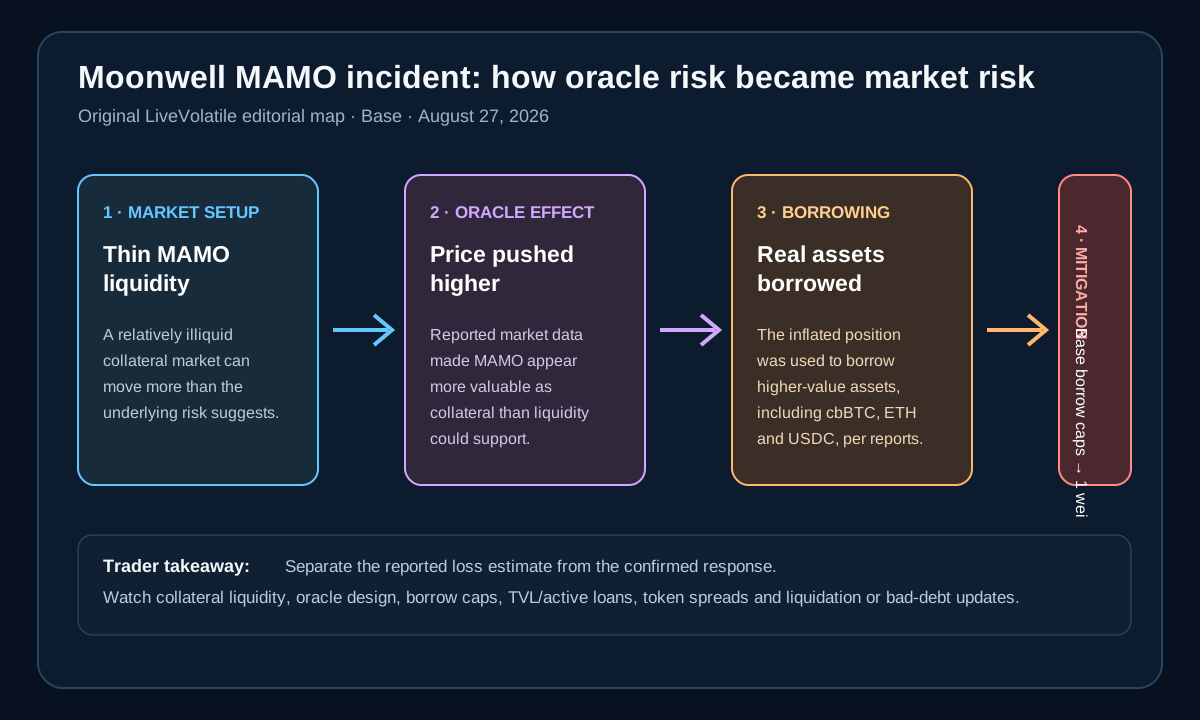
Visual credit: Original LiveVolatile editorial SVG created for this article from the incident facts reported by Crypto Briefing, The Defiant and Bitcoin.com News. The diagram distinguishes reported facts from monitoring implications; it is not a forensic reconstruction or price forecast.
What happened in the Moonwell MAMO incident?
Moonwell is a multichain lending protocol that allows users to supply assets and borrow against collateral. The affected market was on Base and used MAMO as collateral. Reporting from Crypto Briefing said the attacker artificially pushed MAMO’s collateral value higher before borrowing real cbBTC from Moonwell’s lending market. The Defiant separately reported that the attacker manipulated MAMO’s price and used the inflated position to borrow real assets.
That sequence matters because the attack did not require the collateral token to have deep, durable economic value. A thin market can produce a displayed price that looks precise while remaining vulnerable to a relatively small amount of trading pressure. If a lending market accepts that price as collateral value without enough liquidity, time-weighting, caps or other circuit breakers, the lending protocol can extend loans against a valuation that cannot be realized in the underlying market.
The reported result was a conversion of a local MAMO price distortion into claims on more liquid assets. Reports described cbBTC, ETH and USDC among the borrowed or moved assets, with proceeds later consolidated into DAI. Those transaction-level details are still part of an evolving investigation, so readers should distinguish security-firm observations and media reporting from a completed protocol accounting.
Confirmed response versus estimated impact
A disciplined reading separates what Moonwell confirmed from what outside observers estimated.
| Item | Current evidence | Editorial confidence | Why it matters for volatility |
|---|---|---|---|
| Affected market | Moonwell said the issue affected the MAMO Core Market on Base. | High | Identifies the initial risk surface. |
| Immediate control | Moonwell said Base Core Market borrow caps were set to 1 wei; MAMO and WELL supply caps were also reduced. | High | Removes or sharply limits new borrowing while the investigation proceeds. |
| Attack mechanism | CertiK, PeckShield and media reports described manipulation of relatively illiquid MAMO collateral pricing. | Medium-high | Shows how spot-market fragility can transmit into lending risk. |
| Apparent loss | Security-firm estimates cited by reports were approximately $8.7 million. | Medium | Useful for scale, but not a final audited reconciliation. |
| Final bad debt | No final Moonwell post-mortem or repayment accounting was available in the sources reviewed for this article. | Low / unresolved | Determines who ultimately absorbs the loss. |
The distinction is not cosmetic. A preliminary estimate can change as investigators label recovered funds, calculate protocol reserves, identify bad debt, or separate borrowed value from net realized loss. Traders should not convert an early estimate into a guaranteed final number.
The volatility transmission chain
The incident can be understood as five linked risk layers:
- Thin collateral liquidity: MAMO’s market depth was insufficient to make a sharp price move economically robust.
- Price-feed sensitivity: The lending market treated market data as an input to collateral valuation. A manipulable input can overstate borrowing capacity.
- Leverage conversion: The attacker exchanged an inflated collateral position for claims on assets with deeper liquidity and wider market utility.
- Protocol-wide defense: Moonwell reduced Base borrow caps to 1 wei, freezing new borrowing across the Core Markets rather than only isolating the MAMO market.
- Secondary repricing: Users, liquidity providers and ecosystem vaults must reassess withdrawal liquidity, token exposure and the probability of future restrictions.
This is why the event can create volatility even for traders who never owned MAMO. A protocol-wide borrowing pause changes the behavior of suppliers and borrowers, and any uncertainty about recoveries can affect WELL, related vaults and confidence in collateral listings.
Why a one-wei borrow cap is a market signal
Setting a borrow cap to 1 wei is an emergency containment measure. It is not evidence that all Moonwell markets are permanently insolvent, and it is not proof that the final loss equals the first public estimate. It means the protocol chose to prevent new borrowing while preserving enough contract functionality to investigate and coordinate a response.
The measure has three immediate implications:
- New leverage is constrained: Users cannot continue opening ordinary borrow positions against Base Core Markets while the cap remains at 1 wei.
- Existing positions still matter: A borrowing freeze does not automatically resolve outstanding debt, collateral valuation, liquidation mechanics or withdrawals.
- Liquidity becomes information-sensitive: Suppliers may change behavior based on whether assets can be withdrawn, whether reserves cover losses and whether a remediation vote is required.
Bitcoin.com News reported that ecosystem partner Zyfai disabled Moonwell-related Morpho vaults as a precaution and said automated rebalancing had moved user funds from affected opportunities. That is a separate risk-management response, not proof that every connected product suffered a loss. The relevant question is whether other integrations have independent controls or inherit Moonwell’s market assumptions.
What traders should monitor now
Use the LiveVolatile markets monitor, liquidations dashboard and crypto volatility tools to frame the broader market response, then verify incident-specific data on-chain and through protocol updates.
1. Borrow-cap and supply-cap changes
The first signal is whether Moonwell keeps, relaxes or further tightens the 1-wei settings. A restoration without a clear oracle and collateral-risk explanation could create renewed uncertainty. A prolonged pause may reduce immediate exploit risk but increase pressure on liquidity providers and borrowers.
2. MAMO market depth and spread
The collateral token’s price is not meaningful without the liquidity behind it. Monitor pool depth, bid-ask spreads, slippage and the concentration of liquidity across Base venues. A token can display a recoverable-looking price while still being unable to support a large collateral exit.
3. Oracle design and governance changes
Look for a technical explanation of the price source, update frequency, market selection, time-weighting, deviation checks and fallback behavior. A governance proposal that merely raises or lowers a cap is weaker evidence than a documented change to the price-validation process.
4. Active loans, reserves and bad debt
DefiLlama’s Moonwell page showed the protocol operating across Base, OP Mainnet, Ethereum and Moonbeam, with Base the largest listed chain by TVL at the time of access. Its dashboard is useful for trend monitoring, but third-party dashboard figures can change and should not be treated as Moonwell’s incident accounting. Watch active loans, TVL, fees, reserve changes and any formal statement on bad debt.
5. WELL and connected-vault behavior
WELL can react to governance, confidence and liquidity expectations rather than only to the direct value of MAMO. Connected vaults may rebalance or pause independently. A sharp token move alongside withdrawals, widening spreads or declining liquidity is a more meaningful stress signal than a single percentage change.
What this does—and does not—say about Base DeFi
The event is evidence of a protocol-specific collateral and oracle failure mode, not proof that Base itself failed or that every Base lending market has the same exposure. Base is the execution environment; Moonwell’s market configuration determines which collateral, price source, caps and risk parameters were used.
The useful comparative exercise is to ask whether other Base protocols:
- Accept low-liquidity assets as collateral;
- Use spot prices without robust time-weighting or deviation controls;
- Publish collateral factors and supply/borrow caps transparently;
- Have automated pause mechanisms;
- Can isolate a risky market without freezing unrelated markets;
- Disclose reserves and recovery procedures clearly after an incident.
Those are research questions, not accusations about unnamed protocols. The Moonwell case makes them timely because the cost of a collateral decision can be paid in assets that were never directly exposed to the thin market.
FAQ
Was Moonwell’s code hacked?
The reporting reviewed for this article describes a price-manipulation and collateral-valuation exploit. That does not establish that no code defect existed; only Moonwell’s completed investigation can explain the exact technical failure and whether contract logic, oracle configuration or governance choices were involved.
Was the loss exactly $8.7 million?
No final figure should be presented as exact at this stage. CertiK and PeckShield estimates cited in reporting put the apparent extracted value around $8.7 million. The number may change after funds, recoveries, bad debt and protocol accounting are reconciled.
Why did Moonwell freeze borrowing across Base?
Moonwell said it set borrow caps for all Base Core Markets to 1 wei to prevent new borrowing and limit further impact while investigating the MAMO market. That is a containment step, not a final diagnosis.
Why can an illiquid token create a large lending loss?
If the lending protocol accepts a market price as collateral value, an attacker may move the price, deposit the apparently valuable token and borrow more liquid assets. The loss is possible when the borrowed assets exceed what the collateral can actually support during liquidation.
Is this a signal to short WELL or Base tokens?
No. The incident raises risk questions but does not produce a reliable directional trade by itself. A trading decision would require current prices, liquidity, funding, open interest, governance updates and an assessment of whether the response contains the issue.
Conclusion
The Moonwell MAMO incident is a sharp example of how DeFi volatility can begin outside the headline asset. Thin MAMO liquidity became consequential because its price informed collateral value; inflated collateral then supported borrowing of more liquid assets; and Moonwell responded by constraining borrowing across Base Core Markets.
The most useful takeaway is operational: do not evaluate collateral risk from token price alone. Pair price with executable liquidity, oracle methodology, collateral factors, caps, reserves and the protocol’s ability to isolate a market. Until Moonwell publishes a completed technical and financial accounting, treat the approximately $8.7 million figure as a serious but preliminary estimate—and watch the mitigation and recovery data more closely than the headline.
Risk disclaimer: This article is for informational and educational purposes only. Crypto assets, DeFi positions and related tokens are highly volatile and may lose some or all of their value. Nothing here is financial, legal or investment advice.
Sources
- Moonwell — official protocol website; accessed August 27, 2026. Moonwell’s public response is quoted and reproduced in the secondary reports below; the protocol’s investigation was ongoing at publication time.
- Crypto Briefing: DeFi protocol Moonwell suffers $8.7 million exploit on Base: Report — August 27, 2026; reports the MAMO price-manipulation mechanism, CertiK estimate and Moonwell’s 1-wei mitigation.
- The Defiant: Moonwell Loses $8.7 Million To MAMO Price Manipulation On Base — August 27, 2026; reports the incident sequence, security-firm estimates, transaction examples and distinction between apparent loss and final accounting.
- Bitcoin.com News: Moonwell Locks Base Borrowing After $8.7M MAMO Attack — August 27, 2026; reports the 1-wei caps, partner-risk response and preliminary attack phases.
- DeFiLlama: Moonwell Lending — accessed August 27, 2026; third-party dashboard for current chain distribution, TVL, active loans, fees and recorded prior incidents. Values are mutable.
Image credits: Original LiveVolatile SVG at /images/articles/2026-08-27-moonwell-mamo-oracle-volatility-map.svg; created from the cited incident reporting and protocol information. No third-party image is reproduced.
— LiveVolatile Research Desk