BNB Chain Pasteur Hardfork on August 25: The Bridge and Capacity Risks Traders Should Watch
Direct answer: BNB Smart Chain’s Pasteur hardfork is scheduled for 25 August 2026 at 02:30 UTC. BNB Chain says the upgrade combines stronger bridge-signature verification through BEP-682, tighter validator-key and governance handling through BEP-695, and a builder-to-validator change under BEP-675 intended to increase block utilization. The hardfork is not an automatic BNB price signal. Its immediate volatility relevance is operational: node readiness, bridge flows, builder adoption, congestion and any implementation incident can change liquidity and confidence around the network.
Key takeaways
- Mainnet activation is scheduled for 25 August at 02:30 UTC.
- BNB Chain says mainnet nodes must run client v1.7.7 before activation.
- BEP-682 rejects duplicate validators in bridge-signature sets, closing a way to count the same validator power more than once.
- BEP-695 makes rotated validator keys lose authority and tightens related slashing and governance checks.
- BEP-675 lets builders submit already executed blocks for faster validator-path checks; BNB Chain reports a testnet benchmark of 1,237 to 2,324 TPS, which is not a mainnet result.
- The main trading risk is a change in settlement and execution conditions—not a guaranteed bullish or bearish move in BNB.
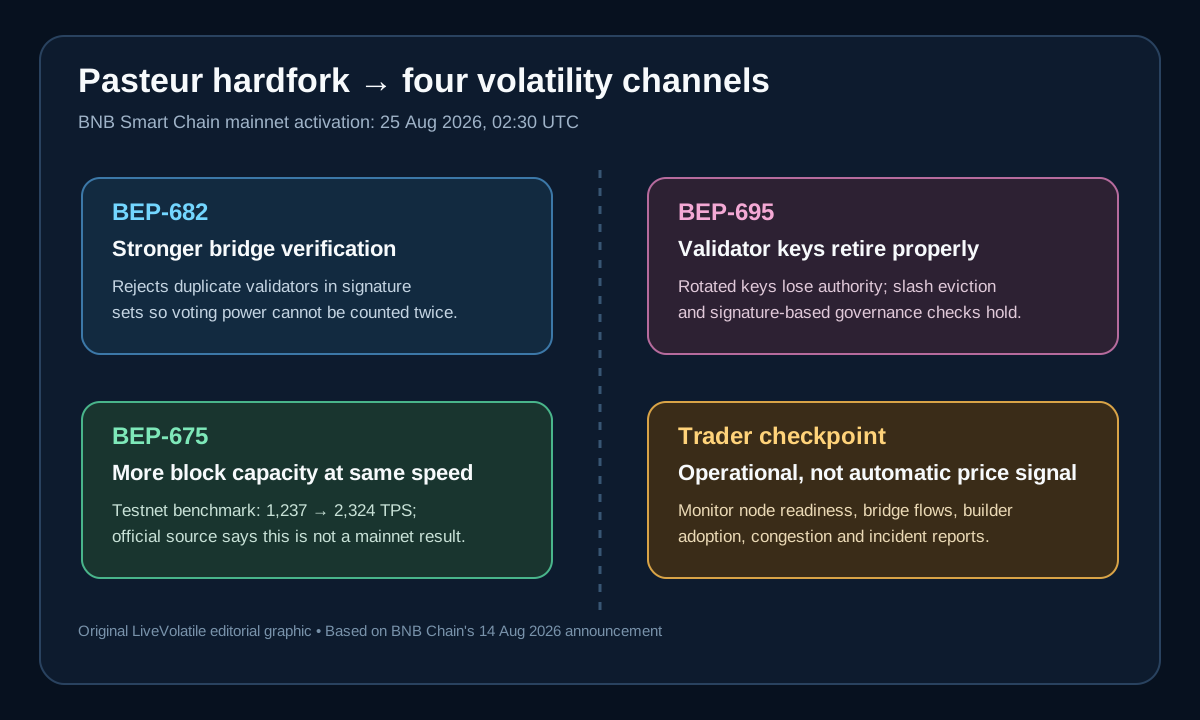
Visual credit: Original LiveVolatile editorial SVG, created August 22, 2026 from the official BNB Chain Pasteur announcement. The benchmark figures shown are testnet figures reported by BNB Chain, not a forecast.
What is the Pasteur hardfork?
Pasteur is a scheduled BNB Smart Chain protocol upgrade grouped under BEP-673. BNB Chain describes it as a security and capacity release rather than a migration that requires ordinary users to move their assets. The announcement says the fork has been live on BSC testnet since 21 July and will activate on mainnet at 02:30 UTC on 25 August.
The timing creates a defined event window for BNB Chain users and traders. Before the fork, infrastructure providers need to confirm client compatibility and node operators need to complete the required update. During and after activation, the useful evidence will be whether blocks finalize normally, bridge operations remain available, and applications handle the new execution path without abnormal errors.
| Component | Verified change | Volatility channel |
|---|---|---|
| BEP-682 | Rejects duplicate validators in bridge-signature sets | Bridge confidence, cross-chain settlement and liquidity access |
| BEP-695 | Retires validator-key authority and strengthens related governance checks | Validator operations, governance confidence and incident risk |
| BEP-675 | Allows a builder to submit an already executed block for faster validation | Capacity expectations, congestion and builder adoption |
| Node requirement | v1.7.7 required before mainnet activation | Upgrade readiness and temporary operational disruption |
BEP-682: Why bridge verification matters to market structure
Cross-chain bridges are part of a token’s market plumbing. They allow assets and liquidity to move between networks, exchanges and applications. If a bridge’s verification rules are weak, an invalid message can create a supply or settlement problem. If a bridge is paused for investigation, even a technically contained issue can fragment liquidity.
BNB Chain says BEP-682 rejects duplicate validators in signature sets. Before the change, a crafted set could list the same validator repeatedly and count that validator’s power more than once. The stated fix is designed to ensure that the threshold represents distinct validators rather than repeated entries.
For BNB traders, the practical checkpoint is not simply “bridge security improved.” Monitor whether bridge deposits and withdrawals, wrapped-asset flows and major venue transfers operate normally around the activation window. A pause, delayed finality or unexplained reserve imbalance can widen spreads and make prices on different venues less interchangeable.
This is a risk framework, not a claim that Pasteur will cause an exploit or a bridge outage. The official announcement presents BEP-682 as a hardening measure; no new incident should be inferred from the scheduled upgrade itself.
BEP-695: Validator-key rotation becomes a market signal
Validators rotate consensus keys as part of normal operational security. BNB Chain says BEP-695 addresses three areas: a rotated key loses validator-administration authority, slash eviction follows a key rotation, and blacklisted addresses are rejected in signature-based governance votes where the check previously applied only to direct votes.
These changes are mostly invisible when they work. Their volatility relevance comes from the dependency chain. Validators, staking providers, governance systems and monitoring tools must all handle the new rules consistently. If an implementation problem appears, the first signals may be operational—missed blocks, governance errors, validator alerts or delayed transactions—before they become a broader market narrative.
Traders should therefore separate two ideas:
- Protocol intent: stronger key retirement and governance checks are intended to reduce abuse and ambiguity.
- Execution risk: the upgrade still has to be implemented by clients, validators, builders and applications without creating a new failure mode.
BEP-675: More capacity, but do not treat the benchmark as a promise
BEP-675 changes the builder-to-validator path. BNB Chain says builders can submit a block they have already executed, allowing validators to check it against consensus rules and sign or broadcast it before completing full verification. The aim is to reduce the amount of the roughly 450-millisecond interval consumed by repeated execution.
The official announcement reports a QANet testnet benchmark in which throughput rose from 1,237 to 2,324 transactions per second at the same 450-millisecond interval and 100M gas limit. Average block gas used rose from 46.35M to 84.15M, while the announcement says finality lag did not move.
Those are controlled testnet figures. They are useful evidence about the mechanism, but they are not proof that BSC mainnet will immediately deliver 2,324 TPS. Mainnet has different traffic, geographic distribution, builder behavior, application mixes and failure conditions. Treating the benchmark as a guaranteed price catalyst would be a category error.
The more useful market questions are:
- Do builders adopt the new path or continue using legacy bids?
- Does block utilization rise without abnormal latency or reorg concerns?
- Do busy periods show less queueing and more stable execution?
- Do node operators report memory, CPU or synchronization issues after the update?
What BNB traders should monitor on August 25
1. Upgrade readiness
BNB Chain says mainnet nodes must run v1.7.7 before activation. Watch official release notes, validator announcements and explorer behavior. Avoid relying on an unverified social post claiming that the fork was delayed or completed.
2. Bridge and exchange status
Check whether cross-chain transfers, deposits and withdrawals remain enabled for the networks and assets being used. A token’s ticker is not enough; network, contract and venue status matter.
3. Block utilization and congestion
If BEP-675 performs as intended, higher utilization should show up in capacity and queueing data rather than only in promotional headlines. Look for abnormal confirmation delays, failed transactions, RPC errors or sudden fee changes.
4. Builder and validator incidents
Missed blocks, client crashes, delayed finality or repeated governance/validator errors would be more meaningful than a short-lived BNB candle. The goal is to identify whether the upgrade is operating normally before interpreting price action.
LiveVolatile readers can compare the crypto volatility dashboard, review the spot-versus-futures risk framework, and use the risk-management guide for volatile trading. These are monitoring resources, not trading signals.
What users should avoid
Do not download a node binary from an unverified link or treat a message about “Pasteur migration” as an instruction to send BNB. The official announcement says the upgrade does not require an ordinary user asset migration. Use BNB Chain’s official release notes and your venue’s verified maintenance notices.
Do not assume that a throughput benchmark guarantees lower fees or a higher BNB price. Capacity can improve while price falls, and a security-focused upgrade can still produce temporary operational uncertainty around activation.
FAQ
When does the BNB Chain Pasteur hardfork activate?
BNB Chain’s official announcement schedules BSC mainnet activation for 25 August 2026 at 02:30 UTC.
Which BNB Chain client version is required?
The official announcement says mainnet nodes must be running v1.7.7 before activation.
Will ordinary BNB holders need to migrate their tokens?
The official announcement describes no ordinary-user asset migration. Users should still follow verified exchange and wallet notices and confirm network details before transacting.
Does Pasteur guarantee higher BNB prices?
No. The upgrade may affect security confidence, capacity and operational risk, but it does not provide a reliable directional price forecast.
Is 2,324 TPS a confirmed BNB Smart Chain mainnet speed?
No. It is a testnet benchmark reported by BNB Chain under a controlled QANet workload. Mainnet performance may differ.
Why can a bridge upgrade affect volatility?
Bridges connect liquidity across networks. A pause, delay or confidence shock can fragment markets, widen spreads and reduce arbitrage even if the underlying token supply is unchanged.
Conclusion
Pasteur gives BNB Chain traders a scheduled infrastructure event with three distinct monitoring lanes: bridge verification, validator-key handling and block-capacity execution. The security changes are intended to make cross-chain and governance operations harder to abuse, while BEP-675 is designed to use BSC’s existing block interval more efficiently.
The disciplined way to trade the event is to watch implementation evidence—not extrapolate from the hardfork label or the best testnet benchmark. Node readiness, bridge availability, block behavior, builder adoption and incident reports will tell traders more than a single headline candle.
This article is for informational purposes only and is not investment, legal or security advice. Crypto assets are volatile. Verify networks, contracts, software releases and transaction instructions independently before taking action.
Sources and credits
- BNB Chain: Pasteur Hardfork Arrives on BSC Mainnet on August 25, published August 14, 2026; primary source for schedule, client requirement, BEP descriptions and benchmark figures.
- BNB Chain release notes, accessed August 22, 2026; client-release context.
- Inline visual: Original LiveVolatile editorial SVG, created August 22, 2026 from the verified BNB Chain announcement; no third-party image rights asserted.
— LiveVolatile Research Desk