GENIUS Act Stablecoin Rules Could Make Exchange Due Diligence a Liquidity Gate
Direct answer: The U.S. Treasury’s August 17, 2026 Notice of Proposed Rulemaking for Section 3 of the GENIUS Act would make the compliance evidence behind a foreign-issued payment stablecoin an important condition of U.S. market access. Digital-asset service providers would generally need reasonable due diligence before relying on a foreign issuer’s representation that it can and will comply with lawful U.S. orders and relevant reciprocal arrangements.
That is not a blanket delisting order, a finding about USDT, or a prediction that any named token will lose its peg. It is a proposed access-and-liquidity framework. If exchanges cannot document sufficient issuer and jurisdiction evidence, availability could become more fragmented. For traders, the first observable effects would more likely appear in spreads, transfer routes, basis and redemption friction than in an automatic one-for-one price shock.
Key takeaways
- Treasury issued the Section 3 GENIUS Act proposal on August 17, 2026; the Federal Register comment period is 60 days from publication.
- Beginning on the Act’s expected January 18, 2027 effective date, digital-asset service providers generally may not make foreign-issued payment stablecoins available in the U.S. unless the issuer meets the statute’s lawful-order capability and commitment requirements.
- A stricter limitation on offering or selling payment stablecoins to people in the U.S. is scheduled in the Act for July 18, 2028, subject to the statute and final rules.
- The proposal does not identify qualifying tokens or decide whether a particular stablecoin remains available.
- The market-structure risk is venue fragmentation: different exchanges may reach different conclusions about issuer evidence, jurisdictional supervision, reserves, sanctions exposure or customer geography.
- Traders should monitor stablecoin spreads, depth, transfer costs, redemption access and cross-venue price differences rather than treating the NPRM as an immediate depeg signal.
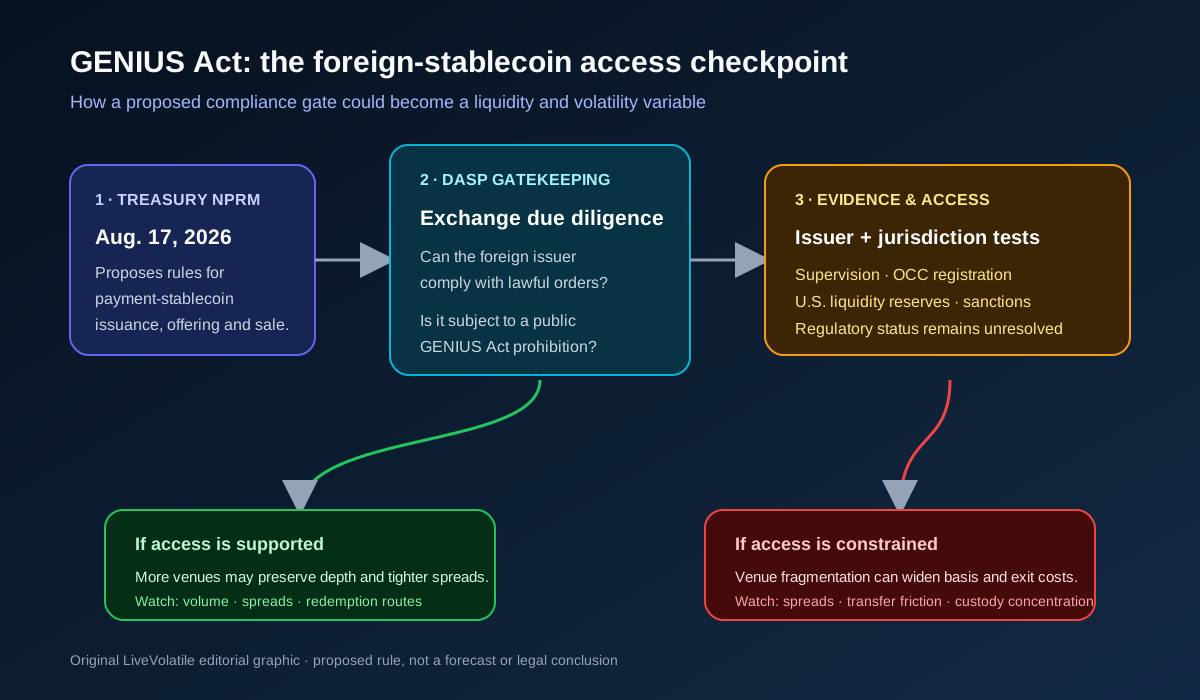
Visual credit: Original LiveVolatile editorial SVG created from the U.S. Treasury’s August 17, 2026 press release. It explains the proposed process and monitoring implications; it is not a legal conclusion or market forecast.
What Treasury proposed
Treasury’s announcement says the NPRM implements Section 3 of the Guiding and Establishing National Innovation for U.S. Stablecoins Act. The proposal addresses when a person is considered to issue a payment stablecoin in the United States and when a provider is considered to offer, sell or otherwise make a payment stablecoin available to a person in the United States.
The foreign-issuer provision is especially relevant to exchanges, brokers, custodians and other digital-asset service providers. Treasury says providers generally may not make a foreign-issued payment stablecoin available unless the foreign issuer has the technological capability to comply with, and will comply with, the terms of a lawful order and any applicable reciprocal arrangement between the United States and the issuer’s home jurisdiction.
The proposal therefore shifts part of the practical decision from the token contract alone to the relationship between:
- The issuer and its ability to respond to lawful orders;
- The issuer’s home jurisdiction and relevant arrangements;
- The service provider’s customer, listing and compliance controls; and
- The evidence available when the provider makes its decision.
The release does not say that all foreign-issued stablecoins are prohibited today. It invites public comment and says comments are due within 60 days of Federal Register publication. The final rule may differ from the proposal.
Why exchange due diligence can affect liquidity
A stablecoin’s market quality depends on more than its stated reference value. It also depends on how many venues support it, whether users can move it across those venues, how quickly eligible holders can redeem it, and whether market makers can keep inventories balanced.
A compliance gate can affect those conditions through several channels:
| Channel | What could change | Volatility signal to monitor |
|---|---|---|
| Listings | A provider may pause, limit or avoid offering a token while evidence is reviewed. | Venue count, quoted depth and bid-ask spreads |
| Transfers | Networks or customer routes may be restricted by geography or policy. | Transfer delays, fees and cross-venue price gaps |
| Market making | Liquidity providers may reduce inventory where access is uncertain. | Thin order books and larger execution slippage |
| Redemption | The issuer’s legal, banking and operational routes matter more during stress. | Redemption queues, discounts and secondary-market premiums |
| Basis | The same reference asset may trade at different prices by venue or region. | Stablecoin/USD, stablecoin/fiat and stablecoin/crypto spreads |
These are conditional mechanisms, not claims that the proposal has already changed a named token’s market. The useful editorial distinction is between regulatory uncertainty and realized liquidity deterioration. The former can be tracked through announcements and exchange policies; the latter requires market data.
The proposed timeline matters more than the headline
| Date or phase | What the source supports | Trading interpretation |
|---|---|---|
| August 17, 2026 | Treasury issued the Section 3 NPRM. | Start of a formal comment and implementation process, not a final listing decision. |
| Federal Register publication | Treasury requested comments within 60 days of publication. | Issuers, exchanges and market makers can challenge or clarify operational requirements. |
| January 18, 2027 | The Act’s expected general effective date, according to Treasury’s release. | Compliance planning may become a live access variable if the statutory conditions are met. |
| July 18, 2028 | The Act provides a stricter offering or sale limitation for payment stablecoins to U.S. persons. | Longer-dated venue, issuer and customer-segmentation planning becomes important. |
The dates should not be read as a calendar for an automatic market-wide delisting. Treasury’s release describes expected statutory timing, while the proposal and any final rules determine how the requirements are implemented. The immediate event is the NPRM and comment process.
What this does—and does not—say about USDT or other tokens
The proposal does not identify which tokens qualify. It does not decide whether USDT, USDC or another named stablecoin can remain available on U.S. venues. It also does not establish that a foreign issuer has failed any requirement.
That boundary is important because stablecoin headlines often compress three different questions into one:
- Issuer status: Is the issuer permitted or otherwise eligible under the applicable framework?
- Provider decision: Can a specific exchange or service provider document the required diligence and offer the token to its customer base?
- Market behavior: Are users actually experiencing wider spreads, lower depth, transfer restrictions or redemption stress?
Only the third question is a direct market-volatility observation, and it must be supported by current venue and issuer data. The first two require legal and operational determinations that the NPRM does not yet finalize.
How fragmentation could transmit stress
If different providers apply different evidence standards or move at different speeds, liquidity may fragment before any broad peg event occurs. A token could remain close to its reference value on one venue while trading with a premium or discount elsewhere because users cannot move inventory efficiently between markets.
Three scenarios are worth monitoring:
1. Evidence is accepted and access remains broad
If providers can obtain satisfactory issuer, jurisdiction and customer-control evidence, the main market effect may be operational cost. Liquidity could remain distributed across venues, with limited volatility impact beyond periodic compliance-related repricing.
2. Access is narrowed but orderly
A provider may limit U.S. customer access or stop new listings while existing transfer and redemption routes remain functional. In that case, market depth may decline in particular pairs without producing a system-wide depeg. Spreads and slippage would be the early warning signals.
3. Access changes during market stress
The most dangerous combination would be a compliance decision arriving while users are already trying to exit risk. If transfers, market making and redemption routes tighten simultaneously, venue-specific discounts could widen. That is a liquidity and access shock—not proof that the reserve asset has lost value.
Monitoring checklist for traders
LiveVolatile readers can turn the proposal into a measurable watchlist:
- Exchange notices: Record whether a venue changes listing, transfer or U.S.-customer policies.
- Depth and spreads: Compare the same stablecoin pair across several venues before and after any announcement.
- Transfer functionality: Check whether deposits, withdrawals and supported networks remain available for eligible users.
- Redemption evidence: Separate issuer-confirmed redemption information from social-media claims or secondary-market rumors.
- Jurisdiction exposure: Note whether the issuer’s home jurisdiction, banking partners or sanctions status becomes part of the public record.
- Customer segmentation: Watch for different treatment of U.S. persons, non-U.S. persons, self-custody wallets and direct transfers.
- Cross-asset spillover: Compare stablecoin conditions with LiveVolatile’s markets monitor, stablecoin risk monitor and liquidations dashboard.
The most useful signal is a cluster: widening spreads plus thinner depth plus transfer friction is more meaningful than any single exchange banner or viral post.
FAQ
Is the GENIUS Act proposal an immediate stablecoin ban?
No. Treasury issued a proposed rule and requested public comment. The proposal does not announce a blanket ban on foreign-issued stablecoins or identify specific tokens for removal.
Will every foreign stablecoin be delisted from U.S. exchanges?
That conclusion is not supported by Treasury’s August 17 release. Access will depend on the final framework, issuer and jurisdiction facts, provider diligence and customer circumstances.
What is the main volatility risk?
The clearest risk is fragmented liquidity. If venues differ in access or transfer support, spreads, slippage, basis and redemption costs can move sharply even if the stablecoin’s reference value remains broadly intact.
When should traders expect changes?
The NPRM was issued August 17, 2026, and Treasury requested comments within 60 days of Federal Register publication. Treasury’s release identifies January 18, 2027 as the Act’s expected general effective date and July 18, 2028 for a stricter offering or sale limitation. These are implementation milestones, not guaranteed dates for a specific token’s listing outcome.
Is this article legal or investment advice?
No. It is a market-structure analysis of a proposed rule. Readers should consult qualified legal and financial professionals for decisions involving stablecoins, exchanges or jurisdiction-specific compliance.
Conclusion
Treasury’s GENIUS Act NPRM creates a new checkpoint for foreign-issued payment stablecoins: can an exchange or other service provider document enough evidence about the issuer’s lawful-order capability, jurisdiction and market access to continue offering the token?
That question could matter to volatility because compliance decisions influence where liquidity can be quoted, moved and redeemed. The disciplined trade is not to predict a depeg from the proposal. It is to monitor venue policies, depth, spreads, transfer routes and issuer disclosures as the comment and implementation process develops.
For now, the NPRM is a watchlist catalyst. It is primary-source verified, but it is not final law, a token-specific listing decision or proof of realized market stress.
Risk disclaimer: This article is for informational and educational purposes only. Crypto assets and stablecoins are volatile and may lose value. Nothing here is financial, legal or investment advice.
Sources
- U.S. Department of the Treasury: Treasury Seeks Public Comment on GENIUS Act Proposed Rulemaking — August 17, 2026; primary source for the NPRM, proposed foreign-issued stablecoin access framework, expected effective dates and comment process.
- U.S. Department of the Treasury: GENIUS Act Section 3 NPRM PDF — linked by Treasury as the proposed rule text; consult the proposal for detailed definitions and conditions.
- Federal Register — publication and comment-record portal referenced by Treasury; the article does not treat an unverified search result as the rule text.
Image credits: Original LiveVolatile SVG at /images/articles/2026-08-31-genius-foreign-stablecoin-listing-gate.svg; based on the cited Treasury announcement and clearly labeled as an explanatory original graphic.
— LiveVolatile Research Desk