SBI’s Ajaib Stake Puts JPYSC on a New Asian Volatility Path
Direct answer: SBI Holdings announced on August 28, 2026 that a subsidiary acquired an approximately 20% minority stake in Ajaib Group, an Indonesian multi-asset investment platform. The strategic investment makes Ajaib an equity-method affiliate and gives SBI a regional distribution and settlement partner spanning traditional assets, crypto, payments and foreign exchange.
The immediate crypto-market implication is not a guaranteed JPYSC price move. It is a new market-structure path: a regulated yen stablecoin can be connected to Indonesian retail distribution, corporate settlement and broader Southeast Asian digital-asset infrastructure. That creates potential efficiency, but also observable volatility risks around FX conversion, liquidity, custody, transfer restrictions and local regulatory access.
Key takeaways
- SBI’s official announcement reports an approximately 20% stake in Ajaib; it does not describe a full acquisition.
- Ajaib says it serves millions of retail investors and offers equities, crypto assets, stablecoins, commodities, FX, payments and savings services.
- SBI described Ajaib’s corporate offering as including OTC stablecoin settlement and liquidity for Indonesian companies and institutions.
- SBI and Startale previously described JPYSC as a trust-structured yen stablecoin issued by Shinsei Trust & Banking, with SBI VC Trade as distribution partner.
- The announcement does not establish JPYSC launch volume, Indonesian regulatory approval, a live retail on-ramp or guaranteed adoption.
- Traders should monitor FX basis, stablecoin spreads, redemption and transfer routes, custody concentration and jurisdiction-specific access before treating the deal as a bullish catalyst.
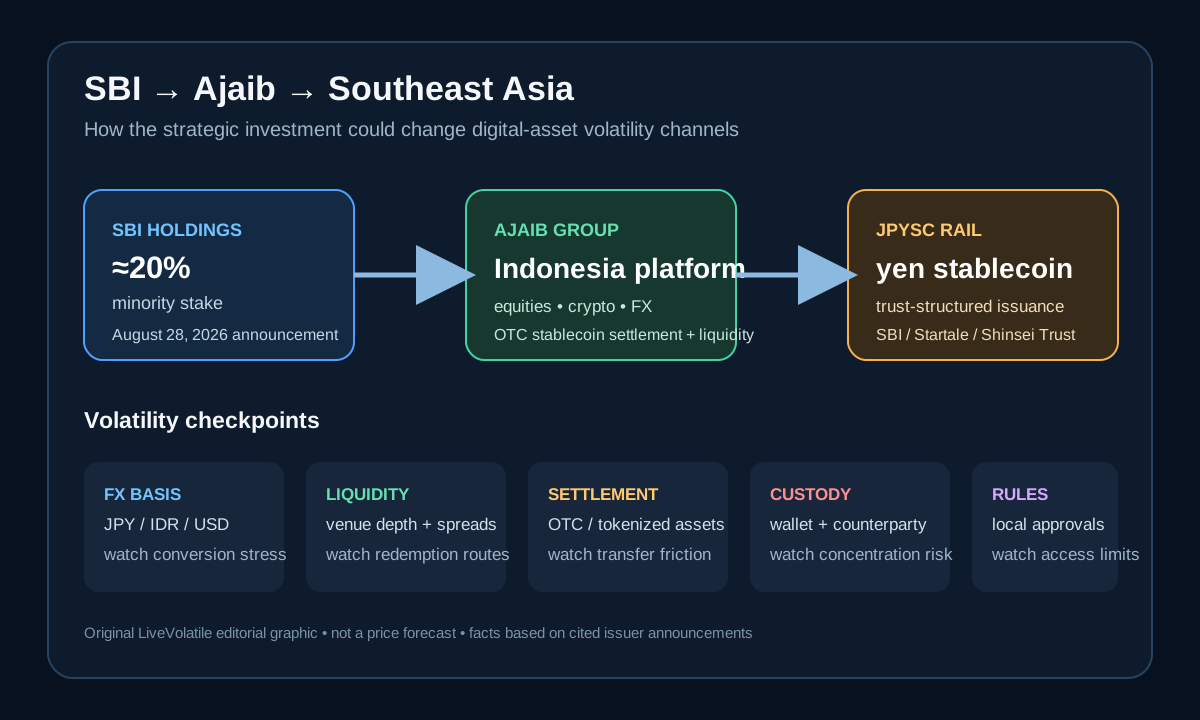
Visual credit: Original LiveVolatile editorial SVG created from the SBI Holdings announcement and Startale’s JPYSC announcement. It is an explanatory market-structure graphic, not a forecast or third-party reproduction.
What did SBI announce?
SBI said it acquired shares in Ajaib Group through a subsidiary, taking an approximately 20% minority position. The announcement says Ajaib became an equity-method affiliate of SBI Holdings. It describes Ajaib as an Indonesia-based online investment and treasury platform that has expanded beyond securities brokerage into digital assets and payments.
The strategic logic is broader than a token listing. Ajaib’s stated product scope includes domestic and international equities, bonds, mutual funds, ETFs, crypto assets, stablecoins, commodities and FX. For corporate clients, SBI specifically highlighted OTC stablecoin settlement services and tailored liquidity.
That matters for volatility because settlement infrastructure can alter where liquidity appears and how quickly capital moves between currencies, venues and asset types. But the release does not quantify future transaction volume or confirm that the partnership has already produced a live JPYSC market in Indonesia.
Where JPYSC fits
SBI and Startale’s February announcement describes JPYSC as a trust-based stablecoin issued by Shinsei Trust & Banking under Japan’s regulatory framework. SBI VC Trade is the primary distribution partner, while Startale leads technical development. SBI’s August 28 release says the group has issued JPYSC with Shinsei Trust & Banking serving as trustee.
The new Ajaib relationship can therefore be read as an expansion of the distribution and settlement thesis, not proof of a new token supply event. A yen-denominated digital rail entering a platform with Indonesian users and corporate clients would introduce cross-border use cases, but each use case depends on approvals, liquidity, custody, banking connections and the ability to move or redeem the asset.
The volatility channels to watch
| Channel | Why the deal could matter | Evidence still required |
|---|---|---|
| FX basis | Yen-denominated settlement meets Indonesian-rupiah operating flows. | Live JPYSC/IDR and JPYSC/USD quotes, conversion costs and depth |
| Liquidity | Ajaib’s platform and OTC business could aggregate more demand. | Confirmed volumes, spreads, counterparties and redemption data |
| Settlement | Stablecoins may shorten or automate certain cross-border transfers. | Product launch details, transaction rails and settlement finality |
| Custody | Regional distribution can concentrate operational dependencies. | Custodians, wallet architecture, reserve and incident disclosures |
| Regulation | Access can differ across Japan, Indonesia and other Asian markets. | OJK, Japanese regulator and venue-specific approvals |
A useful distinction is between infrastructure optionality and realized market impact. SBI has announced the partnership and described the capabilities of both groups. The market still needs evidence of actual issuance, onboarding, volume and redemption behavior before those capabilities can be translated into a volatility signal.
Why this could amplify, not just reduce, volatility
Stablecoin rails are often framed as a way to reduce settlement friction. That can be true for eligible users, but faster movement can also transmit stress faster. A sharp yen move, an interruption at a local venue, a widening FX spread or a temporary redemption constraint could create price differences between regions.
The key risk is not necessarily a loss of the yen peg. It may be basis and access volatility: a token can remain close to its reference currency while the cost of converting, transferring or redeeming it changes sharply. Traders should separate:
- The reference value of JPYSC;
- The price available on each venue;
- The cost and timing of moving the token;
- The ability of an eligible holder to redeem or settle;
- The FX rate used by the end user or corporate counterparty.
This is why a partnership headline should not be treated as a standalone buy signal for JPYSC, SBI-related assets or Asian crypto markets.
What would confirm the thesis?
The next meaningful evidence would be concrete and documentable:
- Ajaib or SBI announces a live JPYSC distribution, settlement or custody product in Indonesia.
- Relevant authorities or licensed entities clarify the permitted customer and transaction scope.
- Public market data shows sustained volume, narrow spreads and functioning transfer routes.
- Corporate users disclose real settlement activity rather than only a roadmap.
- Reserve, trustee, custody and incident-reporting information supports confidence during market stress.
Until then, the disciplined interpretation is that SBI has strengthened a regional infrastructure strategy. It has not guaranteed adoption, liquidity or stablecoin performance.
Use the LiveVolatile markets monitor, stablecoin risk monitor and liquidations dashboard to compare broad crypto stress with stablecoin and cross-venue conditions.
FAQ
What percentage of Ajaib did SBI acquire?
SBI’s August 28 announcement says its subsidiary acquired an approximately 20% minority stake. Ajaib became an equity-method affiliate of SBI Holdings.
Is JPYSC already live in Indonesia?
The sources reviewed confirm the strategic investment and JPYSC’s Japanese trust-structured design, but they do not confirm a live Indonesian retail launch, transaction volume or local on-ramp. Those details require a subsequent product or regulatory announcement.
Does the deal guarantee JPYSC adoption?
No. It improves the strategic distribution case by connecting SBI’s digital-asset initiatives with Ajaib’s Indonesian platform, but adoption depends on approvals, product execution, liquidity, custody and customer demand.
What is the main volatility risk?
The main risk is a cross-border basis problem: FX conversion costs, venue spreads, transfer friction or redemption constraints could move faster than the reference value. Regional regulatory and custody dependencies are additional checkpoints.
Conclusion
SBI’s approximately 20% Ajaib stake is significant because it links a Japanese financial group’s yen-stablecoin and digital-asset strategy to an Indonesian platform that spans retail investing, crypto, FX, payments and corporate settlement. That is a clearer infrastructure story than a simple token promotion.
For LiveVolatile readers, the actionable question is whether the partnership produces measurable liquidity and settlement activity without creating new regional bottlenecks. Track verified launch details, JPYSC spreads, FX basis, redemption access, custody disclosures and jurisdictional permissions. Until those data arrive, the deal is a watchlist catalyst—not a price forecast.
Risk disclaimer: This article is for informational and educational purposes only. Crypto assets, stablecoins and related securities are volatile and may lose value. Nothing here is financial, legal or investment advice.
Sources
- SBI Holdings: Announcement of a Strategic Investment in Ajaib Group — August 28, 2026; primary source for the approximately 20% stake, Ajaib business scope and SBI’s digital-asset strategy.
- Startale Group and SBI Holdings Introduce JPYSC — February 27, 2026; product and regulatory-structure context for JPYSC, including Shinsei Trust & Banking, SBI VC Trade and Startale’s roles.
- CoinDesk: How SBI’s $270 million Ajaib stake drives its Asian stablecoin ambitions — August 28, 2026; secondary reporting and transaction-value context. Access was rate-limited during this run, so claims were not used in place of the primary SBI release.
Image credits: Original LiveVolatile SVG at /images/articles/2026-08-28-sbi-ajaib-jpysc-volatility.svg; based on the cited SBI and Startale announcements. No third-party image is reproduced.
— LiveVolatile Research Desk