The Sandbox SAND Bridge Exploit: Why Base and BSC Liquidity Now Matter for Volatility
Short answer: The Sandbox said it identified and contained a vulnerability in the SAND cross-chain bridge affecting Base and BNB Smart Chain (BSC). Attackers minted unbacked SAND on those networks, after which cross-chain functions were suspended. Reporting on the project’s disclosure says the affected amount was less than 0.01% of total SAND supply, while SAND on Ethereum and Polygon remained unaffected. The immediate market risk is therefore less about a system-wide supply collapse and more about isolated liquidity, paused transfers, uncertain recovery mechanics and unreliable price discovery on the affected networks.
Key takeaways
- The incident affected the SAND bridge routes connected to Base and BSC.
- The Sandbox’s response was to suspend cross-chain functionality and isolate SAND on both networks.
- The reported token impact is under 0.01% of total SAND supply, but the percentage alone does not restore liquidity or arbitrage.
- Reporting says Ethereum and Polygon SAND were unaffected and user wallets were not compromised.
- Traders should wait for verified reopening, compensation and post-mortem details rather than assuming every SAND market is interchangeable.
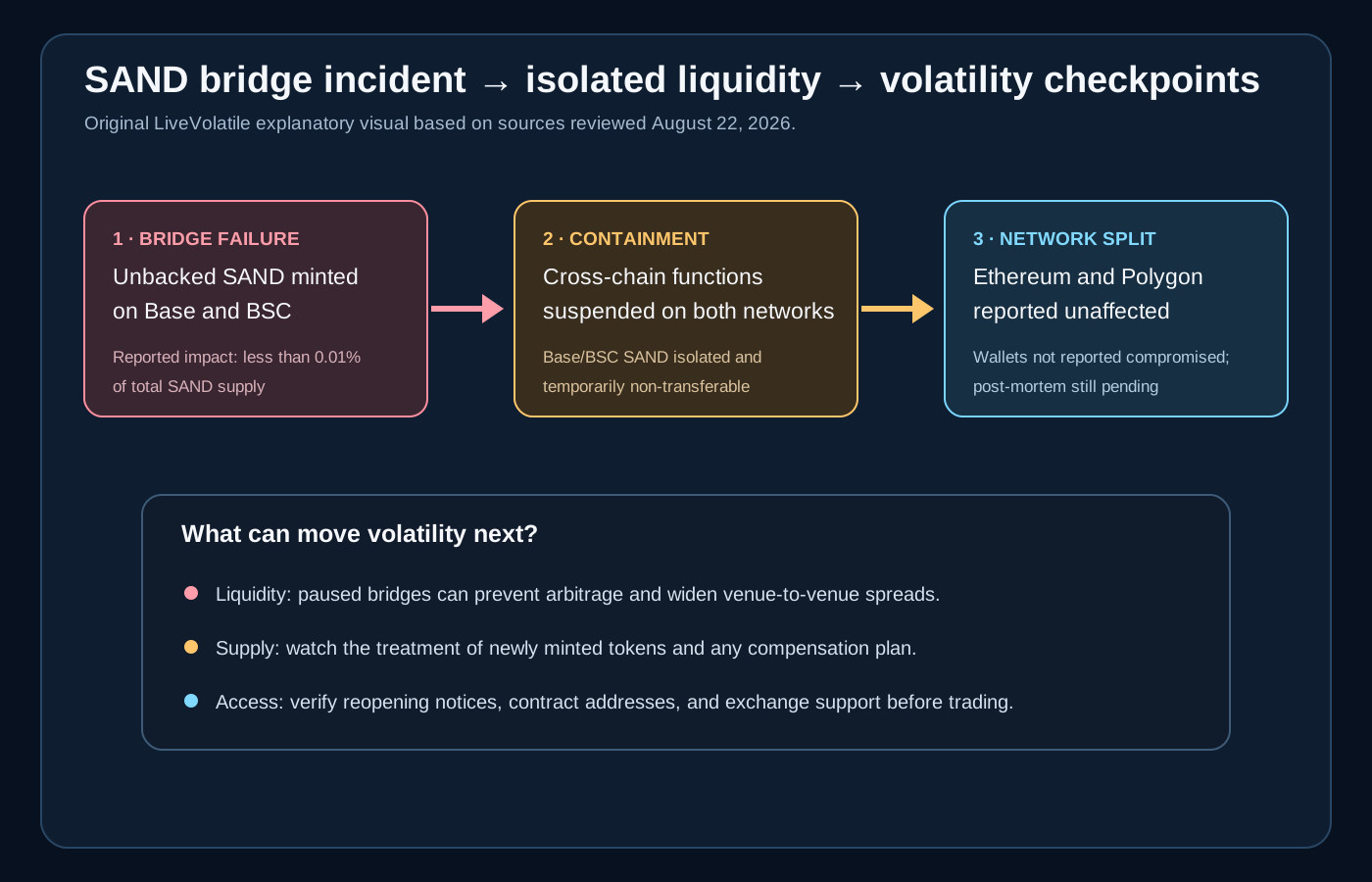
Original LiveVolatile editorial SVG. It explains the bridge failure, containment and market-access risks using claims reported by Lookonchain and Yahoo Finance, with project context from The Sandbox.
What happened to SAND on Base and BSC?
The reported failure involved The Sandbox’s cross-chain bridge. Attackers were able to mint SAND without the corresponding backing on Base and BSC. That is different from a claim that the entire SAND supply was compromised: the incident was reported as limited to those bridge-connected networks, with the affected amount representing less than 0.01% of total supply.
The Sandbox then suspended cross-chain functionality on Base and BSC. Lookonchain reported that SAND on those networks was isolated and temporarily non-transferable or non-exchangeable. That operational detail is more important for short-term volatility than the headline percentage. A small supply event can still create sharp price dislocations when deposits, withdrawals, pools or arbitrage routes are interrupted.
The sources reviewed for this article do not provide a completed technical post-mortem. The exact exploit path, affected contracts, token disposition and final remediation should therefore be treated as open items until The Sandbox publishes more detail.
Why a small supply impact can still create large price moves
Market prices are formed at the margin. If a bridge is paused, traders cannot assume that a token bought on one network can be moved to another venue, redeemed through the bridge or used in a pool with normal settlement. The result can be a split market:
| Market condition | Likely volatility mechanism | What to monitor |
|---|---|---|
| Bridge suspended | Arbitrage becomes slower or impossible | Deposit and withdrawal status by venue |
| Affected-network tokens isolated | Order books and pools can thin rapidly | Spread, depth and slippage on Base/BSC |
| Unbacked mint is under review | Supply and compensation expectations diverge | Official remediation and snapshot language |
| Unaffected networks remain live | Prices may diverge across network representations | Cross-network quotes and pool reserves |
This does not mean every SAND price difference is an arbitrage opportunity. A quote can be cheap because the asset cannot be withdrawn, redeemed or sold into normal liquidity. Traders need to verify transferability before treating a discount as mispricing.
Ethereum and Polygon are a separate risk bucket
Lookonchain’s summary of The Sandbox’s disclosure said SAND on Ethereum and Polygon remained unaffected, and that user wallets were not compromised. Those statements narrow the incident’s scope, but they do not eliminate market-structure risk. Exchanges may pause SAND operations globally while they review bridge exposure, and liquidity providers may reduce inventory even on unaffected networks.
That creates two separate questions:
- Is the token representation technically affected? The available reporting says Ethereum and Polygon were not.
- Is the market operationally normal? That depends on exchange policy, pool liquidity, transfer status and the project’s remediation instructions.
The distinction is useful for volatility analysis. A trader can be exposed to operational interruption even when the underlying network representation is not part of the exploit.
Four volatility checkpoints for SAND traders
1. Reopening notices
The first meaningful signal is not a social-media price target. It is a verified notice that a bridge route, exchange deposit, withdrawal or trading pair has reopened. Confirm the exact network and asset contract; “SAND reopened” is not precise enough when several network representations exist.
2. Supply treatment
Watch how The Sandbox handles the unbacked tokens. The sources reviewed here do not establish whether tokens were burned, frozen, clawed back or otherwise neutralized. Do not infer the final supply outcome from an early headline.
3. Pool and order-book depth
A normal last-traded price can hide abnormal execution risk. Compare bid-ask spreads, depth near the market price, pool reserves and slippage. A thin pool can amplify both a sell-off and a rebound without either move representing broad market consensus.
4. Post-mortem quality
A detailed technical report should clarify the vulnerable bridge logic, affected addresses, containment steps and any remaining permissions. Until that arrives, uncertainty itself can keep realized volatility elevated, particularly around new announcements.
LiveVolatile readers can use the crypto volatility dashboard, review the spot-versus-futures risk framework, and compare the risk-management guide for volatile trading. These are monitoring resources, not trading signals.
What should users avoid right now?
Avoid unsolicited migration, recovery or compensation links. The incident involves a bridge and isolated network representations, which makes phishing especially plausible. Use The Sandbox’s verified channels and formal exchange notices, and inspect the network and contract address before signing any transaction.
Do not assume that a token labelled “SAND” on Base or BSC has the same transferability as SAND on Ethereum or Polygon. Confirm whether the asset can be deposited, withdrawn and exchanged on the intended venue before sending funds.
FAQ
Was all SAND compromised?
No. The available reporting describes unbacked minting on Base and BSC and says the impact was less than 0.01% of total SAND supply. It also says Ethereum and Polygon SAND were unaffected.
Can SAND on Base and BSC be traded normally?
The sources reviewed say those network representations were isolated and temporarily non-transferable or non-exchangeable after cross-chain functions were suspended. Check current official and venue-specific notices before acting.
Were user wallets hacked?
Lookonchain’s summary of the project’s disclosure says user wallets were not compromised. That does not remove the need to verify links and contracts during remediation.
Why can SAND volatility rise if the impact is small?
Paused bridges and restricted transfers can fragment liquidity, widen spreads and stop arbitrage. Market access—not only supply size—can determine the short-term move.
Is this a prediction that SAND will fall?
No. The incident creates identifiable operational risks, but direction and magnitude cannot be inferred reliably from the available disclosures. Monitor transferability, liquidity and remediation instead of treating the event as a price forecast.
Conclusion
The Sandbox SAND incident is a useful case study in why bridge risk and market risk are related but not identical. The reported supply impact is small, yet the suspension of Base and BSC cross-chain functions can change where SAND is liquid, transferable and priceable. Until the project publishes a fuller technical account and confirms the recovery path, the most important volatility signals are network-specific access, pool depth, exchange status and verified remediation—not a single headline percentage.
This article is for informational purposes only and is not investment, legal or security advice. Crypto assets are volatile. Verify networks, contracts and transaction instructions independently before taking action.
Sources and credits
- The Sandbox official website and news hub, accessed August 22, 2026.
- Lookonchain: The Sandbox confirms SAND cross-chain bridge vulnerability, published August 22, 2026.
- Yahoo Finance: The Sandbox contains bridge exploit after unbacked SAND minted on Base and BSC, published August 22, 2026.
- Inline visual: Original LiveVolatile editorial SVG, created from the verified incident summaries above; no third-party image rights asserted.
— LiveVolatile Research Desk