BounceBit Chain Shutdown After BB Exploit: What the BNB Migration Means for Volatility
Short answer: BounceBit is permanently retiring its standalone Layer 1 after an authorization flaw allowed about 286.5 million BB to move from nine accounts. The project says it will restore balances from a pre-attack snapshot and reissue BB as a BEP-20 token on BNB Chain. For traders, the immediate risks are not only the exploit itself but also exchange pauses, snapshot reversals, a not-yet-published replacement contract, and fragmented price discovery during the migration.
Key takeaways
- BounceBit reported that 286,543,148 BB moved across 14 unauthorized transactions during the incident.
- The project said no private keys, signatures, wallets, hardware devices or exchange accounts were compromised.
- Block production stopped at 20,702,857, while balances will be reconstructed from block 20,697,260, immediately before the first unauthorized transaction.
- The standalone chain will not be restarted; BB is planned to be reissued on BNB Chain.
- Users should not interact with claim links or replacement-token contracts until BounceBit publishes the address through a verified channel.
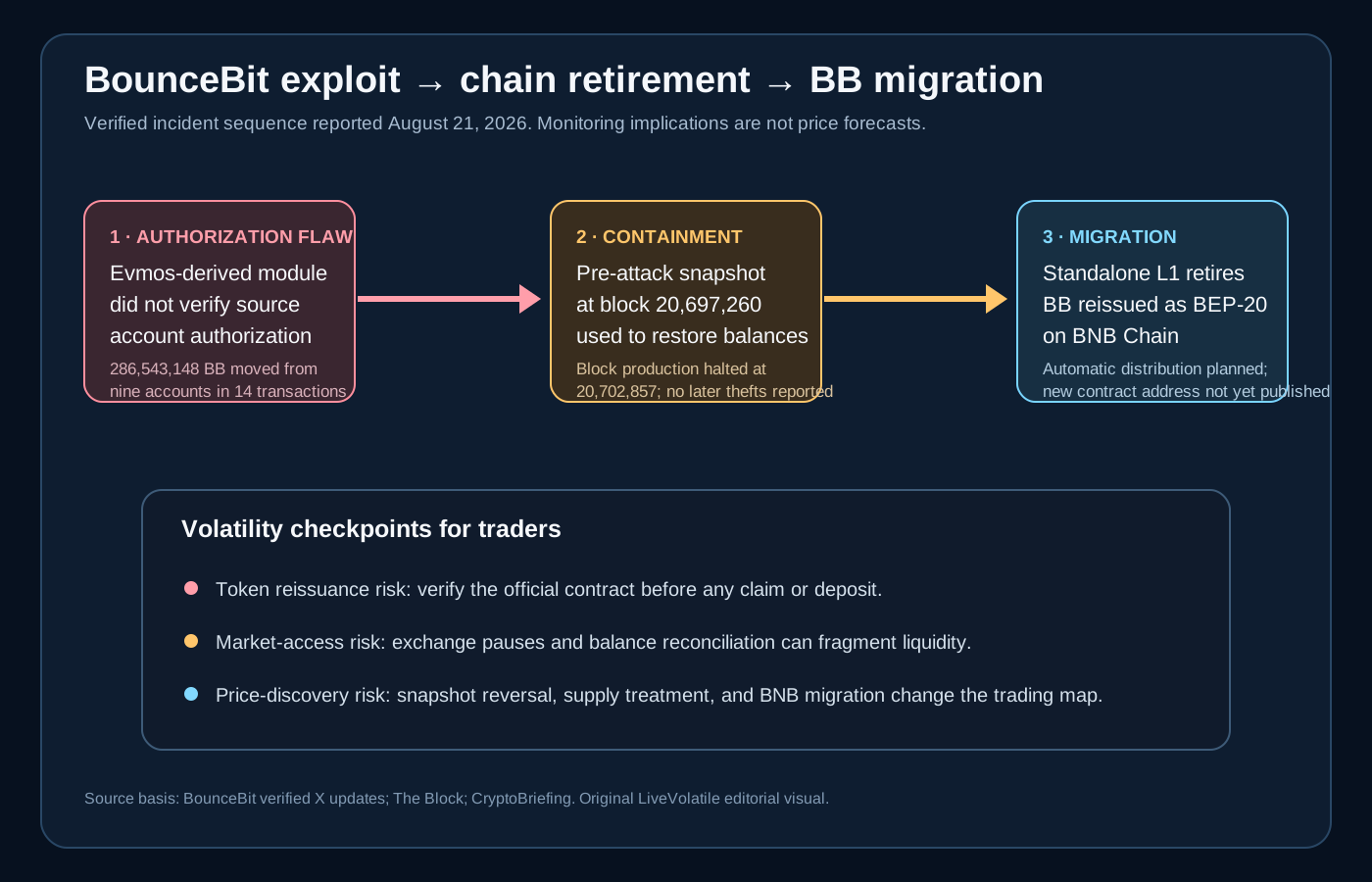
Original LiveVolatile editorial visual. It maps the verified incident sequence and the market-access points traders should monitor. Source basis: BounceBit’s verified X updates, The Block, and CryptoBriefing.
What happened on BounceBit Chain?
The incident occurred between 21:02 UTC on August 19 and 01:54 UTC on August 20, according to the project’s incident update as reported by CryptoBriefing. The attacker used a flaw in an authorization path associated with an Evmos-derived module handling vesting and lockup accounts. The practical failure was that the transaction could specify a different account as the source of funds without correctly proving that the account had authorized the debit.
That distinction matters. The available reporting does not describe a leaked private key or a compromised exchange account. It describes a protocol-level authorization failure that enabled unauthorized movement from accounts on the chain. The Block reported that approximately 286.5 million BB moved from nine wallets and valued the tokens at roughly $3 million at the time of its report.
BounceBit halted block production at height 20,702,857 at about 02:36 UTC on August 20. The project said no unauthorized transfers occurred after the halt. The incident therefore created two separate market questions: how much value was moved, and how the chain would preserve a trustworthy account state after the halt.
Why BounceBit chose retirement instead of a restart
BounceBit said it would permanently shutter the standalone Layer 1 rather than patch and upgrade it. The stated reason was that the chain was built on the Evmos stack, which was discontinued in May, making a secure rebuild, audit and validation process difficult. The project also said that many of its products and users were already operating on BNB Chain, so migration was the more practical path.
This is a significant governance and market-structure decision. A conventional incident response might involve a patch, a coordinated upgrade and a restart. BounceBit is instead changing the settlement environment. The migration reduces the burden of maintaining an isolated chain, but it introduces a new dependency: holders, exchanges, wallets and applications must agree on the replacement token and distribution process on BNB Chain.
The decision should not be read as evidence that every BNB Chain asset has the same risk. It does mean BB holders face a transition in which the token’s execution venue, contract address and balance history are changing at the same time.
How the snapshot changes BB balances
BounceBit plans to use the state at block 20,697,260, recorded before the first unauthorized transaction, as the basis for reissued balances. The 286,543,148 BB moved during the exploit will not be included in the new token supply, according to the project’s update reported by CryptoBriefing.
Transactions made between the snapshot and the halt are also expected to be effectively reversed. Users who did not transact during that window should see their snapshot balance restored, while staked and unbonding balances recorded at the snapshot are intended to be included. BounceBit said holders currently do not need to submit a claim and that automatic distribution to corresponding BNB Chain addresses is planned.
That process creates a temporary accounting risk for traders. A price on an exchange may reflect an old chain balance, a suspended market, or an anticipated reissued token rather than a fully settled market. Deposits and withdrawals can remain paused while exchanges reconcile customer balances and wait for the official replacement contract.
The project has also warned that no claim site currently exists. Until an official contract address is published through verified BounceBit channels, any website asking users to connect a wallet or approve a migration transaction should be treated as a phishing risk.
Volatility implications: four checkpoints
1. Contract-address risk
The most immediate risk is operational rather than directional. A fake BEP-20 contract, unofficial airdrop page or premature exchange listing could create a sharp but unreliable price move. Traders should verify the contract through BounceBit’s official account and exchange announcements, not through search ads, forwarded messages or unaudited social posts.
2. Liquidity and venue divergence
When deposits and withdrawals are paused, the price on a venue can diverge from the price elsewhere because arbitrage cannot move tokens freely between markets. Watch bid-ask spreads, order-book depth, funding terms and whether an exchange has reopened deposits—not only the last traded price.
3. Snapshot and reconciliation uncertainty
The snapshot protects the intended balance history, but it also reverses activity during the incident window. Users, market makers and exchanges may have different operational timelines for reconciliation. That can produce temporary supply confusion and forced position adjustments even if the final distribution follows the announced plan.
4. Migration concentration
Moving BB to BNB Chain may improve access if the project’s products already have activity there. It also concentrates BB’s future settlement and liquidity around a new environment. Traders should monitor the official token deployment, exchange support, bridge or migration instructions, and whether applications update their token metadata correctly.
What BB traders should monitor next
| Checkpoint | Why it matters | Evidence to verify |
|---|---|---|
| Official replacement contract | Prevents buying a counterfeit token | BounceBit verified channels and exchange notices |
| Deposit/withdrawal reopening | Shows whether arbitrage and settlement are returning | Individual exchange status pages |
| Snapshot treatment | Determines which balances and transactions count | BounceBit incident update and distribution terms |
| BNB Chain liquidity | Indicates whether price discovery is functioning | On-chain pools, exchange order books and volume |
| Exchange reconciliation | Reduces customer-balance uncertainty | Formal exchange announcements, not screenshots |
LiveVolatile readers can also monitor the crypto volatility dashboard, compare the spot-versus-futures risk framework, and review risk management in volatile trading. These are monitoring resources, not trading signals.
FAQ
Did BounceBit lose private keys?
The available incident reporting says no private keys, signatures, wallets, hardware devices or exchange accounts were compromised. The reported cause was an authorization flaw in a protocol module.
Is BounceBit Chain coming back?
No. BounceBit said it would permanently retire the standalone chain rather than restart or upgrade it, and reissue BB on BNB Chain.
Do BB holders need to claim new tokens?
BounceBit said holders currently do not need to take action and that automatic distribution is planned. The replacement contract address had not been published in the sources reviewed for this article. Wait for verified instructions.
Why can BB volatility increase even if the exploit is contained?
A contained exploit can still disrupt deposits, withdrawals, exchange balances, order-book depth and arbitrage. Those market-access changes can widen spreads and create venue-specific price moves.
Is every BB migration link safe?
No. BounceBit warned that no claim site currently exists. Treat unsolicited claim links as potentially fraudulent until the project publishes verified instructions and the official contract address.
Conclusion
BounceBit’s response converts a security incident into a full settlement migration. The project’s pre-attack snapshot and planned automatic reissuance may limit the effect on legitimate balances, but the transition can still produce volatility through paused markets, reversed state changes, exchange reconciliation and counterfeit-token risk. The key trading signal is not a headline price spike; it is whether the official BNB Chain token, exchange support and liquidity become verifiable and synchronized.
This article is for informational purposes only and is not investment, legal or security advice. Crypto assets are volatile. Verify contracts and transaction instructions independently before taking action.
Sources and credits
- BounceBit verified X profile and incident updates, accessed August 22, 2026.
- The Block: BounceBit to sunset blockchain after $3 million exploit, August 21, 2026, 1:28 PM EDT.
- CryptoBriefing: BounceBit shuts down chain after attacker moves 286.5 million BB, August 21, 2026.
- Inline visual: Original LiveVolatile editorial SVG, AI-free, created for this article from the verified incident sequence and linked sources; no third-party image rights asserted.
— LiveVolatile Research Desk