Ethereum Glamsterdam Testnet: Why Platåberget Could Reprice Gas and ETH Volatility
Direct answer: Ethereum’s Platåberget public testnet is the first broad testing ground for the planned Glamsterdam upgrade. The Ethereum Foundation says Glamsterdam includes gas repricing, a separate state-gas dimension for some state-creating operations, enshrined proposer-builder separation, block-level access lists, and larger contract-size limits. The changes are not a mainnet activation or an ETH price catalyst by themselves, but they create a concrete software-compatibility and execution-risk checkpoint. Wallets, indexers, gas estimators, validators, and builder infrastructure that rely on fixed gas assumptions should test before Glamsterdam advances to Sepolia, Hoodi, and eventually mainnet.
Key takeaways for ETH traders and Ethereum users
- Platåberget opened to public participation on August 17, 2026, and its Glamsterdam fork was scheduled for August 20.
- The Foundation explicitly warned that tools relying on a hardcapped maximum gas limit can break and need updates.
- A normal transfer to an existing account remains 21,000 gas in the Foundation’s explanation; sending ETH to a new account can incur additional state gas.
- Glamsterdam is still in staged testing. There is no verified mainnet activation date in the sources reviewed.
- The near-term volatility channel is operational: failed tooling, client bugs, stalled testnet activity, or a delayed rollout could affect confidence and positioning around ETH infrastructure.
What is Platåberget and why does it matter?
Platåberget is a public Ethereum testnet intended to run for several months rather than function as a short-lived private devnet. It gives application developers, solo stakers, distributed-validator projects, client teams, and infrastructure operators a place to test the post-Glamsterdam rules before they reach Ethereum’s longer-lived Sepolia and Hoodi testnets.
The timing matters because the network begins in a pre-fork state and then transitions into the new rules. That lets operators test not only the upgraded state, but also the migration itself. The Foundation’s announcement says the public validator set can be joined through deposits, while a faucet and resources page support experimentation.
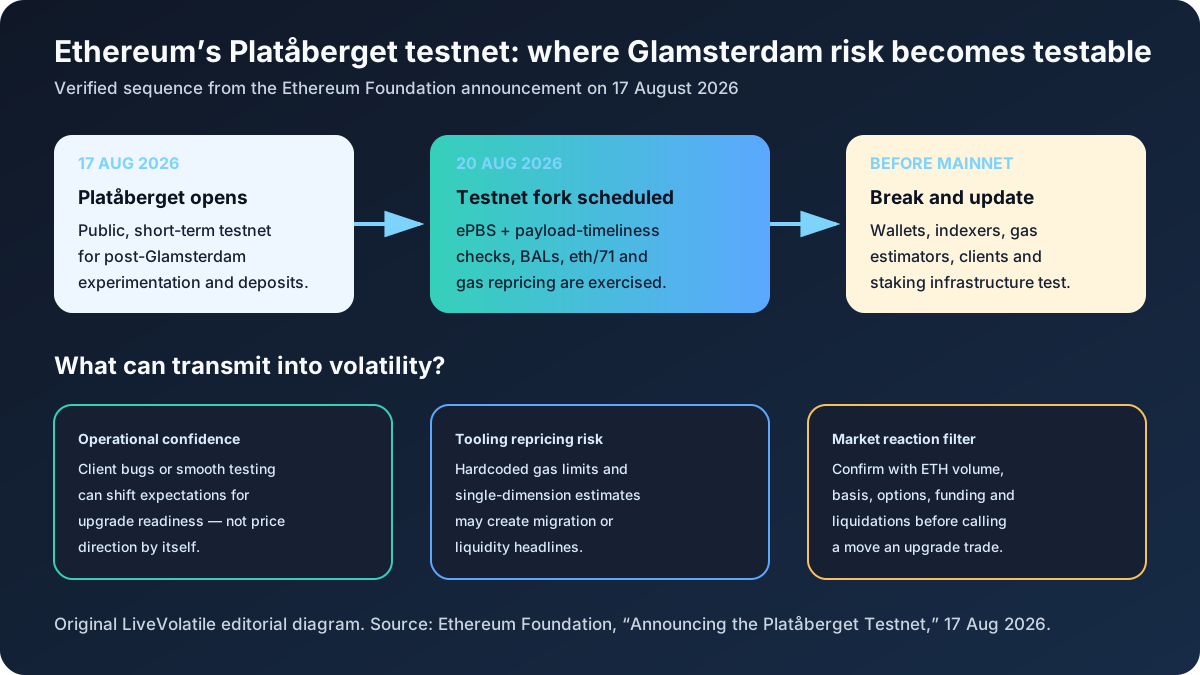
Visual credit: Original LiveVolatile editorial diagram, created August 21, 2026, based on the Ethereum Foundation’s August 17 announcement. It is an explanatory graphic, not a price forecast. Source: Ethereum Foundation.
The gas change that could break hardcoded assumptions
The clearest application-level warning concerns gas limits and state creation. The Foundation says any tool that relies on a hardcapped maximum gas limit—including wallets, indexers, and gas estimators—will be affected.
The practical distinction is important:
| Transaction or operation | What the Foundation says to expect | Why it matters |
|---|---|---|
| ETH transfer to an existing account | Still 21,000 gas in the described decomposition | Existing assumptions may continue to work in this narrow case |
| ETH transfer to a new account | Additional state gas for creating the account | A universal “21,000 gas covers every transfer” rule becomes unsafe |
| New storage, account creation, or code deployment | State creation is metered by state bytes at runtime | Estimators need more than one gas dimension |
| Contract deployment | Larger maximum deployed-contract and initcode limits | Deployment tools and testing assumptions need review |
EIP-8037 introduces a separate state-gas dimension for operations that create new state. The Foundation describes a fixed cost per state byte, charged at runtime. It also points developers to EIP-2780 for decomposed intrinsic costs and EIP-8038 for state-access increases.
This does not mean every ETH transaction suddenly costs more. It means applications must stop treating a single familiar number as a universal guarantee. That distinction is especially relevant for wallets that pre-set gas limits, exchanges that sweep funds to newly created addresses, indexers that model execution costs, and dApps that create storage during user flows.
Glamsterdam is more than a gas repricing
Enshrined proposer-builder separation
Glamsterdam brings enshrined proposer-builder separation, or ePBS, into the protocol. The Foundation describes changes to block building, proposing, and validation, including a new builder API flow and payload-timeliness checks.
The volatility implication is operational rather than automatically bullish or bearish. Validator operators, staking services, relays, builders, and custom clients have to verify that their infrastructure handles the new flow. A defect or incompatibility could create missed blocks, delayed confirmations, or uncertainty around upgrade readiness. Those outcomes can widen spreads and increase event-driven ETH risk even if Ethereum’s base-layer balances remain secure.
Block-level access lists
Block-level access lists will record state locations accessed during execution and post-transaction changes. The Foundation says this data is stored separately from the block body and can be exchanged between execution-layer peers through eth/71.
The feature is intended to improve execution coordination and help support higher capacity. But clients, execution infrastructure, explorers, and analytics systems must parse and propagate the new information correctly. Traders should treat testnet stability, client-release readiness, and bug reports as more useful signals than headline claims about future throughput.
Larger contracts and initcode
The announced changes raise the maximum deployed contract size from 24 KiB to 64 KiB and the maximum initcode size from 48 KiB to 128 KiB. That could make some larger applications easier to deploy, but it also expands the set of edge cases that developers need to test across clients, tooling, and security controls.
How the testnet could affect ETH volatility
Platåberget does not change ETH supply or activate Glamsterdam on mainnet. Its market relevance comes from the information it produces:
- Successful fork transition: Evidence that clients and infrastructure can handle the new rules may reduce upgrade uncertainty.
- Gas-estimation failures: Incorrect limits or fee calculations could create user friction and short-lived execution stress.
- Client or consensus bugs: A serious issue could delay the path to Sepolia, Hoodi, or mainnet and become a sentiment catalyst.
- Operator readiness: Validator, builder, and DVT participation provides a practical test of the upgraded block-production path.
- Mainnet scheduling: The Foundation says the rollout proceeds from Platåberget to longer-lived testnets before mainnet; no final mainnet date was confirmed in the reviewed sources.
For traders, the appropriate response is not to price a guaranteed ETH rally or crash. It is to monitor upgrade risk as a potential volatility regime change around developer milestones.
What should traders and developers monitor next?
- Platåberget fork health: Chain participation, finality, client errors, and documented incidents after the scheduled fork.
- Client support: Release notes for execution and consensus clients, especially support for gas changes, ePBS, BALs, and new APIs.
- Wallet and exchange testing: Whether gas estimators correctly distinguish existing-account transfers from state-creating transfers.
- Sepolia and Hoodi dates: These are stronger rollout signals than social-media speculation about mainnet timing.
- ETH market structure: Options skew, perpetual funding, liquidations, and spot depth around major developer updates.
- Official upgrade communications: The Ethereum Foundation, All Core Dev calls, Glamsterdam tracker, and client repositories should outrank anonymous claims.
LiveVolatile readers can use the crypto volatility guide and volatility tools to frame range and liquidity risk. Those tools do not establish whether an upgrade is technically safe.
FAQ
Is Glamsterdam live on Ethereum mainnet?
No. The sources reviewed describe staged testing. Platåberget is followed by testing on longer-lived networks such as Sepolia and Hoodi before a possible mainnet transition. No final mainnet date was confirmed in the Ethereum Foundation announcement.
Will every ETH transfer cost more than 21,000 gas?
No. The Foundation says a transfer to an existing account remains 21,000 gas in its described decomposition. A transfer to an account that does not yet exist can incur additional state gas, so 21,000 should not be treated as a universal limit for every transfer.
Which software is most exposed?
Wallets, indexers, gas estimators, execution and consensus clients, validator tooling, builder infrastructure, and applications that create new state are the clearest categories named or implicated by the Foundation’s warning.
Is Platåberget an ETH investment signal?
It is a development and infrastructure signal, not a standalone trading signal. Successful testing could reduce uncertainty, while bugs or delays could increase event risk. ETH’s price will also depend on liquidity, macro conditions, positioning, and unrelated catalysts.
Conclusion
Platåberget turns Glamsterdam from a proposal discussed by developers into a public compatibility test. The most important change for ordinary Ethereum tooling is not that every transaction receives a new price; it is that gas and state creation can no longer be safely represented by one hardcoded assumption.
The next useful ETH volatility signals are testnet health, client readiness, wallet and exchange compatibility, and the timing of later Sepolia and Hoodi upgrades. Until those gates pass, treat Glamsterdam as a staged infrastructure catalyst—not a confirmed mainnet event.
Disclaimer: This article is informational and is not investment, trading, software-security, or deployment advice. Crypto assets and blockchain software can carry substantial financial and operational risk.
Sources
- Ethereum Foundation: Announcing the Platåberget Testnet, published August 17, 2026; accessed August 21, 2026.
- Cryptopolitan: Ethereum opens Platåberget testnet for public Glamsterdam testing, published August 17, 2026; accessed August 21, 2026. Used as secondary context; Foundation claims take precedence.
- crypto.news: Ethereum devs warn Glamsterdam upgrade could break wallets and gas tools, published August 18, 2026; accessed August 21, 2026. Used for independent reporting context; market prices in the page were not used.
— Marcus Reynolds, Senior Crypto Volatility Analyst