Ethereum Platåberget Testnet: What Glamsterdam Testing Means for ETH Volatility
Direct answer: Ethereum opened Platåberget, a public short-term testnet for the upcoming Glamsterdam upgrade, on August 17, 2026. The Ethereum Foundation says the testnet’s Glamsterdam fork is scheduled for August 20. This is not an Ethereum mainnet activation and it is not a direct ETH price signal. It is an infrastructure-readiness event: wallets, indexers, gas estimators, execution and consensus clients, validators, and staking operators now have a public environment in which to find compatibility problems before the upgrade reaches longer-lived testnets and, later, mainnet.
For traders, the useful angle is not “testnet launch equals ETH rally.” The useful angle is whether testing produces credible evidence of smooth client coordination or exposes operational failures that can widen uncertainty around the upgrade timeline.
Status note: This analysis reflects the Ethereum Foundation’s Platåberget announcement and the Ethereum.org Glamsterdam roadmap available on August 17, 2026. Glamsterdam remains an upcoming upgrade planned for Q4 2026; the mainnet date is not fixed by the testnet launch.
Key takeaways
- Platåberget is a public testing ground for Glamsterdam, intended to run for several months rather than function as a short-lived devnet.
- The testnet fork is scheduled for August 20, giving validators and infrastructure teams a near-term compatibility checkpoint.
- Glamsterdam testing includes enshrined Proposer-Builder Separation (ePBS), Payload Timeliness Committee checks, Block-Level Access Lists (BALs),
eth/71, gas repricing, and larger contract and initcode limits. - Wallets, indexers, and gas estimators that hardcode a maximum gas limit or assume a single gas dimension are specifically exposed to migration risk.
- A successful testnet is evidence about engineering readiness, not proof of a mainnet date or a bullish ETH outcome.
- ETH volatility should be evaluated with market structure—volume, funding, basis, options, spreads, and liquidations—rather than a headline alone.
What happened on August 17?
The Ethereum Foundation announced Platåberget as a public, short-term testnet for community testing of post-Glamsterdam changes. The Foundation describes it as a more stable place to experiment than the short-lived devnets that preceded it, with an expected lifespan of a few months.
The testnet has a relatively small but publicly joinable validator set. Participants can deposit validators and test validator and builder deposit workflows. A faucet supplies testnet ETH for deposits and gas, while the Platåberget resources page provides network settings, bootnodes, client information, and an “Add Network” flow.
This matters because Glamsterdam changes both the consensus and execution layers. The announcement is therefore more than a branding update: it creates a public checkpoint where client teams, node operators, dApp developers, and infrastructure providers can test assumptions against a shared environment.
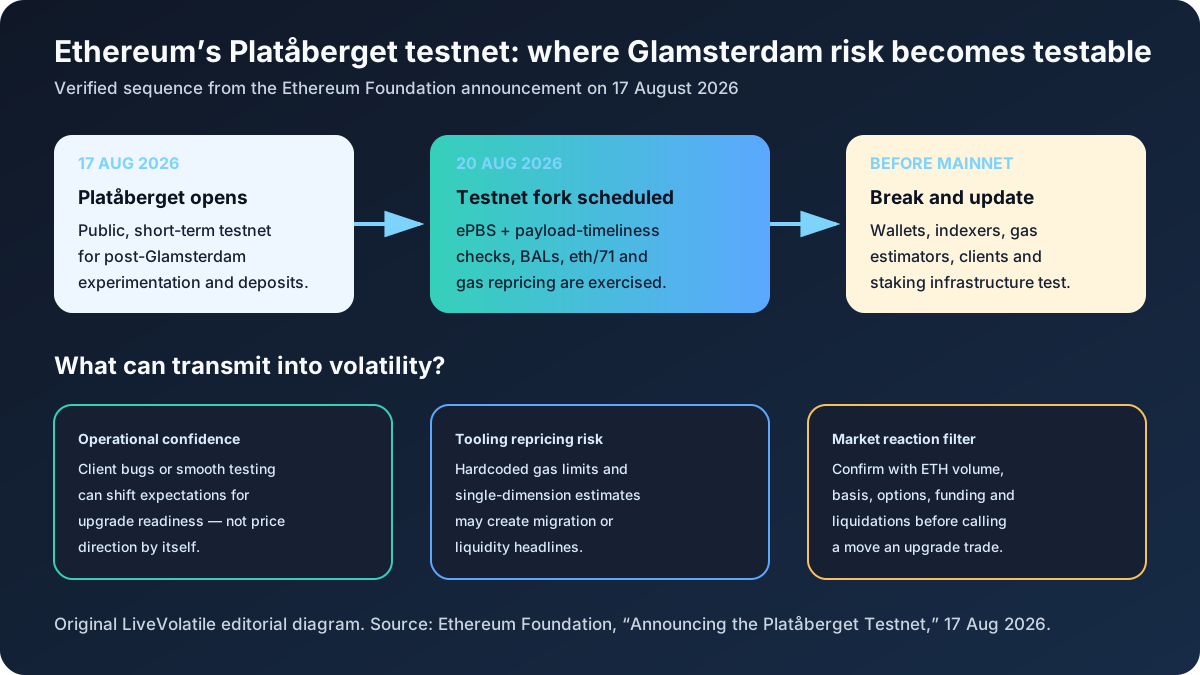
Visual credit: Original LiveVolatile editorial diagram, based only on the Ethereum Foundation’s August 17 announcement and Ethereum.org’s Glamsterdam roadmap. It is explanatory, not a forecast.
What Glamsterdam is testing
The Ethereum.org Glamsterdam roadmap describes the upgrade as a Q4 2026 change focused on scaling Layer 1, improving data handling, and keeping state growth sustainable. Platåberget’s announcement names the main test areas.
| Component | Plain-English purpose | Who should care now | Volatility relevance |
|---|---|---|---|
| ePBS | Moves proposer-builder coordination into protocol-level mechanics and adds timeliness checks. | Validators, builders, staking pools, client teams. | Operational headlines can affect confidence in the upgrade path. |
| BALs | Records block state-access information so unrelated work can be prepared for parallel processing. | Execution clients, node operators, tooling teams. | Bugs or delays can change perceived implementation risk. |
| eth/71 | Lets execution-layer peers exchange Block Access Lists. | Execution-layer client and infrastructure operators. | Network-readiness signals may influence event positioning. |
| Gas repricing | Changes the cost accounting for operations and state creation. | Wallets, indexers, gas estimators, dApps. | Broken estimates can create user-facing friction and short-term uncertainty. |
| Larger limits | Raises maximum deployed contract and initcode sizes in the test specification. | Developers and deployment tooling. | Migration costs matter more than token narrative at this stage. |
The Foundation warns that tools relying on a hardcapped maximum gas limit—its examples include wallets, indexers, and gas estimators—will break and need updates. It also explains that new state creation introduces a separate state-gas dimension, meaning an assumption that every transfer is covered by a flat 21,000 gas figure needs revisiting in relevant cases.
The implementation path from testnet to mainnet
The important sequence is staged. Platåberget is not the final upgrade destination.
flowchart LR
  A[17 Aug: Platåberget public testnet] --> B[20 Aug: Glamsterdam fork test]
  B --> C[Client and application feedback]
  C --> D[Further devnet testing, including non-finality scenarios]
  D --> E[Sepolia and Hoodi testnets]
  E --> F[Mainnet transition after testnet stability]
Diagram source: LiveVolatile synthesis of the order stated in the Ethereum Foundation announcement. The dates shown are only the public testnet launch and scheduled testnet fork; no mainnet date is asserted.
The Foundation says feedback will be incorporated into client software and specifications before a non-finality devnet follows within the month. After the devnets are stable, Sepolia and Hoodi are expected to run through the fork. Only after those longer-lived testnets upgrade and remain stable would mainnet become the next step.
That sequence creates several information points for ETH markets. A clean testnet transition may reduce perceived implementation risk, while client incompatibilities, consensus failures, or postponed testing could increase uncertainty. Neither outcome fixes the ETH trend by itself because macro conditions, ETF flows, leverage, and broad risk appetite remain separate drivers.
How the testnet can affect ETH volatility without moving ETH directly
1. Engineering risk can become event risk
Protocol upgrades are implemented by software teams, not by a single issuer. News about client releases, testnet failures, validator participation, or changed timelines can therefore create event-driven repricing. The move may be sharp if positioning is concentrated, but it can also fade quickly if spot volume does not confirm it.
2. Gas-estimation failures can become user-experience headlines
The gas changes are especially relevant because they touch a broad tooling layer. If a wallet displays an insufficient estimate, an indexer misreads a new field, or a dApp assumes the old cost model, users may experience failed transactions or confusing fees on the testnet. Those are testnet issues, not evidence that mainnet users are already affected—but they can reveal work still required before deployment.
3. ePBS and BALs change infrastructure assumptions
ePBS changes how block proposers and builders coordinate, while BALs provide a map of state accesses that can support parallel processing and faster state updates. The potential benefit is long-term scalability and reduced dependence on off-protocol coordination. The near-term risk is integration complexity across clients, validators, builders, staking pools, and monitoring systems.
4. ETH positioning may front-run the wrong milestone
A trader may buy or sell ETH because a headline says “Glamsterdam launched,” even though the event is a testnet launch. The distinction is material. A testnet can validate software assumptions, but it does not guarantee a mainnet schedule, successful execution under production conditions, lower fees, or a particular ETH price.
What ETH traders should monitor next
Use a simple confirmation stack instead of reacting to one headline:
- Protocol signal: Did the August 20 testnet fork complete as scheduled? Are official client and testnet resources updated?
- Operational signal: Are validators, builders, execution clients, and consensus clients reporting compatibility issues?
- Market signal: Did ETH spot volume, perpetual funding, futures basis, options skew, and liquidations move together?
- Relative signal: Is ETH outperforming or underperforming BTC and major smart-contract platforms on the same window?
- Narrative signal: Is the market discussing a concrete test result, or merely extrapolating from the announcement?
LiveVolatile readers can compare the Ethereum coin page, market analysis dashboard, and liquidations monitor. These are monitoring tools, not a substitute for the Ethereum Foundation’s technical documentation or investment advice.
A practical event framework
| Observation | More constructive interpretation | More cautious interpretation |
|---|---|---|
| Fork completes and clients report no critical blocker | Readiness risk may be lower than before the test. | It still does not set a mainnet date. |
| Client incompatibility or tooling breakage appears | Early testing is doing its job by finding issues. | Upgrade uncertainty and event volatility may rise. |
| ETH rallies on the headline with weak volume | Positioning or broader market beta may be driving it. | Avoid labeling it an upgrade-specific repricing. |
| ETH and derivatives confirm the move | The market is assigning more weight to the catalyst. | Confirmation can still reverse if macro risk changes. |
FAQ
What is the Platåberget testnet?
It is a public, short-term Ethereum testnet intended to let the community test changes associated with the upcoming Glamsterdam upgrade before those changes move to longer-lived testnets and eventually, if stable, mainnet.
Is Glamsterdam live on Ethereum mainnet?
No. The Ethereum.org roadmap describes Glamsterdam as an upcoming Q4 2026 upgrade. The August 17 announcement concerns a testnet, and it does not publish a fixed mainnet activation date.
What is scheduled for August 20?
The Ethereum Foundation says the Glamsterdam fork on Platåberget is scheduled for August 20, 2026. That is a testnet fork date, not a mainnet date.
Which Ethereum tools are most exposed?
The Foundation specifically highlights wallets, indexers, and gas estimators that rely on hardcoded maximum gas limits. Validators, builders, execution and consensus clients, staking pools, and dApp infrastructure also need to test the relevant changes.
Does Platåberget make ETH bullish?
Not automatically. It is a meaningful engineering milestone, but ETH price direction also depends on liquidity, macro conditions, leverage, flows, and the market’s interpretation of subsequent test results.
Conclusion
Platåberget turns Glamsterdam from a roadmap discussion into a public testing process. The immediate story is operational: Ethereum developers and infrastructure operators can now test ePBS, BALs, eth/71, gas repricing, and related changes in an environment designed to expose breakage before longer-lived testnets.
For ETH traders, the highest-quality signal will arrive after the headline—through fork execution, client compatibility reports, and market confirmation. Treat the August 20 testnet fork as a readiness checkpoint, not a guaranteed catalyst. A testnet can reduce uncertainty by working well, or increase it by revealing problems; neither result alone determines ETH’s next move.
Risk disclaimer: This article is for educational and informational purposes only and is not investment, legal, or tax advice. Crypto assets are volatile and may lose all value. Protocol timelines and specifications can change. Verify current Ethereum Foundation, client-team, exchange, and market information before acting.
Sources and visual credits
- Ethereum Foundation, “Announcing the Platåberget Testnet”, August 17, 2026. Primary source for the testnet purpose, scheduled August 20 fork, included changes, validator participation, and next steps.
- Ethereum.org, “Glamsterdam”, page updated August 6, 2026. Primary roadmap reference for the upgrade’s goals and technical concepts including ePBS and BALs.
- Visual credit:
/images/articles/ethereum-plataaberget-glamsterdam-risk-map-2026-08-17.svgis an original LiveVolatile editorial diagram created for this article from the two primary sources above; no third-party image was reused. - Diagram credit: The Mermaid sequence is an original LiveVolatile synthesis of the staged path described in the Ethereum Foundation announcement. It is not a prediction of dates beyond the explicitly stated August 17 launch and August 20 testnet fork.