BitMine Holds 5.85M ETH: Why Treasury Concentration Could Amplify Ethereum Volatility
Direct answer: BitMine Immersion Technologies (NYSE: BMNR) reported on August 24, 2026 that it held 5,847,611 ETH as of August 23 at 2:00 p.m. ET. The company said that represented about 4.8% of the 120.7 million ETH supply it used in its calculation. BitMine also reported 5,067,309 ETH staked, or roughly 87% of its ETH holdings, and total crypto, cash, marketable securities and “moonshots” of $14.9 billion.
That does not mean BitMine controls Ethereum or that ETH must rise or fall next. It does create a new market-structure variable: a large public-company treasury now combines substantial spot exposure, staking economics and equity-market sentiment. Traders should monitor staking and exit flows, ETH/BTC relative strength, BMNR’s premium or discount to its reported asset value, spot depth and leverage—not treat the announcement as a standalone price forecast.
Key takeaways
- BitMine’s issuer announcement reported 5,847,611 ETH held as of August 23, 2026.
- The company’s stated 4.8% figure is based on 120.7 million ETH supply; it is an issuer-reported holding and calculation, not an independent audit performed for this article.
- BitMine reported 5,067,309 ETH staked, leaving approximately 780,302 ETH outside the stated staked balance at that snapshot.
- The announcement said BitMine bought 32,447 ETH during the preceding week and had bought ETH weekly since its treasury strategy began in June 2025.
- Concentration can affect liquidity and expectations, but the report does not establish that BitMine intends to sell, that staking withdrawals are imminent, or that ETH price direction is guaranteed.
- The most useful volatility signals are treasury-equity divergence, ETH/BTC momentum, staking-flow changes, funding rates and order-book depth.
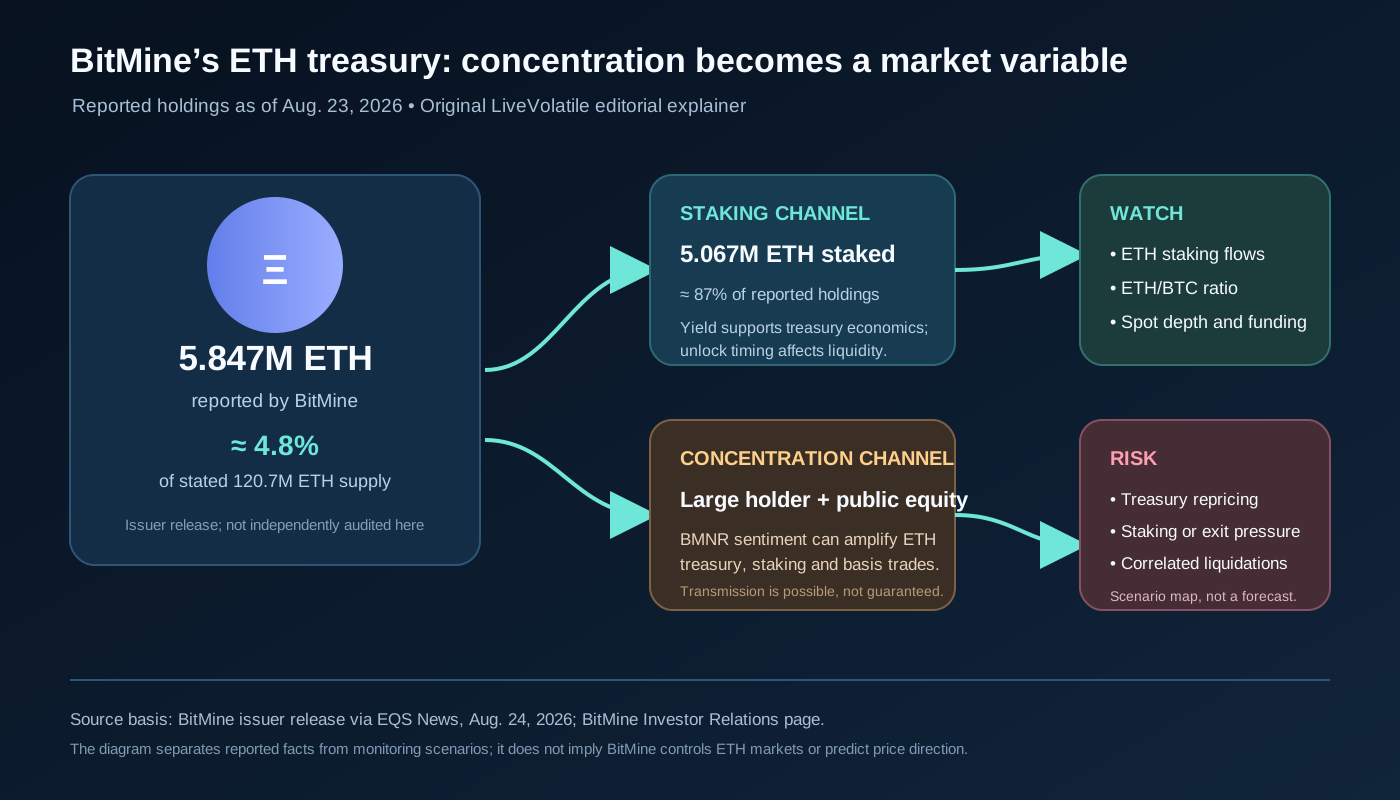
Visual credit: Original LiveVolatile editorial SVG created for this article from BitMine’s August 24 issuer announcement distributed through EQS News and the BitMine Investor Relations page. It separates reported facts from scenario-based monitoring points and is not a price forecast.
What did BitMine announce?
BitMine’s release said its crypto, cash, marketable securities and “moonshots” totaled $14.9 billion. The breakdown included 5,847,611 ETH valued in the release at $2,440 per ETH, 210 BTC, $308 million in cash and marketable securities, a $180 million stake in Beast Industries and an $89 million stake in Eightco Holdings.
The announcement is important because the ETH number is large enough to matter to market participants even if the company never becomes a forced seller. A treasury of this size can influence how investors think about available supply, staking participation, corporate financing and the relationship between ETH spot markets and BMNR shares.
The figures should still be read precisely. They are a company announcement based on a stated snapshot and valuation. The release does not by itself provide an independent custody attestation, a complete wallet-by-wallet reconciliation or a guarantee that every reported asset is immediately liquid.
The staking number changes the liquidity question
BitMine said 5,067,309 ETH was staked, representing $12.4 billion at the release’s $2,440 reference price. Dividing that reported staked balance by the reported 5,847,611 ETH total gives approximately 86.7%, which rounds to the company’s stated 87%.
This matters because staked ETH is not equivalent to cash sitting on an exchange. Staking can produce yield, but withdrawals, validator exits, custody arrangements and operational timing affect how quickly exposure can change. The announcement does not say that BitMine plans to unstake or sell. Therefore, the correct trading interpretation is a monitoring framework rather than a claim of imminent supply pressure.
The immediate questions are:
- How much of the reported balance is liquid or readily transferable?
- Are staking and custody arrangements changing as the treasury grows?
- Does BMNR trade at a premium or discount to the market value of its crypto and other assets?
- Would a sharp ETH drawdown affect the company’s financing or equity-market feedback loop?
Those questions connect an ETH spot move to a public-equity risk channel without assuming that the connection will always be one-way.
How treasury concentration can transmit into volatility
A large corporate holder can influence market expectations through several channels:
| Channel | What could happen | Evidence traders should verify |
|---|---|---|
| Spot concentration | Investors reassess the amount of ETH held by a strategic treasury rather than immediately available to trade. | Custody disclosures, transfers and future filings |
| Staking yield | Staked ETH produces reported yield and may support the treasury narrative. | Actual staking balances, validator performance and realized revenue |
| Equity feedback | BMNR shares may trade differently from the value of the underlying ETH. | BMNR premium/discount, volume and financing disclosures |
| Deleveraging risk | A sharp ETH move could pressure leveraged or collateral-linked positions. | Debt terms, margin arrangements and forced-flow data |
| Relative-value trades | Traders may pair ETH exposure with BMNR or ETH/BTC positions. | Basis, borrow conditions, funding and open interest |
These are mechanisms, not confirmed outcomes. The announcement confirms the size of the reported treasury; it does not prove that any specific hedge fund, lender or trader has taken a corresponding position.
Use the LiveVolatile markets monitor, liquidations dashboard and Bitcoin volatility calculator to compare broad crypto movement with ETH-specific and equity-linked stress.
The ETH/BTC signal is more useful than the headline alone
BitMine’s release highlighted a 30% weekly gain in ETH and argued that earlier episodes of similar weekly performance were followed by further gains. Those historical comparisons are management commentary and should not be treated as a model or a reliable forecast. A past move does not determine the next one.
For traders, the more durable question is whether ETH is outperforming BTC while liquidity and leverage remain healthy. A rising ETH/BTC ratio can indicate that market participants are rotating toward Ethereum exposure, but it can also reflect crowded positioning. A stronger signal would combine relative strength with:
- Increasing spot volume rather than derivatives-only activity;
- Stable or declining excessive funding rates;
- Order-book depth that remains available during pullbacks;
- Staking flows that do not show an abrupt increase in exit pressure;
- BMNR trading activity that does not reveal a sudden equity-market stress signal.
If ETH rallies while BMNR weakens sharply or trades at a widening discount to reported assets, that divergence deserves attention. It does not automatically invalidate the ETH move, but it may show that equity investors are discounting financing, custody, liquidity or valuation risks that spot traders are ignoring.
What could invalidate the bullish treasury narrative?
BitMine’s announcement presents its accumulation and staking strategy as a long-term institutional ETH thesis. That thesis can be challenged by several developments:
- ETH falls enough to reduce the dollar value of the reported treasury;
- BMNR’s market valuation loses its premium or develops a deep discount;
- Staking yields, validator performance or custody arrangements disappoint;
- The company needs to raise capital on terms that dilute shareholders or change treasury economics;
- A large holder becomes a source of supply, whether through a disclosed sale, collateral action or other transfer;
- ETH/BTC strength reverses while leverage and open interest remain elevated.
None of these outcomes is established by the August 24 release. They are the risk checkpoints that make the announcement relevant to volatility analysis rather than merely a corporate balance-sheet statistic.
What traders should monitor next
The next useful evidence will be incremental and document-based:
- A subsequent company update or filing: Look for changes in ETH holdings, custody, staking, financing or asset valuation.
- Wallet and staking-flow data: Confirm whether reported balances move and whether any changes are operational or market-driven.
- BMNR versus ETH performance: Track whether the stock amplifies or discounts the underlying asset move.
- ETH derivatives: Watch funding, open interest, options skew and liquidation clusters around major levels.
- ETH/BTC and spot breadth: A healthier move generally has broader spot participation than a thin, leveraged squeeze.
The company’s Investor Relations page also hosts its chairman’s message and corporate materials. Those materials are useful for understanding management’s thesis, but forward-looking claims about future ETH performance, staking revenue or market adoption remain projections rather than verified results.
FAQ
How much ETH does BitMine report holding?
BitMine reported 5,847,611 ETH as of August 23, 2026 at 2:00 p.m. ET. It said that represented approximately 4.8% of the 120.7 million ETH supply used in its calculation.
How much of BitMine’s ETH was staked?
The company reported 5,067,309 ETH staked, approximately 87% of its reported ETH holdings at that snapshot. The release does not establish that the staked ETH is about to be withdrawn.
Does BitMine control 4.8% of Ethereum?
The 4.8% figure describes the company’s reported ETH holdings relative to the supply figure it cited. It does not mean BitMine controls Ethereum’s protocol, validators, governance or global market price.
Is the BitMine announcement bullish for ETH?
It can be viewed as evidence of one company’s strong ETH accumulation and staking strategy, but it is not a guaranteed bullish signal. ETH price still depends on liquidity, macro conditions, positioning, flows and new information.
What is the main volatility risk?
The key risk is a feedback loop between ETH price, staking and treasury valuation, BMNR equity performance, financing conditions and leveraged positioning. The existence and size of that loop should be verified with future disclosures and market data.
Conclusion
BitMine’s reported 5.847 million ETH treasury makes corporate ownership and staking concentration a more visible part of the Ethereum market structure. The announcement confirms a large snapshot, not a forecast: it does not prove imminent selling, guarantee ETH appreciation or show that BitMine controls the network.
For volatility traders, the disciplined response is to track the transmission channels. Compare ETH with BMNR, monitor ETH/BTC and derivatives positioning, check staking and custody updates, and distinguish liquid spot supply from assets that may require an exit process. The headline is large; the next market move will depend on whether the reported treasury remains a source of confidence, a valuation premium or a new concentration risk.
Risk disclaimer: This article is for informational and educational purposes only. Crypto assets and public-company securities are highly volatile and may lose some or all of their value. Nothing here is financial, legal or investment advice.
Sources
- BitMine Immersion Technologies issuer announcement via EQS News — published August 24, 2026 at 14:35 CET/CEST; reports the ETH, staking, BTC, cash and total-holdings snapshot.
- BitMine Investor Relations — company materials and chairman’s message; accessed August 24, 2026.
Image credits: Original LiveVolatile SVG at /images/articles/2026-08-24-bitmine-eth-treasury-concentration.svg; based on the cited issuer announcement and Investor Relations page. No third-party image is reproduced.
— LiveVolatile Research Desk