Zcash ETF Filing Sends ZEC Volatility Higher: What Traders Should Watch Next
Short answer: Zcash (ZEC) rallied sharply after reporting that Grayscale submitted another amendment to its proposed U.S. spot Zcash ETF. The development moves the product closer to a conventional exchange-traded structure, but it is not SEC approval. For volatility traders, the key issue is the gap between ETF optionality and a confirmed listing: leverage, thin liquidity, changing expectations and a possible rejection or delay can all make the move unstable.
Key takeaways
- Reports on August 22 said Grayscale had filed a fifth amendment for a proposed Zcash ETF conversion.
- The reported structure would rename the product The Zcash ETF, charge a 2.5% annual sponsor fee and seek an NYSE Arca listing under the reported ticker ZCH.
- Grayscale’s existing Zcash Trust page confirms the OTC product’s 2.50% expense ratio, roughly $263.5 million in assets and 4.83 million shares as of August 21, 2026.
- A registration statement or amendment is a proposal under review, not a guarantee that the ETF will launch.
- The practical volatility checkpoints are SEC progress, spot depth, derivatives positioning, custody/creation mechanics and whether the market is pricing approval too aggressively.
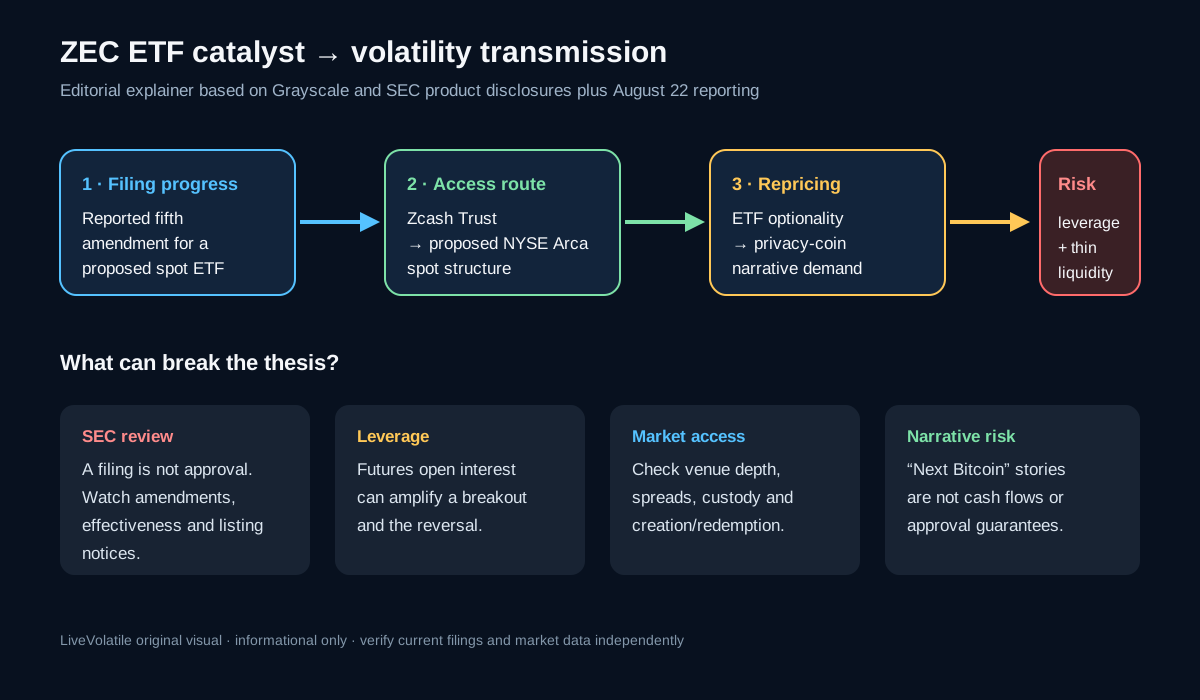
Original LiveVolatile editorial SVG. It maps the reported filing catalyst to market repricing and highlights the main failure points: SEC review, leverage, market access and narrative risk. No third-party image rights are asserted.
What changed in the Zcash ETF story?
The immediate catalyst was a report that Grayscale submitted a further amendment to the U.S. Securities and Exchange Commission for a proposed spot Zcash ETF. The Block’s August 21 report described the filing as another step toward converting Grayscale’s existing Zcash Trust into an exchange-traded product that would directly track ZEC.
The reported amendment is meaningful because it adds or clarifies product terms rather than merely repeating an early concept. Reporting described the proposed name as The Zcash ETF, an annual sponsor fee of 2.5% and a planned NYSE Arca listing under ticker ZCH. Those details help investors understand the intended structure, but they do not establish that the SEC has declared the registration statement effective or approved a listing.
The distinction matters because crypto markets often price the headline before the legal and operational milestones are complete. A filing can improve the probability assigned to a future product while leaving the timing, approval and eventual demand uncertain.
What the current Grayscale Trust data tells us
Grayscale’s product page provides a useful baseline for the proposed conversion. As of August 21, 2026, it listed the Grayscale Zcash Trust under ticker ZCSH on OTC Markets, with a 2.50% total expense ratio, approximately $263.46 million in assets under management, 4,829,300 shares outstanding and a reported NAV per share of $54.56.
The page also says the trust is designed to provide exposure to ZEC without requiring investors to buy and safeguard the token directly. It identifies the CoinDesk Zcash Benchmark Rate as the reference rate used for valuation. This is important for volatility analysis: the existing trust is already an access vehicle, while the proposed ETF structure could broaden brokerage access and improve the way creations, redemptions and arbitrage interact with the underlying market.
That potential is not the same as guaranteed inflows. Investors still need to see an effective registration statement, an approved listing process, authorized-participant readiness and functioning creation/redemption operations.
Why ZEC moved faster than the filing itself
A large repricing can occur before an ETF exists because traders are discounting a possible change in the buyer base. A listed product could make ZEC easier to access through traditional brokerage accounts and could create a more visible institutional channel. For a privacy-focused asset, that prospect is a strong narrative catalyst.
The move can then become self-reinforcing:
| Catalyst stage | Market interpretation | Volatility risk |
|---|---|---|
| Fresh amendment reported | Approval odds may be repriced higher | Headline-driven gaps and chase buying |
| ZEC breaks a major resistance level | Momentum traders join the move | Stops and liquidations cluster near obvious levels |
| Derivatives activity expands | Leverage magnifies directional conviction | A modest spot reversal can trigger forced selling |
| SEC timing remains uncertain | Traders wait for the next filing or notice | Volatility persists around every update |
| Product launches, is delayed or rejected | Expectations are repriced again | Gap risk can exceed normal technical ranges |
This is why a strong one-day move should not be treated as proof that ETF demand has arrived. The market is trading the path to a possible product, not a confirmed asset-gathering record.
The most important volatility checkpoints
1. SEC status, not social-media certainty
Monitor the actual SEC filing record and any effectiveness, comment, delay or listing-related notice. Grayscale’s original S-3 filing states that the prospectus was subject to completion and that the SEC had not approved or disapproved the securities. That warning remains the right framework for interpreting later amendments: a revised document can advance a proposal without eliminating regulatory risk.
2. Spot liquidity and execution quality
A headline price is not enough after a rapid rally. Track bid-ask spreads, order-book depth, venue concentration and the difference between displayed liquidity and executable size. If ZEC’s price rises while depth remains thin, the market can experience large two-way moves even without a new fundamental headline.
3. Futures open interest and liquidation sensitivity
Reports around the move cited unusually large derivatives activity. Treat those figures as secondary-source market data and verify them against a reliable venue or analytics provider before using them quantitatively. The trading implication is straightforward: rising open interest alongside a fast price advance can mean more fuel for continuation, but it can also make the reversal sharper.
4. Creation and redemption mechanics
The SEC filing describes basket-based creation and redemption mechanics for the proposed product and identifies Coinbase entities and BNY Mellon roles in the trust structure. The operational details matter because arbitrage depends on whether authorized participants can create and redeem efficiently. Delays, cash-only limitations or custody friction can allow the product and spot market to diverge.
5. Privacy-coin narrative risk
“Next Bitcoin” framing can attract attention, but it is not a valuation model. Zcash’s official site describes ZEC as encrypted electronic cash and explains its shielded and transparent transaction options. The investment-product narrative and the protocol’s utility are related but different claims. Traders should separate adoption evidence from momentum language.
LiveVolatile readers can use the crypto volatility dashboard, compare the spot-versus-futures risk framework, and review the risk-management guide for volatile trading. These are monitoring resources, not trade signals.
What would invalidate the bullish setup?
The immediate bullish narrative would weaken if the filing is delayed, materially changed, rejected or fails to progress toward an effective product. It could also weaken if ZEC’s rally loses spot liquidity support and becomes dominated by leveraged derivatives.
A different failure mode is operational: even an approved product may not produce the demand traders expect. Assets under management, spreads, tracking quality and net creations would be more informative than the approval headline alone. Until those data exist, the ETF thesis should be treated as an event-risk scenario rather than a completed institutional-flow story.
FAQ
Did the SEC approve a Zcash ETF?
No approval was established by the sources reviewed for this article. The reported event was a further amendment to Grayscale’s proposed registration. A filing is not the same as an effective registration statement, a listing approval or live ETF trading.
What is the reported ticker for the proposed product?
Reporting on the latest amendment described a proposed NYSE Arca ticker of ZCH. Grayscale’s existing OTC trust page lists the current publicly traded trust as ZCSH. These should not be treated as the same live market until the proposed conversion is formally completed.
Why can ZEC volatility rise before an ETF launches?
Traders can reprice the probability of future brokerage access, institutional demand and a broader privacy-coin narrative before the product exists. Leverage and thin liquidity can amplify that repricing in both directions.
Is a ZEC rally proof of ETF inflows?
No. Price movement before launch is not evidence of ETF creations or net institutional buying. Those flows can only be assessed after a product is live and reports reliable asset and creation data.
What should traders monitor next?
Monitor SEC filings and notices, venue liquidity, futures open interest, liquidation data, the proposed product’s operational timetable and whether the next move is supported by spot demand rather than only derivatives.
Conclusion
The Grayscale Zcash ETF filing is a credible volatility catalyst because it could eventually change how traditional investors access ZEC. But the market is still trading an uncertain sequence of regulatory and operational milestones. The cleanest analysis is therefore conditional: a successful conversion could broaden access, while delay, rejection, weak liquidity or excessive leverage could turn the same narrative into a sharp reversal.
For now, the useful question is not simply “Will Zcash keep rising?” It is whether each new move is being confirmed by SEC progress, executable spot liquidity and sustainable market participation.
This article is for informational purposes only and is not investment, legal or regulatory advice. Crypto assets are volatile. Verify filings, market data, venue status and product terms independently before taking action.
Sources and credits
- U.S. SEC: Grayscale Zcash Trust Form S-3, filed November 26, 2025. Used for the proposed trust structure, basket mechanics, custody/administrator roles and approval disclaimer.
- Grayscale: Grayscale Zcash Trust. Accessed August 22, 2026. Used for current OTC trust status, expense ratio, assets, shares and benchmark-rate context.
- Grayscale: Regulatory Filings. Accessed August 22, 2026. Used as the issuer’s filing index.
- The Block: Grayscale moves closer to launching first Zcash ETF in the U.S.. Published August 21, 2026; used for the reported fifth amendment, proposed name, ticker and fee details.
- Zcash official site. Accessed August 22, 2026. Used for protocol and privacy-feature context.
- Inline visual: Original LiveVolatile editorial SVG, created August 22, 2026 from the verified sources above.
— LiveVolatile Research Desk