StarkWare Mines a Quantum-Safe Bitcoin Transaction: What It Changes for BTC Risk
Short answer: StarkWare says a Bitcoin transaction using Avihu Levy’s Quantum-Safe Bitcoin (QSB) method was mined on mainnet on August 26, 2026, without a soft fork or consensus change. The result is an important proof of concept for moving selected coins into a hash-based, quantum-resistant output. It does not make Bitcoin globally quantum-safe, replace ordinary wallets, or create an immediate reason to buy or sell BTC.
For volatility traders, the event matters because it turns a long-dated cryptographic risk into a demonstrated custody and migration question. The near-term market impact is likely to come from how exchanges, custodians, miners, and Bitcoin developers discuss migration—not from the experimental transaction itself.
Key takeaways
- StarkWare reports the first QSB transaction mined on Bitcoin mainnet on August 26, 2026.
- QSB uses Bitcoin’s existing Script rules and hash-based security rather than relying on elliptic-curve hardness for the protected output.
- The network rules did not change. Bitcoin is not therefore quantum-safe as a whole.
- The construction is expensive, nonstandard, and currently requires a direct path to a miner such as MARA’s Slipstream service.
- Existing exposed public keys and ordinary Bitcoin outputs remain outside the protection of this experiment.
- The relevant LiveVolatile watch is BTC custody and policy risk: protocol proposals, exchange support, miner relay policy, and any signs of forced or accelerated address migration.
What happened on Bitcoin mainnet?
StarkWare published the announcement on August 26, saying Levy’s QSB method had moved from an April research paper to a mined mainnet transaction. The company says the transaction was the first time the method had been run on Bitcoin mainnet and that no change to Bitcoin’s consensus rules was required.
The method is designed for a specific job: move coins into an output whose security depends on hash pre-image resistance rather than the secrecy of an elliptic-curve private key. That distinction is important. A successful demonstration shows that a particular construction can work within Bitcoin as it exists today; it does not upgrade every existing output or address.
StarkWare’s official account says the transaction used a nonstandard format and needed a miner-direct route because ordinary relay policy would not carry it through the public mempool. The company identifies MARA Slipstream as the mining path.
How QSB differs from ordinary Bitcoin spending
Conventional Bitcoin spending relies on elliptic-curve cryptography, including ECDSA. A sufficiently capable quantum computer running Shor’s algorithm could theoretically derive private keys from exposed public keys and forge signatures. Today’s QSB construction changes where the security assumption sits.
QSB uses a hash-to-signature puzzle and hash-based commitments embedded in Bitcoin Script. The transaction sender performs substantial off-chain computation to find a transaction and associated data that satisfy the required format. Bitcoin’s existing verification machinery then accepts the resulting script.
The practical trade-off is straightforward:
| Property | Conventional Bitcoin output | QSB-protected output |
|---|---|---|
| Main security assumption | Elliptic-curve hardness / private-key secrecy | Hash pre-image resistance and hash commitments |
| Consensus change required | No | No |
| Ordinary wallet compatibility | Broad | Limited and specialized |
| Relay path | Standard mempool path, subject to policy | Nonstandard; miner-direct submission may be needed |
| Computation before spend | Normal signing | Large off-chain search, currently costing several hundred dollars according to StarkWare |
| Scope | Existing standard outputs | Coins deliberately moved into the QSB construction |
In-body visual: the custody path
The following original diagram summarizes the mechanism using only claims documented by StarkWare and the project’s open-source repository. It is an editorial explainer, not a depiction of a live wallet interface or a fabricated transaction screenshot.
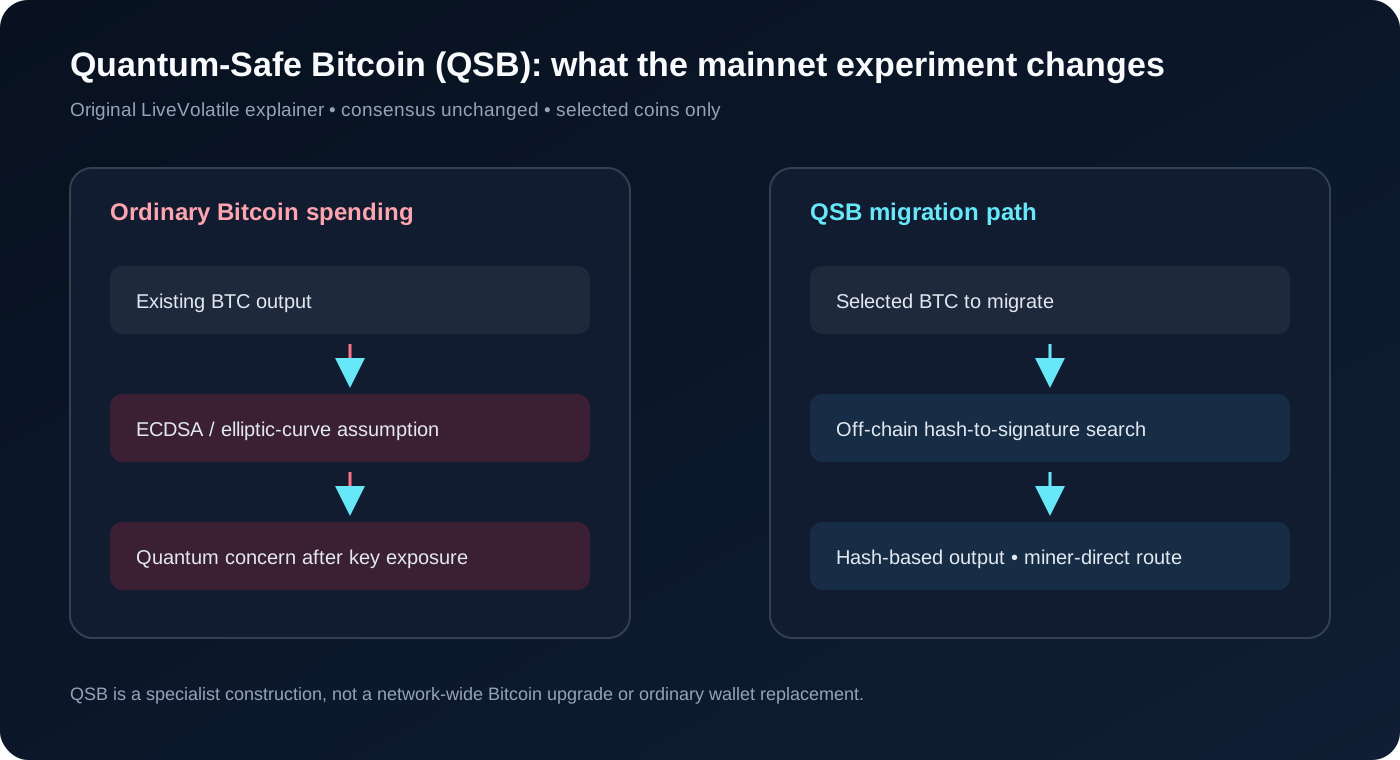
Figure 1a — Original LiveVolatile SVG explainer. Credit: LiveVolatile, based on StarkWare’s August 26, 2026 announcement and the QSB GitHub documentation.
graph LR
    A[Ordinary BTC output] --> B[Public key exposure during spend]
    B --> C[Long-term quantum concern: ECDSA assumptions]
    A --> D[QSB migration transaction]
    D --> E[Off-chain hash-to-signature search]
    E --> F[Hash-based commitments in Bitcoin Script]
    F --> G[Nonstandard transaction]
    G --> H[Miner-direct submission via Slipstream]
    H --> I[QSB-protected output]
    I --> J[Protection applies to this construction only]
Figure 1 — Original LiveVolatile explainer based on StarkWare’s August 26, 2026 announcement and the QSB GitHub documentation. It shows the conceptual migration path; it is not a claim that all BTC has migrated or that Bitcoin’s consensus rules changed.
What the experiment proves—and what it does not
It proves a construction can execute under current consensus rules
The strongest verified conclusion is narrow: QSB can produce a Bitcoin mainnet transaction that the network can validate and mine without a protocol upgrade. StarkWare describes this as a way for holders to move coins into storage that a future quantum computer cannot open using the ordinary elliptic-curve attack described in the announcement.
That is meaningful for high-value custodians because it creates an interim option before any network-wide migration proposal is adopted. It also gives developers a concrete implementation to inspect rather than a purely theoretical paper.
It does not secure all Bitcoin
StarkWare explicitly says QSB does not make Bitcoin itself quantum-safe. Coins in ordinary outputs remain governed by their existing security assumptions. A public key that has already been exposed can also be vulnerable during the period in which a transaction is broadcast and waits for confirmation.
The company continues to describe a soft fork as the better long-term answer. That means the main strategic question remains open: whether Bitcoin developers and users can coordinate a broadly supported post-quantum upgrade before quantum capability becomes an operational threat.
It does not make QSB a normal retail-wallet feature
The QSB repository documents tight constraints, including Bitcoin Script limits, large scripts, nonstandard transaction policy, and a need for miner-direct submission. The repository also describes a computational search involving roughly 2^46-scale puzzle targets and estimates cloud GPU costs of about $75–$150 for the implementation; StarkWare’s newer announcement describes the current cost as several hundred dollars. These figures should be treated as implementation estimates, not a fixed network fee or a retail quote.
For now, QSB looks more like an emergency or specialist custody tool than a drop-in replacement for a hardware wallet. Its usefulness depends on the ability to construct, verify, fund, and deliver the exact transaction safely.
Why this could matter for Bitcoin volatility
The announcement is not, by itself, a conventional BTC price catalyst. It does not change issuance, block rewards, transaction finality, or the supply of bitcoin. The initial market response should therefore be separated from the second-order effects.
Near-term volatility channel: headlines about quantum risk can produce short-lived fear, especially if traders confuse a successful experiment with a network-wide vulnerability or upgrade. Watch for sudden BTC basis changes, options skew, and correlated moves in security-sensitive infrastructure tokens—but do not infer causation from a single candle.
Medium-term volatility channel: custody providers may begin testing migration procedures. If large holders announce QSB pilots, wallet support, or address-rotation policies, the market may reprice operational and liquidity assumptions around dormant or long-held coins.
Policy channel: a Bitcoin Improvement Proposal, soft-fork discussion, or miner-relay policy change would be more consequential than this single transaction. A credible migration timetable could initially increase uncertainty, then reduce tail risk. A fragmented debate could do the opposite.
Liquidity channel: nonstandard transactions and specialist mining routes create execution risk. If demand for quantum-resistant outputs rises faster than tooling improves, the bottleneck may be transaction construction and confirmation—not Bitcoin’s base-layer capacity alone.
LiveVolatile monitoring checklist
For the next several sessions, monitor:
- Official Bitcoin developer discussions: proposals addressing post-quantum signatures, exposed public keys, or migration deadlines.
- Custodian and exchange disclosures: whether major platforms support QSB-like outputs, alternative post-quantum schemes, or planned address migration.
- Miner policy: whether additional pools accept nonstandard quantum-safe transactions and whether relay rules change.
- On-chain behavior: movement from long-dormant or exposed-key outputs into new script types, while avoiding attribution without verified labels.
- Derivatives reaction: BTC options skew, implied volatility, basis, and liquidation concentration around quantum-related headlines.
LiveVolatile readers can pair this event with the platform’s crypto market volatility monitoring and risk-management guidance. Those links are monitoring resources, not investment recommendations.
Frequently asked questions
Is Bitcoin quantum-safe now?
No. StarkWare demonstrated one quantum-resistant transaction construction. Bitcoin’s consensus rules and the security of ordinary outputs did not change.
Does QSB require a Bitcoin soft fork?
No. The published QSB method is designed to operate within existing consensus rules. StarkWare still says a soft fork is the better long-term network-wide solution.
Can ordinary Bitcoin wallets send QSB transactions?
Not as a routine feature based on the current documentation. The construction is specialized, computationally expensive, nonstandard, and may require direct miner submission.
Should this change a trader’s BTC position?
Not on the announcement alone. The immediate event is a technical demonstration, not a change to supply or market structure. Traders should watch verified follow-on actions—custody migrations, developer proposals, exchange support, and miner policy—rather than trade an exaggerated “Bitcoin is hacked” narrative.
What is the biggest unresolved risk?
Coordination. A working specialist construction helps individual holders, but protecting the wider Bitcoin economy requires tooling, safe migration paths, broad review, and eventually decisions about protocol-level support.
Conclusion
StarkWare’s mined QSB transaction is a real milestone, but its significance is easy to overstate. It demonstrates that selected bitcoin can be moved into a hash-based construction using today’s consensus rules. It does not eliminate the quantum threat, protect legacy outputs, or turn a nonstandard research implementation into a mainstream wallet standard.
For volatility analysis, the correct framing is custody migration risk. The next material signals will be implementation, policy, and coordination—not the existence of one successful transaction. Until those signals appear, the disciplined response is to monitor the evidence and avoid both complacency and panic.
Disclaimer: This article is for information and research purposes only. It is not financial, legal, security, or custody advice. Cryptocurrency markets are volatile; verify technical details independently before making decisions.
Sources and credits
- StarkWare — First quantum-safe Bitcoin transaction mined on mainnet — published August 26, 2026. Primary source for the transaction announcement, mechanism, limitations, and MARA Slipstream route.
- Avihu Levy — Quantum-Safe-Bitcoin-Transactions GitHub repository — open-source implementation and technical constraints, accessed August 27, 2026.
- Quantum-Safe Bitcoin Transactions Without Softforks paper — research background linked by the project.
- Visual credit: Figure 1 is an original LiveVolatile Mermaid explainer derived from the two sources above. No external image was used. Featured-image metadata is retained for the site’s card/social presentation; the in-body Mermaid diagram is the qualifying editorial visual.