Term Labs Governance Exploit: How a Vote Grab Drained $8.5M and What Traders Should Watch
Direct answer: Term Labs confirmed on August 23, 2026 that an attacker exploited governance controls affecting Term vaults. Security-firm tracking and the receiving wallet’s public Ethereum balance support a loss of roughly 2,843 ETH plus about 1.68 million USDC, later swapped into DAI—around $8.5 million at the time of reporting. The available evidence points to a governance vote-capture attack, not a failure of Ethereum consensus or a direct compromise of USDC.
That distinction is the key market signal. Traders should not treat this as proof that Ethereum or every DeFi lending protocol is compromised. The immediate risk is narrower but important: a protocol can have functioning smart contracts and still expose depositors to concentrated voting power, weak participation, or insufficient limits on governance-controlled vault actions.
Key takeaways
- Term Labs publicly acknowledged a governance exploit impacting Term vaults on August 23.
- PeckShield reported approximately 2,843 ETH and 1.68 million USDC drained; the USDC was swapped into roughly 1.68 million DAI.
- CryptoBriefing reported that the attacker obtained near-total voting control over multiple affected vaults before directing withdrawals.
- Etherscan showed the tracked receiving address holding approximately 2,843.2 ETH and 1.68 million DAI when checked for this report.
- The incident is distinct from a smart-contract bug that breaks Ethereum or USDC; the reported failure was in the protocol’s governance and vault-control layer.
- The next volatility catalysts are Term Labs’ technical postmortem, any pause or redesign of vault governance, fund movements, and recovery or compensation plans.
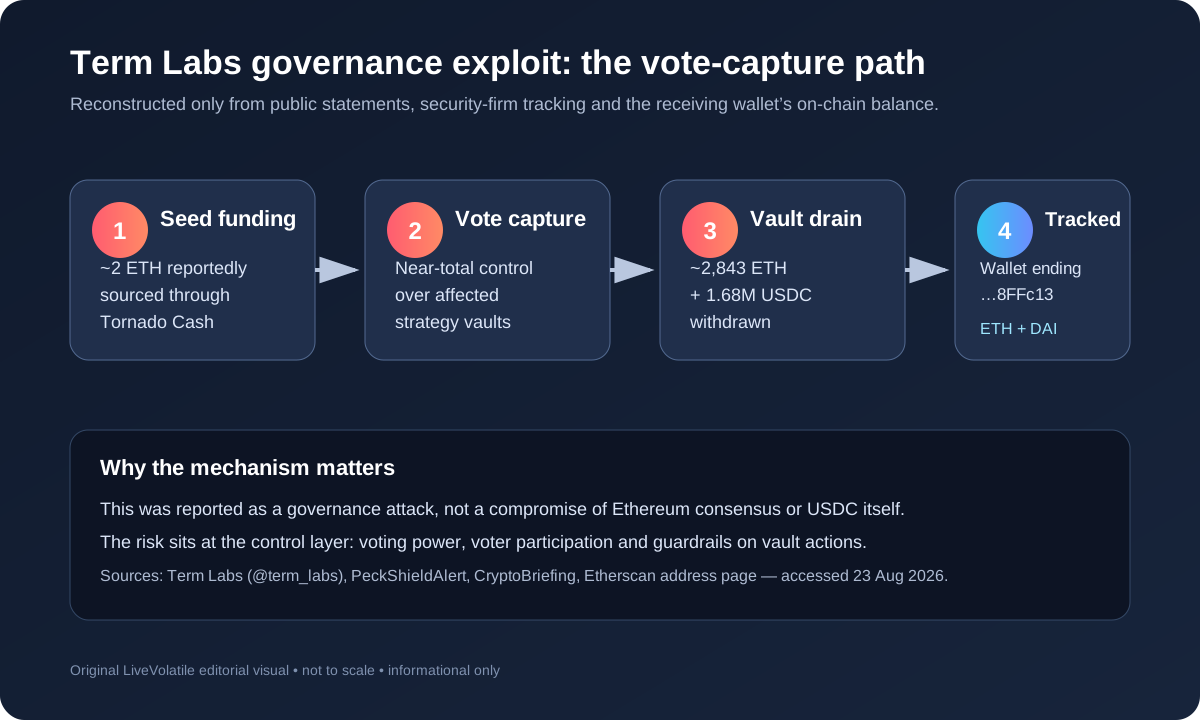
Visual credit: Original LiveVolatile editorial diagram based on Term Labs’ public acknowledgement, PeckShieldAlert’s incident tracking, CryptoBriefing’s reporting and the Etherscan address page. It is a simplified explanatory reconstruction, not a forensic claim beyond those sources.
What happened to Term Labs’ vaults?
Term Labs describes itself as a fixed-rate lending protocol. Its public X account posted that it was aware of a governance exploit impacting Term vaults and would share more detail after investigation. The statement confirmed the event but did not yet publish a technical postmortem explaining the exact permission path or contract sequence.
PeckShield’s incident update reported that the exploiter drained approximately 2,843 ETH—valued by the firm at about $6.87 million in its contemporaneous post—and 1.68 million USDC, which had already been exchanged for roughly 1.68 million DAI. CryptoBriefing separately reported a total loss of approximately $8.5 million and described the event as an attacker quietly accumulating enough voting power to control multiple strategy vaults.
The numbers are therefore best presented as an evidence-backed estimate, not a final accounting. Prices move, token balances can change, and the protocol has not yet released its own complete incident report.
How a governance attack differs from a code exploit
A conventional smart-contract exploit usually abuses a programming error—such as a reentrancy flaw, an oracle mismatch or incorrect accounting—to make a contract do something its designers did not intend. A governance attack can take a different route: it uses the protocol’s authorized decision-making machinery against the system.
The reported Term Labs sequence was:
- An attacker funded an address with a small amount of ETH, reportedly sourced through Tornado Cash.
- The attacker accumulated enough voting power to gain near-total control over affected vault decisions.
- Governance permissions were used to direct assets out of those vaults.
- The withdrawn assets were consolidated at a receiving wallet and part of the stablecoin balance was converted to DAI.
The first step is attributed to security-firm tracking and does not identify the attacker or prove a wider laundering operation. The important structural point is that the reported damage came from control over governance, not from changing Ethereum’s rules or breaking USDC’s token contract.
What the on-chain evidence shows
The tracked address, 0xD5183d8BfC65a50863C62aF2538198A8288FFc13 on Etherscan, showed approximately 2,843.2021 ETH and 1,679,642.4541 DAI when checked on August 23, 2026. Etherscan also displayed incoming transfers of roughly 2,841.237 ETH and 1 ETH from the same funding address in the relevant transaction sequence.
The explorer confirms what the wallet held at the time of inspection; it does not, by itself, prove every governance action that preceded the transfers. That is why the strongest version of the story combines three layers of evidence:
- Protocol acknowledgement: Term Labs’ public statement confirms an active governance incident.
- Independent security tracking: PeckShield reports the affected assets and swap path.
- Public ledger evidence: Etherscan shows the receiving wallet’s ETH and DAI balances and transaction history.
On-chain evidence reference: Open the Etherscan address page for the tracked wallet
Source-linked reference: Etherscan address page, publisher Etherscan, checked August 23, 2026. The page is an external explorer reference rather than a locally hosted screenshot; balances and transaction history can change after publication.
Why this can create volatility without moving Bitcoin
A roughly $8.5 million DeFi loss is meaningful for affected depositors but small relative to the total crypto market. The first market reaction can therefore be concentrated in:
- Term-related governance or lending exposures;
- ETH and stablecoin pools connected to the affected vault architecture;
- DeFi tokens with similar governance concentration or low liquidity;
- Risk premiums for fixed-rate lending and automated vault strategies.
BTC and ETH may barely move if traders interpret the event as isolated. That is not the same as “no risk.” A second-order reaction can emerge if users withdraw from comparable vaults, unwind leveraged positions, or move stablecoins across protocols. Liquidity—not the headline dollar loss alone—will determine whether the incident remains an isolated protocol event or becomes a broader DeFi de-risking episode.
Use the LiveVolatile markets monitor, liquidations dashboard and Bitcoin volatility calculator to separate broad market movement from protocol-specific stress. For this incident, the most useful checks are ETH spot volume, DeFi token breadth, stablecoin pool outflows, funding rates and any rise in forced liquidations.
The governance risk checklist for traders and depositors
The incident offers a practical checklist that is more useful than simply labeling the event a “hack.” Before using a governance-controlled vault, check:
| Risk question | Why it matters | What to monitor now |
|---|---|---|
| Can one wallet or a small bloc control votes? | Low turnout can turn nominal decentralization into effective centralization. | Vote concentration, quorum and delegation data |
| Can governance directly move pooled assets? | A vote with immediate execution has a short response window. | Timelocks, emergency pause and withdrawal limits |
| Are vault strategies isolated? | One compromised control path can affect multiple products. | Shared contracts, delegates and upgrade authorities |
| Is there an independent incident process? | Fast disclosure helps users reduce exposure. | Official updates, postmortem and remediation proposal |
| Can users exit during a governance dispute? | Illiquid exits turn technical risk into market risk. | Queue times, slippage, liquidity and utilization |
The presence of an audit does not answer all five questions. Audits can review code correctness while leaving token distribution, voter apathy, privileged execution and economic attack surfaces as live risks.
What happens next
The next decisive document is Term Labs’ technical postmortem. It should identify the affected vaults, the relevant governance contracts and functions, the vote or permission sequence, the exact loss calculation, and whether any assets remain recoverable.
Traders should also watch for four concrete developments:
- A pause or containment action. This may reduce immediate outflows but can also trap users or widen uncertainty.
- A governance redesign. Timelocks, quorum changes, delegated voting limits and withdrawal caps would show whether the protocol is addressing the control-layer failure.
- Wallet activity. New transfers, swaps or cross-chain movements can change recovery prospects and short-term liquidity conditions.
- A recovery or compensation plan. Any proposal may affect affected depositors, governance-token expectations and comparable DeFi risk premiums.
Until those details arrive, the defensible conclusion is limited: Term Labs confirmed the governance incident, independent trackers support the approximate asset flow, and the receiving wallet remains observable. Claims about the attacker’s identity, the final loss, or the possibility of recovery remain unverified.
FAQ
Was Ethereum hacked in the Term Labs incident?
No evidence reviewed for this article shows a compromise of Ethereum consensus. The reported attack targeted governance and vault controls inside the Term Labs system.
Was USDC itself exploited?
No. PeckShield reported USDC leaving the affected vaults and later being swapped for DAI. That is different from exploiting the USDC token contract.
How much did Term Labs lose?
The currently reported estimate is about $8.5 million, comprising roughly 2,843 ETH and 1.68 million USDC later swapped into DAI. The final figure may change with asset prices and additional protocol accounting.
Is the tracked wallet proven to belong to the attacker?
It is the receiving address identified in public incident tracking and linked to the reported asset movements. Wallet attribution is not the same as identifying the person or organization controlling it.
What should DeFi users do with this information?
Review exposure to Term vaults and similar governance-controlled products, read official updates, and assess exit liquidity and smart-contract permissions. This article is not a recommendation to buy, sell or withdraw any particular asset.
Conclusion
The Term Labs incident is a reminder that DeFi security is broader than code review. A protocol can preserve Ethereum’s consensus, use standard tokens and still fail at the governance layer if voting power can be concentrated and exercised against pooled assets.
For volatility traders, the event is a watchlist catalyst rather than an automatic market-wide sell signal. The key evidence is already clear enough to track—Term Labs’ acknowledgement, PeckShield’s asset-flow estimate and the receiving wallet’s public balances—but the scope, root cause and recovery path are not final until the protocol publishes its postmortem.
Risk disclaimer: This article is for informational and educational purposes only. Crypto assets and DeFi protocols are highly volatile and may lose some or all of their value. Nothing here is financial, legal or investment advice.
Sources
- Term Labs (@term_labs) public incident acknowledgement — official protocol account; post visible on August 23, 2026; accessed August 23, 2026.
- PeckShieldAlert incident update — independent security-firm tracking of the approximate ETH, USDC and DAI flows; accessed August 23, 2026.
- CryptoBriefing: Term Labs suffers $8.5M governance exploit — reporting on the governance-control mechanism and affected vaults; published August 23, 2026; accessed August 23, 2026.
- Etherscan address page — public balance and transaction evidence for the tracked receiving wallet; accessed August 23, 2026.
Image credits: Original LiveVolatile SVG diagram at /images/articles/2026-08-23-term-labs-governance-vote-capture.svg; external source-linked Etherscan reference in body; no unverified or fabricated screenshot used.
— Marcus Reynolds, Senior Crypto Volatility Analyst