Treasury Buybacks and Bitcoin Volatility: Why the $4B Signal Matters
Direct answer: The U.S. Treasury announced on August 19, 2026, that it will increase the maximum size of its long-end nominal liquidity-support buybacks from $2 billion to at least $4 billion per operation beginning September 9. The program targets older Treasury securities in the 10-to-20-year and 20-to-30-year sectors. That is a meaningful bond-market liquidity signal, but it is not quantitative easing and it does not guarantee a Bitcoin rally. The crypto-volatility channel runs through expectations: improved exit liquidity for dealers, possible repricing in long-term yields, changing risk appetite, and the leverage that can magnify both continuation and reversal.
Key takeaways
- Treasury is at least doubling the maximum size of selected long-end liquidity-support buybacks from $2 billion to at least $4 billion per operation.
- The change begins September 9 and is scheduled to remain in effect through November 4, 2026, the end of the current refunding quarter.
- Treasury buybacks are debt-management operations. They should not be described as Federal Reserve quantitative easing or as newly created bank reserves.
- The August 19 announcement coincided with a sharp crypto rally, but correlation with a headline is not proof that the buyback program alone caused every price move.
- Bitcoin traders should monitor long-term Treasury yields, the dollar, spot volume, ETF flows, open interest, funding, and liquidation data together.
- The key risk is a crowded interpretation of the announcement: if yields rise again or leverage outruns spot demand, the same market can unwind quickly.
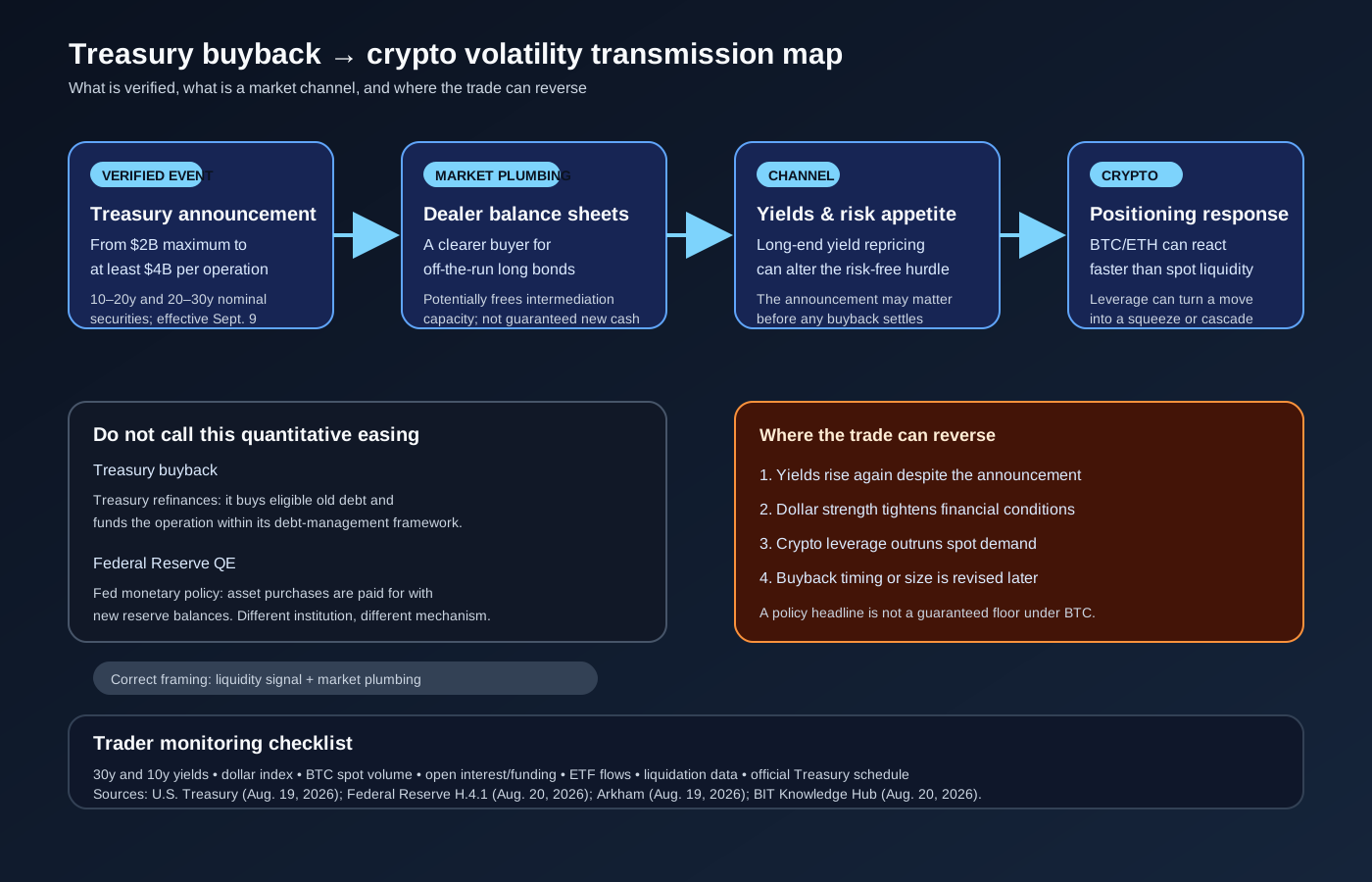
Visual credit: Original LiveVolatile editorial diagram, created from the U.S. Treasury announcement of August 19, 2026, the Federal Reserve H.4.1 release of August 20, and corroborating market-structure reporting. It explains a mechanism and is not a price forecast.
What did the U.S. Treasury actually announce?
The Treasury's official press release, dated August 19, says the department is increasing, by at least double, the size of liquidity-support buyback operations for longer-dated nominal coupon securities. The affected maturity sectors are 10 to 20 years and 20 to 30 years.
The current maximum size is $2 billion per operation. The new maximum will be at least $4 billion per operation. The change takes effect September 9 and remains in place through November 4, 2026. Treasury says the increase reflects its desire to provide greater liquidity support in longer-dated nominal sectors where it receives strong offers from market participants. It plans to release an updated tentative buyback schedule later.
This is a specific change to a standing debt-management tool, not a general promise to purchase every Treasury security. It also does not mean that $4 billion will automatically be spent in every operation. The wording sets a maximum size of at least $4 billion per operation; the eventual amount depends on the schedule, eligible securities, offers, and Treasury's execution.
Why long-end buybacks can matter to markets
Treasury buybacks target previously issued, or “off-the-run,” securities. These bonds remain high-quality government obligations, but they are generally less actively traded than the newest issue in a given maturity. When dealers hold large inventories of less-liquid securities, those positions consume balance-sheet capacity and can make it harder to intermediate new trades during stressed conditions.
A buyback gives eligible holders a more visible potential exit. That can improve the functioning of the long end of the Treasury market even before the operation occurs, because market participants price the announced backstop or liquidity facility into their decisions. The important word is potential: an announcement can change expectations, but it does not remove duration risk, fiscal risk, rate risk, or the possibility that market liquidity remains fragile.
The Treasury's press-release archive identifies this as a liquidity-support operation. It is different from cash-management buybacks, which are designed to smooth short-term swings in the government's cash position. The August 19 announcement concerns the longer-dated nominal sectors and the market's ability to trade those securities.
Treasury buybacks are not Federal Reserve QE
This distinction is essential for crypto analysis. The Treasury and Federal Reserve are separate institutions with different mandates.
Treasury manages the government's debt. A buyback exchanges selected previously issued securities for cash within the government's debt-financing framework. The operation can change the maturity composition and liquidity characteristics of government debt, but it should not automatically be presented as the creation of new central-bank reserves.
The Federal Reserve's quantitative easing programs are monetary-policy operations. When the Fed buys assets under QE, the settlement mechanics involve reserve balances in the banking system. Calling a Treasury buyback “QE” may produce a dramatic headline, but it confuses fiscal debt management with central-bank money creation.
The Federal Reserve's August 20 H.4.1 release provides the current balance-sheet and reserve data. It reported average reserve-bank credit of about $6.706 trillion for the week ended August 19 and listed repurchase agreements at approximately $1 million in the relevant table. Those figures do not turn the Treasury's buyback announcement into a Fed liquidity operation. They are separate pieces of the market-plumbing picture.
The more accurate description is: a larger Treasury liquidity-support signal may affect bond-market functioning and risk appetite, while the operation remains distinct from quantitative easing.
How the signal can transmit into Bitcoin volatility
The crypto connection is indirect, but it can still be fast. A useful framework has four stages.
1. The announcement changes expectations for dealer liquidity
If dealers believe they will have a larger potential buyer for eligible long-dated bonds, they may reassess the balance-sheet cost of holding those positions. That can influence pricing across the long end before the September 9 effective date.
This does not mean dealers must rotate into Bitcoin. It means the market's assessment of liquidity and duration risk can change. Crypto often reacts to changes in expected financial conditions faster than traditional assets because it trades continuously and carries substantial derivatives leverage.
2. Long-term yields reprice
Long-end Treasury yields matter because they influence the return investors can obtain from relatively low-risk government debt and the discount rate applied to riskier future cash flows. A fall in long-term yields can make high-beta assets look relatively more attractive. A rise can do the opposite.
On August 19, market reporting from Arkham linked the announcement with Bitcoin moving above $69,000 and Ethereum reclaiming $2,000. BIT's market-structure explainer also described the distinction between liquidity-support and cash-management buybacks and emphasized that the program is a bond-market plumbing tool rather than Fed QE.
These reports support a market-reaction narrative, not a single-cause proof. Yields, positioning, ETF flows, technical levels, short covering, and other macro headlines can all contribute to a move.
3. Risk appetite reaches crypto markets
Bitcoin is a liquid, globally traded risk asset with a large derivatives market. When the dollar weakens or long-term yields fall, some portfolios may become more willing to hold risk. The effect can be amplified when traders are already positioned for a breakout.
The reverse is also true. If yields rise, the dollar strengthens, or the market decides that the Treasury announcement was smaller or slower than expected, crypto can lose the same support. The transmission is therefore a two-way volatility channel, not a one-way bullish catalyst.
4. Leverage turns a move into a squeeze
A spot move becomes more unstable when open interest and funding rise faster than spot demand. Short covering can accelerate an upside move; crowded longs can accelerate a downside reversal. Crypto.news reported a sharp August 19 Bitcoin move and substantial short liquidations, but liquidation figures are time-sensitive and should be checked against current exchange data before being used as a live trading signal.
The practical lesson is simple: a bond-market headline can be the spark, but positioning determines how large the crypto response becomes.
What the announcement does not prove
The Treasury decision does not prove that:
- the Federal Reserve has restarted QE;
- the U.S. money supply will expand by the buyback amount;
- Bitcoin has a guaranteed floor near its post-announcement price;
- every crypto asset will benefit equally;
- the September operations will produce the same market reaction as the announcement;
- the buyback alone caused the full August 19 rally.
Avoiding these claims is not pedantry. It protects readers from confusing a liquidity-support mechanism with a policy guarantee. It also makes the volatility analysis more useful if the market later reverses.
Three volatility scenarios for Bitcoin and Ethereum
| Scenario | Confirmation to monitor | Volatility implication |
|---|---|---|
| Yield-led continuation | Long-end yields ease, dollar remains contained, spot volume confirms, and ETF flows stay constructive | Breakouts can extend, but rising open interest raises squeeze risk |
| Headline fade | Yields stabilize or reverse, spot volume weakens, and BTC fails to hold its breakout zone | The initial move can retrace as traders unwind the policy premium |
| Macro reversal | Yields and dollar rise together while leverage remains crowded | Liquidations can turn a normal pullback into a fast downside cascade |
These are conditional market maps, not forecasts. For Ethereum, traders should also check whether ETH/BTC strength confirms a broad risk-on rotation or whether capital remains concentrated in Bitcoin.
Trader checklist: what to monitor next
- 10-year and 30-year Treasury yields: Is the long-end response continuing, or did the announcement produce only a brief reaction?
- The U.S. dollar: A stronger dollar can offset some of the risk-appetite effect from lower yields.
- Spot volume: A breakout supported mainly by derivatives is more vulnerable than one confirmed by spot activity.
- Open interest and funding: Fast leverage growth can make the market fragile in either direction.
- ETF flows: Persistent flows are more informative than one strong session, especially after the headline fades.
- Liquidation concentration: A squeeze can explain a sharp move without proving that new long-term demand has arrived.
- Treasury's updated schedule: The operational details will matter more as September 9 approaches.
- The Fed's balance-sheet data: Keep Treasury debt management separate from central-bank reserve conditions.
For live context, readers can use LiveVolatile's Bitcoin volatility calculator, risk-management guide, and crypto volatility trading strategies. These tools cannot predict a policy reaction, but they can help frame range, leverage, and position-size risk.
FAQ
Is the Treasury doubling buybacks the same as QE?
No. Treasury buybacks are debt-management operations. They can improve liquidity in selected Treasury sectors and change the composition of government debt, but they are not the same as Federal Reserve asset purchases financed through new reserve balances.
Why did Bitcoin react to a bond-market announcement?
Bitcoin is sensitive to changes in liquidity expectations, yields, the dollar, and risk appetite. A bond-market repricing can therefore affect crypto positioning, especially when derivatives leverage is high.
Does the announcement guarantee that Bitcoin will keep rising?
No. The announcement may support a risk-on interpretation, but yields can reverse, the dollar can strengthen, ETF flows can weaken, and crowded leverage can create a sharp pullback.
When does the new buyback size take effect?
The Treasury says the increased size takes effect September 9, 2026, and remains in effect through November 4, 2026, the end of the current refunding quarter.
What is the most important volatility signal now?
Watch the interaction between long-end Treasury yields, the dollar, Bitcoin spot volume, derivatives positioning, ETF flows, and liquidations. A single headline is less reliable than confirmation across these markets.
Conclusion
The Treasury's decision is important because it changes the expected scale of a specific long-end liquidity-support operation. It is not important because it magically creates new money or guarantees a crypto bull market. The credible LiveVolatile angle is the transmission mechanism: a larger potential buyer for off-the-run bonds can affect dealer liquidity expectations, yields can reprice, risk appetite can shift, and crypto leverage can amplify the result.
That chain is powerful in both directions. If long-end yields ease and spot demand confirms the move, Bitcoin and Ethereum may remain sensitive to the policy signal. If yields rise again or leverage outruns demand, the same narrative can become an unwind catalyst. Treat the buyback as a market-structure variable to monitor—not as a standalone trading instruction.
Disclaimer: This article is for informational and educational purposes only. It is not investment, financial, tax, or legal advice. Crypto assets are volatile and can lose value rapidly. Verify current market data and official announcements before making decisions.
Sources
- U.S. Department of the Treasury — Increased Sizes of Nominal Long-End Liquidity Support Buybacks, August 19, 2026
- U.S. Department of the Treasury — Press Releases
- Federal Reserve — Factors Affecting Reserve Balances, H.4.1, August 20, 2026
- Arkham Research — Bitcoin Hits $69K, Ethereum Hits $2K After Treasury Announcement, August 19, 2026
- BIT Knowledge Hub — Treasury Buybacks: The Bond-Market Plumbing That Sent Bitcoin to a Two-Month High, August 20, 2026
- crypto.news — The Treasury Buyback Trade, August 20, 2026