BitBox Firmware Vulnerability Update: What Dixence 9.26.5 Means for Bitcoin Wallet Risk
Short answer: BitBox says its Dixence release fixes two severe firmware vulnerabilities and addresses the context around a previously fixed bootloader issue. The company reports no stolen funds and no evidence that the disclosed issues were exploited. BitBox users should update through the official BitBoxApp, but traders should not treat the announcement as proof of an active BitBox breach.
What happened with the BitBox firmware update?
Swiss hardware-wallet maker BitBox published its Dixence security update on August 17, 2026. The company said internal audits, including testing with frontier AI models, identified two severe issues in its firmware. It also disclosed that an exploit path related to an already-fixed bootloader vulnerability was more serious than previously reported.
The corresponding signed firmware release v9.26.5 lists security improvements and was released on August 17. BitBox says all devices on firmware 9.26.5 and later are not affected by the scenarios described in its disclosure.
That distinction matters. This is a patched vulnerability disclosure, not a report that attackers drained BitBox wallets. BitBox specifically says it has no reports of stolen user funds and no reason to believe the issues were exploited.
The three security scenarios traders should understand
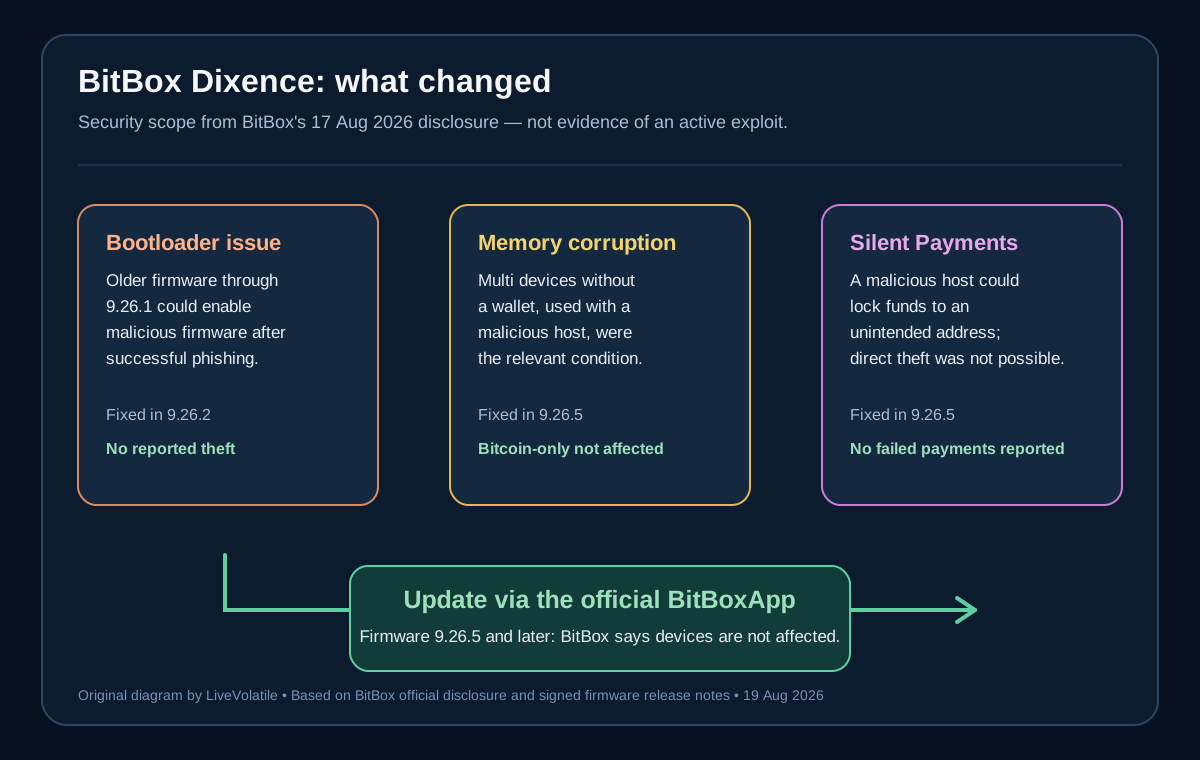
Original LiveVolatile diagram. It summarizes BitBox's official disclosure; no third-party image is used. Source and technical details: BitBox Dixence update and firmware release notes.
1. Bootloader manipulation required a high-friction attack chain
BitBox said an exploit of a bootloader vulnerability already fixed in firmware 9.26.2 could potentially manipulate a user into installing malicious firmware on an authentic BitBox02. The described path required substantial technical ability and a successful phishing operation—for example, directing a user to a fake BitBoxApp and persuading them to unlock the device.
The relevant scope was older firmware through 9.26.1. BitBox says the BitBox02 Nova was not affected by this specific age-related bootloader scenario, and that it has no reports of exploitation or stolen funds.
The practical lesson is not that hardware wallets are useless. It is that the security boundary includes the update channel, the host computer, the download source, and the user's response to urgent-looking messages.
2. A memory issue affected an uninitialized Multi device with a malicious host
The first newly disclosed severe issue involved memory corruption. BitBox says it applied to the Multi edition when the device had not yet been set up with a wallet and was used with a malicious host device. Under those conditions, exploitation could enable arbitrary code execution and potentially malicious firmware installation.
The Bitcoin-only edition was not affected because its firmware does not contain the relevant code, according to BitBox. The issue is fixed in firmware 9.26.5. The narrower condition is important: a headline saying “all BitBox wallets at risk” would overstate what the primary source supports.
3. A Silent Payments issue could lock funds, rather than directly steal them
BitBox also disclosed a potentially severe issue in its Silent Payments implementation. The company says a malicious host could have caused funds to be sent to an unintended payment address. It describes the result as a potential lock-up or ransom scenario, not direct theft, because cooperation between an attacker and recipient would be needed to recover the coins.
BitBox says the issue affected BitBox02 and BitBox02 Nova devices on firmware versions 9.21.0 through 9.26.4 when a user created a transaction to a Silent Payments address with a malicious host. It says the issue is fixed in 9.26.5 and that it has no reports of failed Silent Payments or exploitation.
Who should update, and how?
BitBox recommends that all users update to the latest firmware. The safest route is to open the BitBoxApp already installed on the device, use its update banner or device-management flow, and confirm that downloads come from the official BitBox ecosystem. BitBox warns that security announcements can also be used for phishing and says it will never ask users for recovery words.
| Firmware or condition | BitBox's stated risk | Mitigation |
|---|---|---|
| Through 9.26.1, malicious-app and manipulated-firmware scenario | Potential malicious firmware installation after phishing and device unlock | Fixed by the 9.26.2 bootloader update; update further to 9.26.5+ |
| Multi edition through 9.26.4, no wallet set up, malicious host | Memory corruption and possible code execution | Firmware 9.26.5+ |
| BitBox02/02 Nova 9.21.0–9.26.4, Silent Payments with malicious host | Funds could be locked to an unintended address | Firmware 9.26.5+ |
| 9.26.5 and later | Not affected by the scenarios in the disclosure | Keep firmware and app current |
Why a patched wallet issue can still affect crypto volatility
The immediate market impact of this disclosure may be limited because BitBox reports no theft. The second-order impact is more relevant to a volatility-focused reader.
First, security disclosures can change the perceived risk of self-custody even when the fix arrives before a known loss. Holders may delay transfers, move coins to exchanges, rotate devices, or seek additional verification. Those actions can create short-lived changes in exchange balances and on-chain flows without representing a durable change in Bitcoin demand.
Second, the event highlights operational risk rather than protocol risk. Bitcoin's base network was not shown to be compromised. The possible failure points were firmware, the host device, phishing, and transaction construction. Traders who treat all security headlines as equivalent may overprice a wallet disclosure as a Bitcoin-network event—or underprice it as irrelevant to liquidity.
Third, AI-assisted auditing is becoming part of the security cycle. Faster discovery can improve the chance that bugs are patched before exploitation, but it also means users need to respond to updates more consistently. A rapid patch cadence can produce temporary uncertainty around version support, exchange maintenance, and user transfers.
LiveVolatile monitoring checklist
- Track official BitBox and firmware release notes rather than social-media summaries.
- Watch for exchange notices involving BitBox-related deposits or withdrawals; do not infer restrictions without a notice.
- Separate wallet-provider risk from Bitcoin-network risk when assessing a headline.
- Monitor unusual BTC exchange inflows or outflows only as context, not as proof that BitBox users are selling.
- Treat any request for recovery words as a phishing attempt.
- Use LiveVolatile's crypto volatility guide and Bitcoin volatility tools for risk planning, not price certainty.
FAQ
Was BitBox hacked?
BitBox disclosed severe vulnerabilities and a previously fixed bootloader exploit path, but it says there are no reports of stolen user funds and no reason to believe the issues were exploited.
What is BitBox firmware 9.26.5?
It is the Dixence security release for BitBox devices. BitBox's release notes list security improvements and bug fixes, while its disclosure says 9.26.5 fixes the newly described memory and Silent Payments issues.
Does the disclosure affect Bitcoin's network?
No evidence in the cited primary sources indicates a Bitcoin protocol failure. The described conditions concern hardware-wallet firmware, malicious hosts, phishing, and transaction handling.
Can users update through a link in an email?
The safer approach is to update through the BitBoxApp already installed on the device or navigate directly to the official BitBox website. Never enter recovery words into a website or application because of an unsolicited message.
Does a patched vulnerability guarantee that self-custody is risk-free?
No. It reduces the specific disclosed risks, but self-custody still depends on device integrity, update hygiene, host security, backups, phishing resistance, and careful transaction verification.
Conclusion
BitBox's Dixence disclosure is a useful security warning, not a reason to claim that Bitcoin wallets were broadly drained. The strongest supported takeaway is operational: update to firmware 9.26.5 or later through the official app, verify the update path, and keep the scope of the disclosure precise. For markets, the event is a reminder that crypto volatility can come from custody and transaction infrastructure as well as from price, leverage, and macro news.
Disclaimer: This article is for information only and is not investment, cybersecurity, or custody advice. Verify device-specific guidance with BitBox and consult qualified professionals before moving funds.
Sources
- BitBox: 08.2026 Dixence update, published August 17, 2026; accessed August 19, 2026.
- BitBoxSwiss firmware releases: v9.26.5, released August 17, 2026; accessed August 19, 2026.
— Marcus Reynolds, Senior Crypto Volatility Analyst