LND Channel-Close Reorg Risk: Why Operators Below v0.21 Should Check Their Nodes
Direct answer: A disclosed bug in LND could, in a reproduced worst-case scenario, put an entire Lightning channel balance at risk after a cooperative close, a one-block Bitcoin reorganization and publication of an old revoked commitment transaction. The disclosure says no affected users were known. The important version clarification is that LND’s official reorganization-safe close logic is associated with v0.21.0, not the v0.20.0 cutoff stated in the original August 13 disclosure. Operators on standard releases below v0.21.0 should upgrade or confirm an independent patch before treating the issue as resolved.
Key takeaways
- The issue is specific to LND’s handling of collaboratively closed channels; the sources do not say that other Lightning implementations share the same flaw.
- The attack requires several conditions: a malicious channel peer, a cooperative close, a one-block reorg and an old revoked commitment state.
- The maximum-loss case is a conditional security scenario, not evidence that the flaw was exploited in the wild.
- LND v0.21 changed close handling so channels wait for multiple confirmations—between three and six depending on capacity—before being finalized.
- Traders should not read this as a direct BTC price signal. The nearer market risk is operational: node downtime, channel liquidity stress, routing disruption or loss of confidence if operators fail to patch.
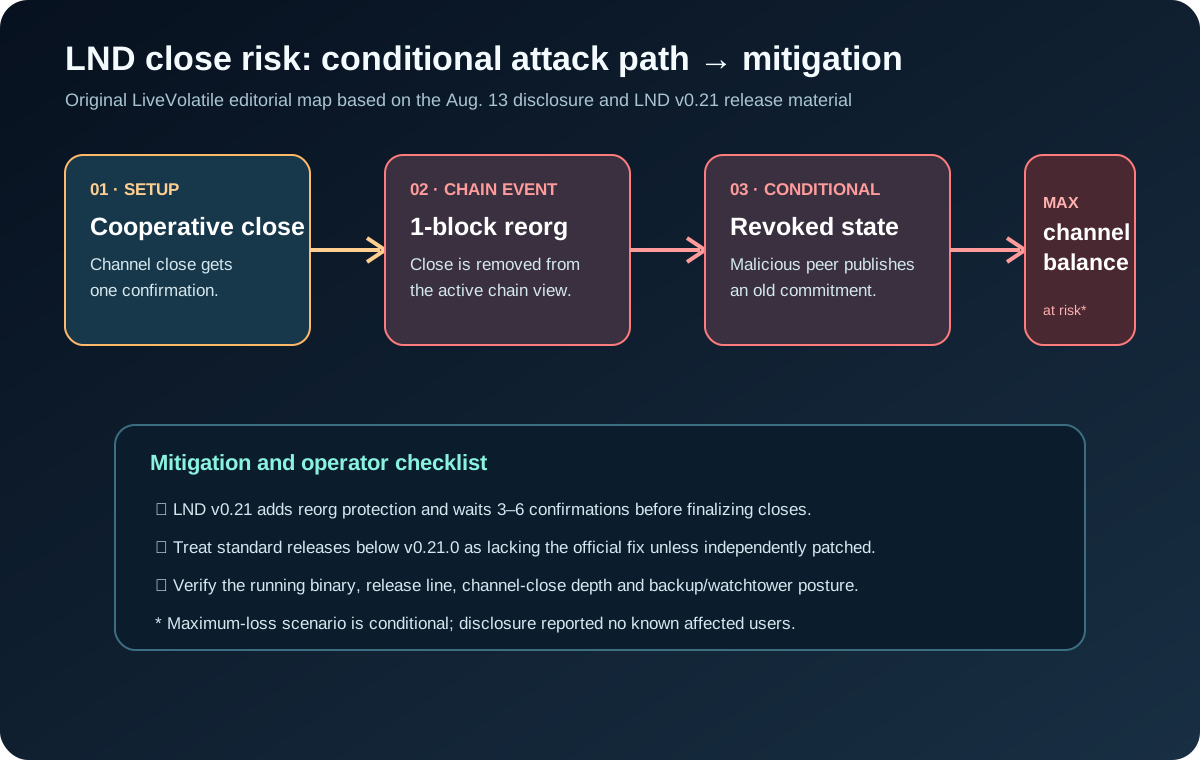
Visual credit: Original LiveVolatile editorial SVG, created August 26, 2026 from the Delving Bitcoin disclosure, LND v0.21 release notes, and Lightning Labs’ v0.21 announcement. The diagram describes a conditional scenario, not a reported exploit.
What happened in LND’s channel-close flow?
In a cooperative Lightning close, both channel participants agree on a transaction that settles their balances on Bitcoin. Before the fix, LND could treat that close as final after the first on-chain confirmation and forget the channel state needed to respond safely if the chain reorganized.
A Bitcoin reorganization replaces a recent chain tip with an alternative valid history. Most short reorgs resolve without user impact, but applications that finalize state too early can act on a transaction that disappears from their view. In the disclosed LND scenario, a malicious peer could use that window to publish an earlier, revoked commitment transaction—an old balance state that should normally trigger a penalty transaction.
If LND had already discarded the relevant close state, it could fail to publish the penalty transaction. The reproduced maximum-loss condition could reach the channel’s full balance. That is the upper bound of the described scenario, not a claim that every outdated node—or every channel—would lose funds.
The disclosure by Bastien Teinturier on August 13 says the issue was found during testing in February 2025 and that no one was known to have been affected. Bitcoin Optech’s summary also describes the vulnerability as fixed in February 2026 and says no affected users were known.
The version confusion: v0.20.0 or v0.21.0?
The version detail matters for operators making a patch decision. The public disclosure said the fix was included in LND v0.20.0. Subsequent repository history and the project’s v0.21 release material place the official reorganization-safe close logic in the v0.21 line. CryptoSlate reported on August 26 that a backport to the 0.20.x branch was later reverted and that standard releases below v0.21.0 should therefore be treated as lacking the official fix unless independently patched.
The evidence chain is:
| Evidence | What it supports | Practical meaning |
|---|---|---|
| Delving Bitcoin disclosure | The bug mechanism, reproduction and original v0.20.0 statement | Establishes the conditional attack path |
| LND PR #10331 | Reorganization-aware close state machine and confirmation logic | Shows the engineering change behind the mitigation |
| LND v0.21 release notes | Close protection requiring 3–6 confirmations | Places the official release-line mitigation in v0.21 |
| Lightning Labs v0.21 announcement | Production release context and safer close explanation | Confirms the operator-facing behavior |
| CryptoSlate, Aug. 26 | Clarification of the cutoff and reverted backport | Secondary reporting; verify against upstream material |
Operators should not rely on a version number copied from a social post. Check the binary actually running, its release notes, package source and whether a distributor has applied a documented backport.
How LND v0.21 changes the risk
LND v0.21 adds reorganization protection for channel closes. The release notes say closes require between three and six confirmations, scaled with channel capacity up to the standard non-wumbo maximum; wumbo channels require six confirmations. Lightning Labs explains the purpose plainly: the close remains in tracked state until it is buried deeply enough that a normal chain reorganization is unlikely to undo it.
The release also restores an early CLOSED_CHANNEL notification when the cooperative close spend first appears, while the final state is protected by the deeper confirmation requirement. That distinction matters for tooling: an application may learn that a close has appeared before LND considers it final for reorg safety.
This is a security hardening measure, not a guarantee against every failure. A deep Bitcoin reorganization, an unrelated implementation bug, compromised credentials or poor backup practice would be separate risks.
What Lightning node operators should check now
1. Confirm the running version
Inspect the version of the LND process that holds or routes funds—not merely the version of a downloaded archive. If it is a standard release below v0.21.0, assume the official fix is absent unless the operator or distributor can document an independent patch.
2. Review close and confirmation behavior
Confirm that cooperative closes are not being treated as final after only one confirmation. Monitoring and accounting systems should distinguish an observed close from a reorg-safe final close.
3. Check channel liquidity and routing dependencies
A node restart, channel force-close or temporary routing outage can change local liquidity even if no funds are stolen. Operators should identify important channels, counterparties and services that depend on the node remaining online.
4. Keep backups and watchtower coverage current
The disclosed issue is not a substitute for normal Lightning operational security. Encrypted channel backups, tested recovery procedures and appropriate watchtower coverage can limit the damage from other failure modes. Never upload seed phrases or macaroon credentials to a supposed emergency patching service.
5. Monitor Bitcoin chain behavior without overreacting
A one-block reorg is part of the scenario, but a reported reorg alone does not prove an attack. Operators should verify chain state, node logs and channel status through trusted infrastructure before closing channels or moving funds in response to an unverified alert.
LiveVolatile readers can use the crypto volatility dashboard, review the spot-versus-futures risk framework, and consult the risk-management guide. These links provide market-risk context; they are not a substitute for node-security procedures.
What does this mean for BTC volatility?
The disclosure is not a standalone bearish Bitcoin catalyst. The issue affects a specific Lightning implementation and requires an unusual chain-and-peer sequence. If operators patch promptly and no exploitation emerges, the most likely market effect is limited to infrastructure discussions rather than broad BTC repricing.
The volatility channel becomes more meaningful if credible evidence shows affected nodes were exploited, major routing providers are offline, or exchanges and payment services pause Lightning operations. Those would be observable operational signals. A headline saying “full channel wipeout” without the conditions would be incomplete and potentially misleading.
The disciplined takeaway is to separate maximum technical exposure from realized market impact. The former explains why patching matters; the latter requires evidence of affected funds, service disruption or sustained liquidity changes.
FAQ
Is the LND vulnerability actively being exploited?
The cited disclosure and follow-up reporting say no affected users were known. That does not remove the need to patch, but it means publication of the bug should not be presented as proof of an active exploit.
Which LND version contains the official fix?
The upstream v0.21 release material associates the reorganization-safe close logic with LND v0.21.0. Standard releases below v0.21.0 should be treated as potentially unpatched unless an independently verified backport is installed.
Can the bug drain every Lightning channel?
No. The described maximum-loss outcome depends on a malicious peer, a cooperative close, a one-block reorganization and a revoked commitment transaction. The sources describe a conditional scenario, not universal exposure.
Does this make Bitcoin unsafe?
No broad conclusion about Bitcoin consensus follows from this LND implementation issue. It highlights the importance of confirmation handling and operational security in Lightning software.
Should traders sell BTC because of the disclosure?
The disclosure alone is not a reliable directional trading signal. Watch for verified exploitation, service pauses, routing disruption and measurable liquidity changes rather than trading a decontextualized headline.
Conclusion
The LND channel-close disclosure deserves prompt operator attention because its reproduced worst-case outcome is severe, even though the attack conditions are narrow and no affected users were known. The key editorial and operational correction is the version cutoff: the official reorganization-safe close handling belongs to LND v0.21.0, so standard releases below that line require an upgrade or documented independent patch.
For markets, the important distinction is between a conditional infrastructure vulnerability and realized Bitcoin stress. Node versions, close-finality behavior, routing availability and verified incident evidence are the signals worth monitoring. The headline alone is not.
This article is for informational purposes only and is not investment, legal, security or operational advice. Crypto assets and Lightning channels carry significant risk. Verify software releases, node state and transaction instructions independently before taking action.
Sources and credits
- Delving Bitcoin: Disclosure—LND doesn’t wait for enough confirmations when closing channels, Bastien Teinturier, August 13, 2026; primary source for the disclosure, reproduction, timeline and reported lack of known impact.
- LND pull request #10331, merged January 16, 2026; upstream engineering record for reorg-aware close handling.
- LND v0.21.0 release notes; primary source for the 3–6 confirmation behavior and close-event handling.
- Lightning Labs: Announcing LND v0.21, June 11, 2026; project explanation of safer closes and release context.
- Bitcoin Optech Newsletter #419, August 21, 2026; reputable secondary technical summary.
- CryptoSlate: Old Lightning nodes may be exposed to a full-channel wipeout after LND fix lands later than disclosed, August 26, 2026; secondary clarification of the v0.21.0 cutoff.
- Inline visual: Original LiveVolatile editorial SVG, created August 26, 2026 from the verified sources above; no third-party image reproduced.
— LiveVolatile Research Desk