Core Lightning Security Warning: What the AI-Found Vulnerabilities Mean for Bitcoin Volatility
Direct answer: Core Lightning maintainers confirmed on August 26 that several vulnerabilities identified through AI-generated reports were real and advised operators to upgrade to signed emergency binaries when available. Operators who cannot upgrade should restart their node with --offline, which stops peer connections while keeping the software running. The technical details remain under a two-week embargo, and the public evidence does not establish that funds have been exploited. For Bitcoin markets, this is first an infrastructure and liquidity-risk story—not proof of a system-wide BTC failure or an automatic sell signal.
Key takeaways
- Core Lightning (CLN) is a major Bitcoin Lightning implementation maintained by Blockstream with open-source contributors.
- The project’s official account said multiple AI-generated CVE reports were valid and that a coordinated fix was underway.
- CLN’s clarified operator guidance is not to power the machine down: upgrade with signed binaries when released, or use
--offlineas the interim alternative. - In offline mode, the node stops communicating with Lightning peers, so it cannot route payments, but it remains available to watch the Bitcoin chain.
- The vulnerability details, affected components and exploitation status are not public as of this publication.
- The market risk would become more material if verified exploitation, large routing outages, service pauses or measurable channel-liquidity stress appeared.
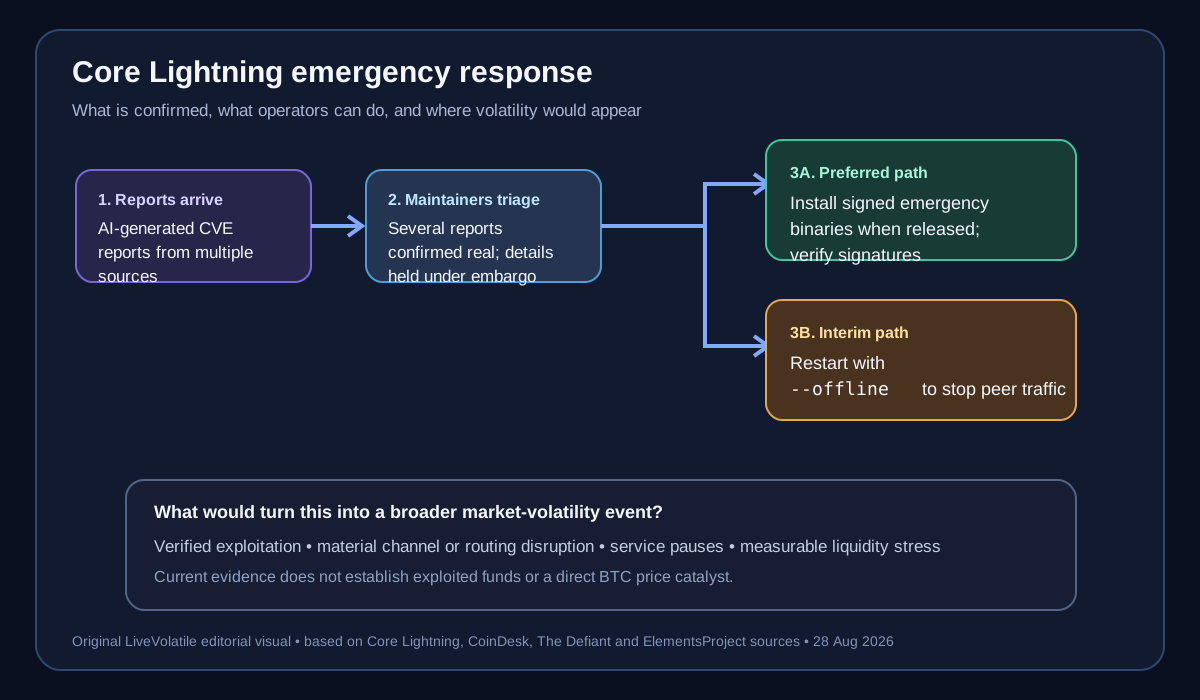
Visual credit: Original LiveVolatile editorial SVG, created August 28, 2026 from the Core Lightning official account, ElementsProject/lightning repository, CoinDesk reporting, and The Defiant’s report. It illustrates confirmed response guidance and conditional market pathways; it does not depict an exploit.
What Core Lightning confirmed
The warning followed a period in which CLN maintainers said they had received a high volume of AI-generated vulnerability reports from multiple sources. In posts on August 26 and 27, the project said several reports were real, that a coordinated fix was underway, and that operators should upgrade promptly when the signed release arrived.
The project has not publicly described the vulnerabilities’ mechanics. That restraint is deliberate: the details are being held for roughly two weeks while maintainers prepare fixes and give node operators time to update before attackers can study the changes. The absence of technical detail means readers should not infer a specific exploit class, loss amount or affected version from secondary headlines alone.
The evidence currently supports four separate claims:
| Confirmed | Not established by the public evidence |
|---|---|
| Multiple AI-generated reports were triaged by CLN maintainers | The exact vulnerabilities or CVE numbers |
| Several reports were judged real | That an attacker has exploited the flaws |
| Signed emergency binaries were planned as the preferred remediation | The amount of funds exposed or lost |
--offline was offered as an interim operator action | That every Lightning implementation is affected |
This distinction matters because security warnings can move faster than the facts needed to interpret them. A serious warning deserves prompt action from affected operators, but it should not be rewritten as a confirmed theft or a Bitcoin base-layer failure.
Why the --offline instruction matters
A Lightning node is not simply a payment endpoint. It also tracks channel state and watches the Bitcoin blockchain. That monitoring role is important because a channel counterparty can broadcast an outdated state, and a node may need to react on-chain within the relevant dispute window.
A full shutdown removes that monitoring process. By contrast, CLN’s --offline mode stops the node from communicating with Lightning peers while leaving the software running. The trade-off is operational rather than magical:
- No new Lightning payments can be routed through the node.
- The node is not available as a peer for normal Lightning traffic.
- The process can continue observing the Bitcoin chain through its Bitcoin backend.
- The operator preserves a path to upgrade and resume service once a trusted fix is installed.
The official CLN clarification on August 27 emphasized that operators do not need to shut the node down. The recommended sequence is to install the signed emergency build once released and verify its signatures. The offline setting is the alternative for operators who will not upgrade immediately.
Operators should rely on the project’s release channels, verify signatures independently and avoid links or binaries circulated only through anonymous posts. A security emergency is exactly when social engineering and fake patches become more plausible.
Timeline of the warning
| Date | Event | Why it matters |
|---|---|---|
| Early-to-mid August 2026 | CLN says it received AI-generated vulnerability reports from multiple sources | Establishes the discovery and triage phase |
| August 13 | CLN publicly described the report volume and ongoing validation | Shows the issue was not a one-hour rumor |
| August 26 | The project issued operator guidance and said several reports were real | Creates an immediate remediation window |
| August 26–27 | Third-party reporting amplified the warning; details and binaries were still limited in public sources | Increases information risk and confusion around wording |
| Approximately two weeks after disclosure | Technical details are expected to be released after the embargo | This is the next major information-risk point |
| Late September | CLN’s regularly scheduled 26.09 release remained planned, according to reporting | Separates the emergency fix from the normal release cycle |
The timeline also explains why coverage should be precise. The first social-media amplification used more urgent language than the CLN wording. The project later clarified that the intended instruction was upgrade or run offline—not simply turn off the machine.
The AI angle is bigger than one patch
AI-assisted vulnerability discovery changes the defensive timetable for open-source infrastructure. Traditional disclosure processes often assume that a researcher can report a bug, a maintainer can reproduce it, a patch can be reviewed and users can update before broad public knowledge creates pressure. Automated code analysis can compress the discovery part of that cycle.
That does not mean every AI-generated report is correct. It means maintainers must triage more findings, more quickly, while attackers may have access to similar tools. In this case, CLN said several reports were real, which turns an abstract debate about AI security into an operational deadline for a live payment network.
The prudent conclusion is narrower than “AI broke Lightning.” The confirmed event shows that small, specialized teams are now managing a faster stream of security findings. The resilience question is whether signed releases, reproducible builds, clear emergency communications and sufficiently rapid operator upgrades can keep pace.
A useful follow-up test is measurable: after the embargo and patch cycle, readers should check whether CLN publishes technical details, whether affected versions are named, how quickly signed binaries reached operators, and whether any exploited funds or service disruptions were confirmed. Those facts will be more informative than speculation during the embargo.
What operators should verify now
This is an information article, not a substitute for the project’s release instructions. For an operator running CLN, the practical checklist is:
- Identify the implementation and version actually handling funds. Do not assume a distribution package or dashboard is current because the host operating system is patched.
- Monitor the official CLN release page and account. Prefer signed binaries and verify the project’s signature instructions before installation.
- Use the documented
--offlinefallback if an upgrade cannot be completed promptly. Understand that routing and peer connectivity will stop. - Keep the Bitcoin backend and node monitoring healthy. Offline Lightning mode is not permission to ignore chain synchronization, logs or alerts.
- Treat unsolicited emergency links as hostile until verified. Never provide seed phrases, macaroon credentials or wallet backups to a patching service.
- Record channel liquidity and service dependencies. An offline node can create routing and settlement friction even if no funds are lost.
LiveVolatile readers can monitor the crypto volatility dashboard, review the spot-versus-futures risk framework, and use the risk-management guide for market context. These links do not replace node-security procedures.
What could make this a Bitcoin volatility event?
The warning alone is not a clean BTC directional signal. Bitcoin’s base layer and the Lightning software layer are related but not identical. A vulnerability in CLN does not imply a consensus failure, a Bitcoin cryptographic break or universal exposure across Lightning implementations.
The more relevant transmission channels are operational:
- Node availability: A large number of operators moving offline could reduce routing capacity.
- Payment-service continuity: Businesses or wallets using CLN could pause Lightning deposits, withdrawals or payments.
- Channel liquidity: Operators could rebalance, close channels or withdraw capital, creating temporary liquidity changes.
- Counterparty confidence: Traders may discount Lightning-dependent businesses or infrastructure providers if the response is slow.
- Confirmed exploitation: Evidence of stolen funds would materially change the risk assessment.
The dashboard signals to watch are therefore not just the BTC price. Track credible reports of affected nodes, payment-service notices, Lightning channel count and capacity, exchange or wallet status pages, and any signed CLN emergency release. If those indicators remain stable and no exploited funds are reported, the event may remain a contained software-maintenance issue despite its severe potential consequences.
The current evidence supports a conditional stress scenario, not a forecast of a market crash. Do not turn the maximum technical impact of an undisclosed vulnerability into a realized-loss statistic.
FAQ
Is Core Lightning being actively exploited?
No active exploitation has been established by the public sources reviewed for this article. CLN confirmed that several reported vulnerabilities were real, but the technical details and exploitation status remained undisclosed at publication.
Should I shut down my Core Lightning node?
The project clarified that operators do not need to shut the machine down. Its guidance is to upgrade to signed emergency binaries when available. If an operator cannot upgrade promptly, CLN said to restart with --offline so peer connections stop while the process can continue watching the Bitcoin chain.
Does --offline keep Lightning payments working?
No. Offline mode stops peer connections, so the node cannot send, receive or route normal Lightning payments. It is an interim risk-reduction setting, not a functioning payment mode.
Are all Lightning nodes affected?
The evidence reviewed identifies Core Lightning as the subject of the warning. It does not establish that LND, Eclair, or every other Lightning implementation shares the same vulnerabilities.
Does this mean Bitcoin is unsafe?
No broad conclusion about Bitcoin’s base-layer consensus follows from this warning. It highlights operational risk in one Lightning implementation and the importance of prompt, verifiable software updates.
Should traders sell BTC because of the warning?
The warning by itself is not a reliable trading signal. Watch for verified exploitation, material Lightning-service disruption, sustained liquidity changes or other evidence that the issue is transmitting into broader market structure.
Conclusion
Core Lightning’s warning is significant because it combines three facts: multiple AI-generated reports were judged real, the technical details are temporarily withheld, and operators face an immediate choice between a signed emergency upgrade and the --offline fallback. That is a genuine operational deadline, but it is not evidence of a confirmed theft or a Bitcoin protocol failure.
For volatility analysis, separate potential exposure from observed impact. The next high-signal events are the signed release, the technical disclosure after the embargo, any confirmed incident reports and measurable changes in Lightning routing or payment-service availability. Until those arrive, the disciplined position is heightened infrastructure vigilance—not headline-driven BTC positioning.
This article is for informational purposes only and is not investment, security, operational, legal or tax advice. Crypto assets and Lightning channels carry significant risk. Verify software releases, signatures, node state and transaction instructions independently before taking action.
Sources and credits
- Core Lightning official account on X, August 26–27, 2026; primary source for the report triage and operator guidance.
- ElementsProject/lightning repository; primary project repository and release channel.
- CoinDesk: AI bug reports trigger emergency warning for Bitcoin Lightning node operators, August 27, 2026; reputable secondary reporting on the warning, embargo and operational mechanics.
- The Defiant: Core Lightning tells node operators to go offline, with no patch published, August 26, 2026; secondary reporting on the initial wording, release status and market context.
- TFTC: Core Lightning critical vulnerabilities and AI CVEs, August 27, 2026; secondary analysis and source roundup.
- Inline visual: Original LiveVolatile editorial SVG, created August 28, 2026 from the verified sources above; no third-party image reproduced.
— LiveVolatile Research Desk