Revolut EURR Launch: Why Euro Stablecoin Distribution Could Change Liquidity Risk
Revolut has begun a phased rollout of EURR, a euro-denominated stablecoin, to eligible customers in Denmark, Poland and Portugal. The token is designed to hold a value of €1.00, is issued by Bridge Building S.A. — a Stripe company — and is launching on Ethereum.
Direct answer: The important market-structure change is not a new ticker by itself. Revolut is putting a euro-denominated on-chain asset inside a large consumer-finance distribution channel. That could improve access to euro liquidity over time, but the August rollout is limited, and the announcement does not establish EURR’s eventual supply, secondary-market depth, adoption or price stability under stress.
This is market journalism and education, not financial advice.
What Revolut announced
Revolut’s announcement, dated August 8, 2026, says EURR will be tested with eligible customers in the three initial markets during August. The company says EURR will be integrated into its retail app and can provide a route between fiat, crypto, external wallets and supported networks. The rollout begins on Ethereum, while wider availability across the European Economic Area is expected later in 2026, subject to regulatory and operational readiness.
Revolut says it serves more than 75 million customers across more than 40 markets. That is the distribution backdrop, not a claim that all of those customers will receive EURR at launch or that they will use it.
The issuance and regulatory details
The official announcement describes EURR as a euro-pegged e-money token issued by Bridge Building S.A., identified by Revolut as a MiCA crypto-asset service provider and electronic-money institution regulated by Luxembourg’s CSSF. Revolut Digital Assets Europe Ltd is identified as the offering entity and a MiCA crypto-asset service provider regulated by CySEC.
Those statements describe the entities and regulatory framing supplied by Revolut. They do not remove ordinary stablecoin risks. Users still need to read the token’s whitepaper, redemption terms and risk disclosures before treating EURR as cash-equivalent in every operational situation.
Why distribution can matter more than the launch headline
Euro stablecoins have historically had less visibility and liquidity than the largest dollar-denominated tokens. A consumer app can change the distribution side of that equation by making a euro-denominated token available where users already manage money and crypto.
But distribution is not the same as market depth. A token can be easy to access inside an app while still having thin external order books, limited venues, or concentrated holders. The volatility question is therefore whether EURR develops a two-sided ecosystem: users who acquire it, counterparties who accept it, market makers who quote it, and a redemption process that works when demand is one-sided.
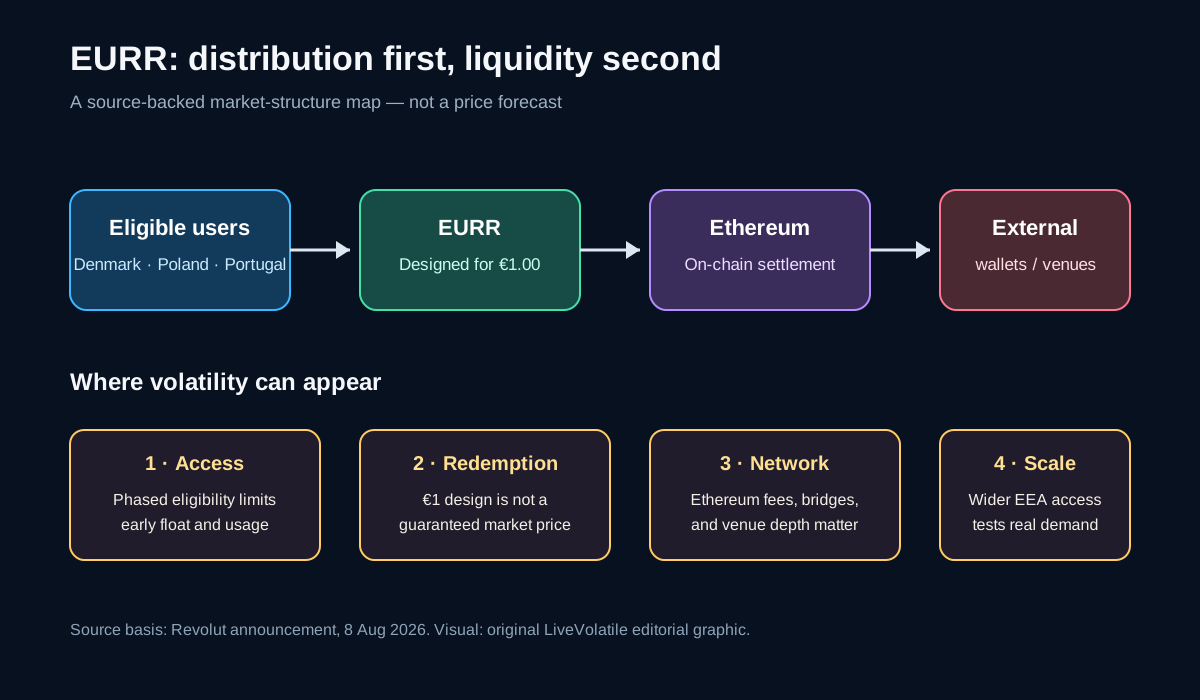
Figure 1. Original LiveVolatile editorial diagram based on Revolut’s August 8 announcement. It maps possible liquidity checkpoints; it is not a price chart and does not predict a depeg.
Four volatility checkpoints to monitor
| Checkpoint | What is verified now | What traders should still monitor |
|---|---|---|
| Initial access | Rollout begins with eligible customers in Denmark, Poland and Portugal. | Eligibility, onboarding pace and whether usage expands beyond a small test group. |
| Redemption | EURR is designed to hold €1.00 and Revolut points users to redemption rights and risks. | Actual redemption mechanics, processing conditions and behavior during heavy outflows. |
| On-chain transfer | The initial launch is on Ethereum and is intended to support on-chain movement. | Network fees, contract details, transfer availability and the depth of external liquidity. |
| Wider rollout | Revolut expects broader EEA availability later in 2026, subject to readiness. | Whether expansion creates diversified demand or simply concentrates risk in one distribution channel. |
The final column is a monitoring framework, not a report of completed events. Revolut’s announcement does not provide a forecast for EURR supply, trading volume or market share.
What EURR could change for traders
1. Less automatic dollar exposure for euro users
A euro-denominated token gives eligible users an on-chain option that is intended to track their local currency rather than the U.S. dollar. That may reduce the need to convert euros into a dollar stablecoin merely to move value on-chain.
This does not eliminate currency risk from a broader portfolio. It changes the denomination of one settlement asset. Bitcoin, ether and other crypto assets can still move sharply against both EURR and fiat euros.
2. A new route between a fintech app and public blockchains
Revolut is presenting EURR as part of a broader crypto offering rather than a single exchange listing. If users move EURR to external wallets or use it with decentralized applications, liquidity may gradually spread beyond the app.
That outcome is not guaranteed. The practical questions are whether transfers are enabled for the user, which applications support the token, where market makers quote it, and how efficiently users can redeem or convert it.
3. A new concentration risk
A large distribution partner can accelerate adoption, but it can also make flows sensitive to one company’s product decisions, compliance processes, operational incidents or regional availability. A phased rollout limits the initial blast radius, yet it also means early market data may not represent eventual demand.
For volatility analysis, watch the difference between access growth and independent liquidity growth. The latter requires activity across multiple venues and counterparties, not just more accounts able to see the token.
What the launch does not prove
The announcement does not prove that EURR will become a leading euro stablecoin, that it will maintain a perfect market price on every venue, or that it will displace existing euro or dollar tokens. It also does not establish a guaranteed timeline for full EEA availability; Revolut says wider access is expected later in 2026 subject to readiness.
Nor should the rollout be treated as a direct bullish or bearish signal for Ethereum. Ethereum is the initial network named by Revolut, but the announcement alone cannot quantify incremental transaction demand, fee pressure or ETH price impact.
LiveVolatile monitoring checklist
- Confirm whether EURR is available in the relevant jurisdiction and account type before assuming access.
- Read the official whitepaper and redemption-risk disclosures; do not infer protections from the word “stablecoin.”
- Verify the token contract and network before sending funds to an external wallet.
- Compare executable spreads and order-book depth, not only an app’s displayed conversion rate.
- Track whether EEA expansion is actually announced, rather than treating “later this year” as a fixed date.
- Monitor whether liquidity becomes diversified across venues and counterparties.
For broader context, use LiveVolatile’s crypto market news, cryptocurrency volatility comparison and Bitcoin volatility calculator. These are research tools, not recommendations.
FAQ
What is EURR?
EURR is Revolut’s euro-denominated stablecoin, designed to hold a value of €1.00. Revolut says it is issued by Bridge Building S.A. and begins on Ethereum.
Where is EURR launching first?
The phased rollout starts with eligible customers in Denmark, Poland and Portugal. Revolut says wider EEA availability is expected later in 2026, subject to regulatory and operational readiness.
Is EURR the same as holding euros in a bank account?
No. EURR is a crypto-asset with its own issuer, terms, transfer mechanics and risks. Users should review the official disclosures and redemption rights rather than assume it has identical legal or operational treatment to a bank deposit.
Does EURR guarantee a €1 market price everywhere?
No. Revolut says EURR is designed to hold a stable value of €1.00. That design objective should not be confused with a guarantee that every secondary-market trade will occur at exactly €1 or that transfers and redemptions will never face friction.
Will EURR make Ethereum more volatile?
The launch may create additional on-chain activity if usage expands, but the announcement provides no data that would quantify an ETH price or fee effect. Any such conclusion would be speculative at this stage.
Conclusion
Revolut’s EURR rollout is best understood as a distribution experiment for euro-denominated on-chain money. Its potential significance comes from placing a regulated, euro-pegged token in front of a large existing user base—not from proving immediate market dominance.
For traders, the useful signal is the gap between availability and resilient liquidity. Follow the rollout markets, redemption terms, external-wallet support, venue depth and future EEA expansion. Until those data points develop, EURR is a meaningful infrastructure and access story, but not evidence of a guaranteed new stablecoin standard.
Disclaimer: This article is for informational and educational purposes only. Crypto assets and stablecoins carry risks, and regulatory, issuer and exchange conditions can change. Nothing here is financial, legal or investment advice.
Sources and credits
- Revolut — Revolut is bringing stablecoins to everyday banking, starting with EURR, published August 8, 2026. Primary source for the rollout markets, Ethereum launch, issuer description, customer footprint and planned wider availability.
- Bloomberg — Revolut Joins Global Stablecoin Race With Euro-Backed Token, August 26, 2026. Secondary report used to confirm the launch timing and market context; access was limited during this run, so claims in this article rely on the accessible primary source unless otherwise noted.
- CoinDesk — Revolut begins rolling out euro stablecoin EURR, August 26, 2026. Secondary report used for freshness and topic triangulation; the article avoids relying on inaccessible details.
- Visual credit: Original LiveVolatile editorial diagram,
2026-08-27-revolut-eurr-stablecoin-liquidity-map.svg, created from the cited Revolut announcement; not AI-generated and not a price chart.