BankChain Alliance Stablecoin Network: What the 2027 Bank-Owned Rail Could Mean for Crypto Volatility
Direct answer: The BankChain Alliance is a newly announced plan by 39 U.S. state bankers associations to develop an industry-owned, industry-designed and industry-governed blockchain network. The coalition says the eventual network could support smart payment tools, tokenized deposits, stablecoins and automated settlement, with a target launch in 2027. It is not a live settlement network yet: the technology partner has not been selected, operating volumes are unknown, and no immediate token-price impact is established. For crypto markets, the important development is a potential change in who controls the rails connecting regulated banks to on-chain money—not a confirmed new source of demand today.
Key takeaways
- BankChain Alliance announced its formation on August 25, 2026, according to its own press release and the Texas Bankers Association.
- The group represents 39 state bankers associations and says the associations collectively represent thousands of financial institutions.
- The proposed network could support tokenized deposits, stablecoins, smart payments and automated settlement.
- The coalition is still selecting a technology partner and is targeting a 2027 launch.
- The announcement does not prove that a stablecoin has been issued, that a blockchain has gone live, or that crypto trading volumes have changed.
- The most useful volatility indicators are delivery milestones, bank participation, settlement volume, liquidity quality and any delay or regulatory friction.
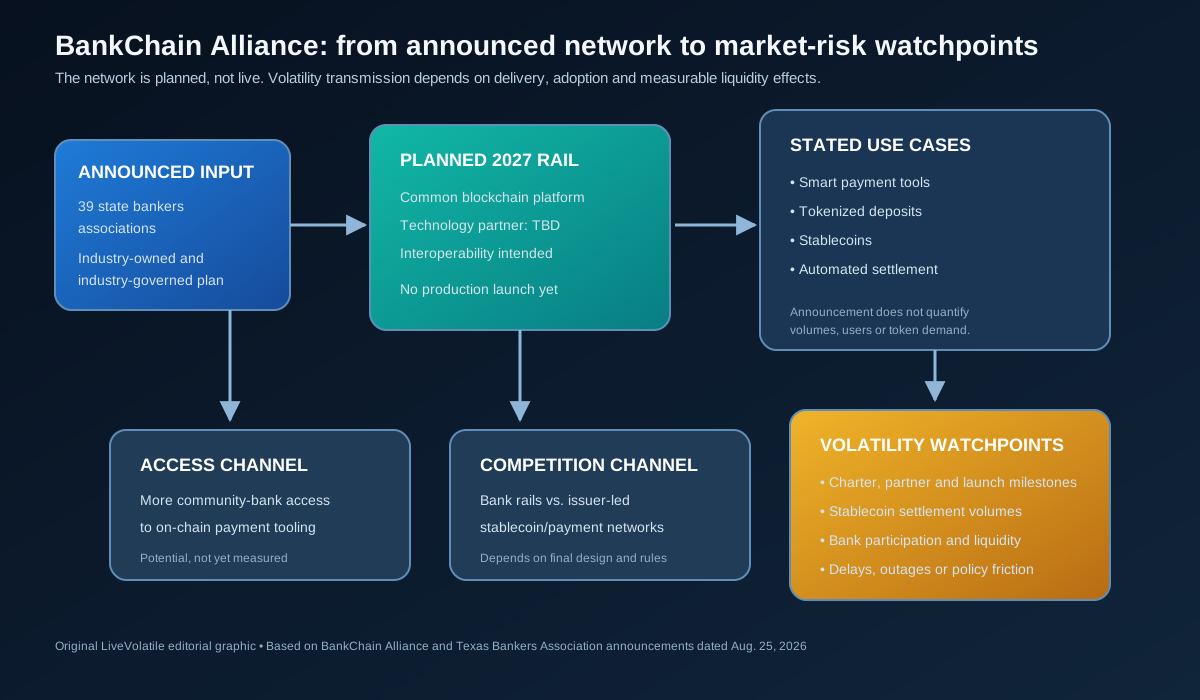
Visual credit: Original LiveVolatile editorial SVG, created August 28, 2026 from the BankChain Alliance press release and Texas Bankers Association announcement. It distinguishes confirmed announcements from conditional market pathways; it does not represent a live network or forecast token prices.
What BankChain Alliance actually announced
The primary announcement describes a coalition, not a finished product. On August 25, BankChain Alliance said 39 state bankers associations had formed the alliance to help financial institutions offer modern banking services while retaining the regulatory standards, security and trust associated with banks.
The planned network is described as industry-owned, industry-designed and industry-governed. The release names possible capabilities—smart payment tools, tokenized deposits, stablecoins and automated settlement—but does not specify the final architecture, consensus mechanism, stablecoin issuer, settlement asset, fee model or custody design.
The Texas Bankers Association separately confirmed that it and 38 other state associations were involved. Its release says the alliance is registered in Texas, is selecting a technology partner and is targeting a 2027 launch. Those details provide useful corroboration, but they do not turn the target into a guaranteed delivery date.
| Confirmed by primary sources | Not established by the announcement |
|---|---|
| 39 state bankers associations announced the alliance | A production blockchain is live |
| Industry ownership and governance are intended | The technology partner or chain design |
| Tokenized deposits and stablecoins are listed as use cases | A specific stablecoin, ticker or token launch |
| A 2027 launch is the target | Final launch date, transaction volume or users |
| Interoperability is intended | Which external networks will connect, and when |
That distinction is central to responsible volatility coverage. A plan can affect expectations and competitive positioning before it produces measurable on-chain activity, but expectation is not the same as adoption.
Why a bank-owned settlement rail matters
Stablecoin infrastructure has largely been discussed through the lens of issuers, fintechs, exchanges and public blockchain networks. BankChain Alliance introduces a different institutional proposition: banks themselves would coordinate ownership and governance of a common rail rather than relying entirely on a single private technology provider or an issuer-led network.
If delivered, such a rail could lower the organizational barrier for smaller and regional banks that want to experiment with tokenized deposits or programmable payments. The alliance explicitly frames participation as a way for institutions of different sizes to offer modern capabilities while continuing to serve local communities.
The potential market effects are structural rather than immediate:
- Distribution could widen. More banks participating in a shared rail could make regulated digital-money services available through existing customer relationships.
- Settlement competition could intensify. Bank-led tokenized deposits and stablecoins could compete with issuer-led payment networks for treasury, transfer and settlement flows.
- Interoperability could become a differentiator. If the network can connect safely to public chains and other regulated rails, it may reduce fragmentation. If not, it could add another walled garden.
- Governance risk could move to the front. A large coalition must resolve membership, voting, operational responsibility, liability, upgrades and incident response before market confidence can be tested.
None of these outcomes is guaranteed by the announcement. They are the mechanisms through which the plan could become relevant to crypto market structure.
How the announcement could transmit into volatility
A bank infrastructure announcement can create volatility through several stages, and each stage has a different evidentiary threshold.
Stage 1: expectation volatility
News of a large institutional coalition can change narratives around stablecoins, tokenized deposits and payment networks. Traders may rotate attention toward related assets or listed companies even when no direct economic exposure has been identified. That is an expectations effect, not proof of fundamental demand.
Stage 2: milestone volatility
The next potential catalysts are concrete: selecting a technology partner, publishing technical standards, announcing participating banks, completing testing, or securing relevant approvals. These events can produce sharper repricing because they reduce uncertainty about delivery.
Stage 3: adoption and liquidity volatility
Only after the rail is live should analysts look for measurable changes in settlement flows, stablecoin balances, bank participation, spreads, redemption liquidity and transaction concentration. A network can be technically successful but economically immaterial if usage remains low.
Stage 4: operational or policy stress
Delays, outages, governance disputes, security incidents or regulatory constraints could generate downside volatility. A bank-owned network may carry higher expectations for controls and continuity; failure against those expectations could affect confidence beyond the network itself.
The disciplined interpretation today is therefore conditional infrastructure significance, not a directional crypto trade.
What traders and researchers should monitor next
LiveVolatile readers should separate announcement signals from delivery signals. The following checklist is more useful than reacting to headlines alone:
| Signal | What it would tell us | Volatility relevance |
|---|---|---|
| Technology partner selected | The plan has moved into implementation | Reduces design uncertainty; may reprice related infrastructure themes |
| Named participating banks | Adoption intent is becoming more concrete | Helps estimate distribution and potential settlement reach |
| Technical and governance documentation | Rules, permissions and interoperability are clearer | Reveals concentration, upgrade and counterparty risks |
| Pilot or production transaction data | Usage is observable rather than promised | Tests whether the rail changes actual liquidity or payment flows |
| Stablecoin or tokenized-deposit issuance | A real settlement instrument exists | Creates measurable supply, redemption and flow questions |
| Delays, outages or regulatory objections | Execution risk is rising | Can widen spreads and reverse expectation-driven moves |
The key mistake would be to treat the alliance’s aggregate bank representation as equivalent to committed transaction volume. The announcement establishes organizational breadth, not usage intensity.
Readers can use the crypto volatility dashboard, review stablecoin depegging risks, and compare the spot-versus-futures risk framework when evaluating whether a market move is being confirmed by liquidity and derivatives data.
Bank-owned rails versus issuer-led stablecoins
The announcement also opens a useful comparison. An issuer-led stablecoin typically concentrates responsibility for issuance, reserves, redemption and compliance in the issuing entity, even when the token moves across multiple blockchains. A bank-owned network could distribute governance across member institutions, but distribution does not automatically eliminate concentration risk.
The two models may compete in some use cases and coexist in others:
- Issuer-led model: often optimized around a recognizable reserve-backed instrument and broad exchange or wallet distribution.
- Bank-owned rail: potentially optimized around regulated bank connectivity, payment workflows and institutional governance.
- Interoperable future: banks may use a shared rail for settlement while connecting to external stablecoins or public chains through controlled interfaces.
The final balance will depend on fees, settlement speed, redemption certainty, compliance obligations, operational resilience and access rules. None of those parameters has been finalized in the public announcement reviewed here.
What this does—and does not—mean for crypto assets
The announcement may affect the competitive conversation around stablecoins and tokenized deposits, but it does not identify a token beneficiary. BankChain Alliance has not announced a native token, a specific stablecoin, a public-chain deployment or a trading-market integration. Any immediate claim that BTC, ETH or a particular altcoin must rise because of the announcement would go beyond the evidence.
There may eventually be indirect effects. Public chains that offer reliable interoperability, deep liquidity or institutional-grade settlement could benefit if the network connects to them. Conversely, a permissioned bank rail could divert some flows from public venues if it provides a sufficient alternative. Those are scenarios to test after architecture and usage data become available.
For now, crypto traders should watch for confirmation in volumes, spreads, stablecoin supply, cross-venue basis and related equities—not just social-media attention. If no measurable flow follows, the announcement may remain a policy and infrastructure narrative rather than a sustained market catalyst.
FAQ
What is the BankChain Alliance?
It is a coalition announced by 39 U.S. state bankers associations to develop an industry-owned, industry-designed and industry-governed blockchain network for modern banking capabilities.
Is the BankChain blockchain already live?
No. The primary announcements say the alliance is selecting a technology partner and targeting a 2027 launch. They do not establish that a production network is operating.
Will BankChain Alliance issue a stablecoin?
The alliance lists stablecoins among possible use cases, but the reviewed announcements do not name an issuer, instrument, ticker, reserve model or issuance date.
Does the announcement mean crypto prices will rise?
No immediate token-price impact is established. The announcement could influence expectations, but a durable market effect would require evidence of implementation, adoption and settlement flows.
Why could this matter for stablecoin volatility?
A bank-owned rail could introduce another channel for regulated digital-money settlement. That might improve access or intensify competition, but it could also create new governance, interoperability and operational risks.
What is the next high-signal event?
A named technology partner, detailed governance and technical documentation, participating-bank commitments, or verifiable pilot activity would be stronger evidence than the formation announcement alone.
Conclusion
BankChain Alliance is significant as an institutional infrastructure proposal: 39 state bankers associations are coordinating around a possible bank-owned blockchain network with tokenized deposits, stablecoins, smart payments and automated settlement among its stated use cases. The coalition’s target is a 2027 launch, but the design and technology partner remain unsettled, and no production usage has been shown.
For LiveVolatile readers, the right framework is to track the gap between organizational intent and measurable settlement activity. A selected partner, named banks, technical standards and real transaction data could turn this into a meaningful stablecoin-market story. Until then, it is a credible competitive signal with conditional volatility implications—not evidence of a live network, a new token or an automatic trading opportunity.
This article is for informational purposes only and is not investment, legal, regulatory, tax or financial advice. Crypto assets and digital-money infrastructure carry significant risk. Verify announcements, market data and regulatory information independently before making decisions.
Sources and credits
- BankChain Alliance: State Bankers Associations Announce Industry-Owned Blockchain Network, August 25, 2026; primary source for the alliance, stated capabilities, governance intention and 2027 target.
- Texas Bankers Association: Texas Bankers Association supports launch of industry-owned blockchain network, August 25, 2026; corroborating primary association announcement and participating-association context.
- BankChain Alliance press page, accessed August 28, 2026; confirms the announcement listing and links to publisher coverage.
- Inline visual: Original LiveVolatile editorial SVG, created August 28, 2026 from the primary sources above; no third-party image reproduced.
— LiveVolatile Research Desk