Fidelity Solana Fund Filing: How FSOL Staking Could Change SOL Volatility Monitoring
Direct answer: Fidelity’s post-effective amendment for the Fidelity Solana Fund (FSOL), filed with the SEC on August 19, 2026, describes an exchange-traded product that can stake SOL and pass staking-based amounts into the product’s economics. The filing is not, by itself, evidence of a new approval, a fresh launch, or an imminent SOL price move. Its useful market signal is structural: staking introduces reward, slashing, activation, exit, custody, and liquidity variables that traders should monitor alongside SOL price, funding, basis, spreads, and ETF flows.
This matters because FSOL trades on a traditional exchange while spot SOL trades continuously on crypto venues. A staking-backed ETP can therefore connect two market structures without making them identical. The result is a new set of event and liquidity checkpoints—not a simple “ETF staking is bullish” thesis.
Key takeaways
- The SEC filing dated August 19 identifies FSOL as an NYSE Arca exchange-traded product tracking SOL and incorporating staking-based amounts into its objective.
- Under normal circumstances, the filing says the sponsor may stake up to 100% of the Trust’s SOL, while retaining discretion for liquidity, expenses, protection, and other needs.
- Staking rewards can vary, and staking exposes the product to slashing, validator, operational, activation, and exit-buffer risks.
- A staking feature does not guarantee net inflows, a higher SOL price, or lower volatility.
- FSOL’s stock-market trading hours differ from spot SOL’s 24/7 market, so premiums, discounts, overnight gaps, and weekend information risk deserve attention.
- The cleanest trading framework is to separate filing mechanics, actual creation/redemption or flow evidence, and observed market response.
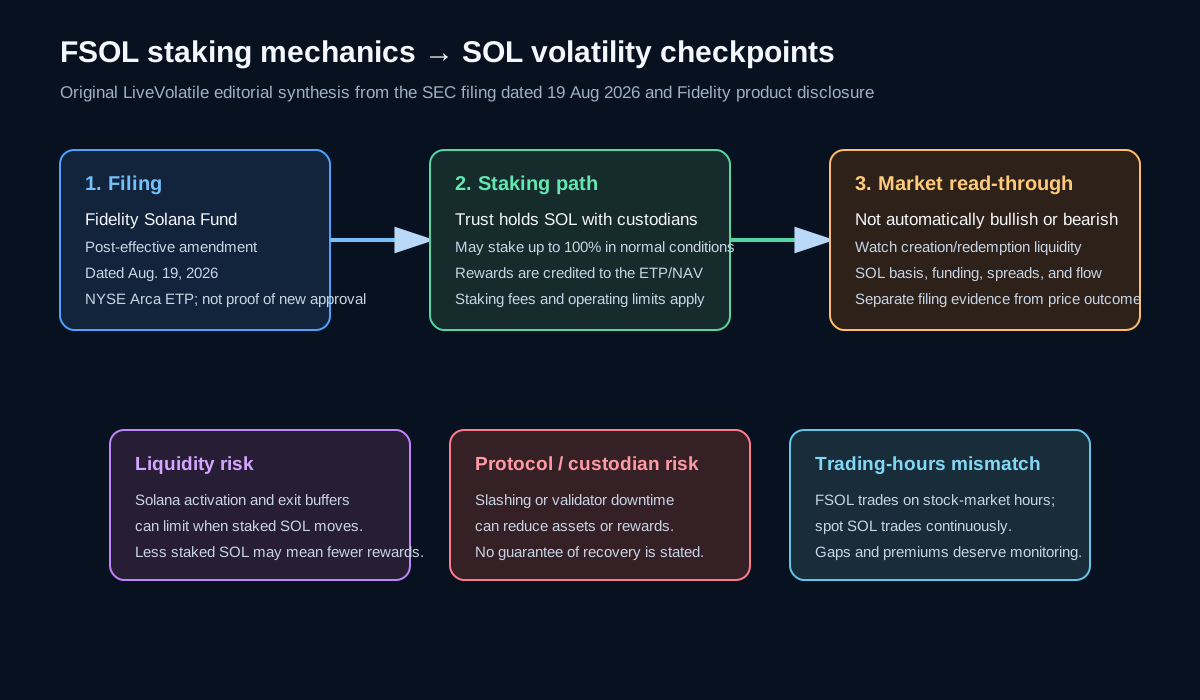
Visual credit: Original LiveVolatile editorial diagram, created for this article from the SEC filing and Fidelity’s FSOL product disclosure. It is explanatory, not a forecast.
What the August 19 filing actually says
The SEC filing is Post-Effective Amendment No. 5 to the Fidelity Solana Fund’s Form S-1 registration statement. It is dated August 19, 2026. The prospectus describes FSOL as an exchange-traded product whose shares trade on NYSE Arca under the ticker FSOL.
The stated objective is to track SOL through the Fidelity Solana Reference Rate, adjusted for expenses and liabilities, plus an amount based on staking rewards associated with SOL. The filing says the Trust may stake, or cause to be staked, all of its SOL with trusted node operators, except for SOL reserved at the sponsor’s discretion for foreseeable redemptions, expenses, protection of assets, and liquidity management.
That wording is important. “May stake up to 100% under normal circumstances” is not the same as “will always stake 100%.” The sponsor retains discretion, and extraordinary redemption activity, network disruption, operational considerations, or liquidity requirements can change the percentage actually staked.
The filing also says there is no minimum percentage that must be staked. Traders should therefore avoid turning a maximum or stated intention into a guaranteed supply-locking statistic.
How staking changes the volatility map
Staking can add a source of potential return to the ETP, but it also adds dependencies. The market impact depends on which dependency becomes relevant first.
| Mechanism | What is verified | What traders should monitor | Possible volatility channel |
|---|---|---|---|
| Staking rewards | FSOL seeks an amount based on staking rewards; rewards are not fixed | Reported rewards, fees, NAV behavior | Expectations can reprice if realized rewards differ from assumptions |
| Liquidity reserves | Sponsor may keep SOL unstaked for liquidity and other needs | Creation/redemption activity, available liquidity | More reserves can reduce rewards but improve redemption flexibility |
| Activation and exit buffers | Fidelity says Solana’s processes can limit when assets are unstaked and withdrawn | Withdrawal timing, stressed-market disclosures | A rush for liquidity can interact with redemption constraints |
| Slashing and downtime | Filing and Fidelity disclosure identify validator-related loss risks | Validator performance, incidents, penalty disclosures | A confirmed loss can create a discrete risk premium |
| Market-hours mismatch | FSOL trades on an exchange; spot SOL trades continuously | Premium/discount, overnight and weekend moves | Information can be repriced in spot before FSOL opens |
The table distinguishes facts from monitoring implications. None of these mechanisms predicts a direction for SOL. They define where a volatility shock could originate or amplify.
The main risk is not “staking” in isolation
Fidelity’s FSOL product disclosure says staking rewards can vary significantly. It also identifies the possibility of losing SOL through slashing penalties if third-party validators either validate incorrect transactions or remain offline for a prolonged period. The disclosure states there is no guarantee that the Trust would recover staked assets, or their value, after slashing or penalties.
The same disclosure describes activation and exit buffer periods on the Solana network. These can limit when assets may be unstaked and withdrawn. Fidelity says it will seek to mitigate this liquidity risk, but that doing so may result in less than all of the Trust’s SOL being staked. In turn, a lower staking percentage can reduce potential rewards and affect the value of shares.
For a volatility trader, this is a conditional chain:
- A validator, network, custody, or liquidity event occurs.
- The event affects the amount of SOL that can be staked, moved, or redeemed.
- The market evaluates the effect on rewards, NAV, liquidity, or trust in the product.
- Spot SOL, FSOL, derivatives, and related instruments may respond on different clocks.
That is a risk framework, not a prediction that any step will occur.
Why the stock-market clock matters for SOL traders
Spot SOL trades around the clock on crypto exchanges. FSOL shares trade through the schedule of the exchange on which they are listed. The underlying token and the ETP can therefore receive information at different times.
A weekend SOL move, a validator incident, or a change in staking expectations may appear first in spot markets. When the traditional market reopens, FSOL can reflect accumulated information through a gap, a premium or discount, or a change in secondary-market liquidity. Conversely, a sharp move in FSOL during its trading session can become an additional signal for traders watching spot and derivatives.
The correct question is not whether FSOL and SOL have the same price path. They have different wrappers, liquidity conditions, fees, custody arrangements, and trading hours. The useful questions are:
- Is FSOL trading close to its indicative value or at an unusual premium/discount?
- Does spot SOL lead the move, or does the ETP appear to lead during exchange hours?
- Are funding and basis confirming the move, or is the reaction isolated to one market?
- Are spreads widening while volume rises, suggesting stress rather than orderly adoption?
- Is there verified evidence of creations, redemptions, or assets changing hands, rather than only a filing headline?
LiveVolatile readers can pair the SOL volatility dashboard with spot-versus-derivatives spreads, funding, open interest, and liquidation data. The dashboard is a monitoring aid; it does not establish causation between a filing and a price move.
What would count as a meaningful market signal?
The filing itself is a mechanics signal. A stronger market conclusion would require additional evidence. A practical hierarchy is:
Level 1: Documented product mechanics
The SEC filing and Fidelity disclosure establish what FSOL is designed to do, what staking may involve, and which risks are disclosed. This is the evidence available immediately from the August 19 filing.
Level 2: Observable implementation or reporting
The next layer would include official product updates, prospectus changes, fund disclosures, verified custody or staking information, and transparent data about assets or rewards. These could show whether the described mechanics are being used in practice.
Level 3: Market confirmation
Only after checking price, volume, premiums or discounts, funding, basis, open interest, and liquidations should an analyst describe a volatility response. Even then, macro news and broader crypto flows may be confounding factors.
This hierarchy prevents a common editorial and trading mistake: treating a filing as if it were proof of capital inflow. A registration or amendment can matter without immediately changing the supply-demand balance for SOL.
How FSOL interacts with Solana’s other current catalysts
Solana is also undergoing infrastructure changes. In a separate August 19 Solana engineering article, the network discussed a staged plan to reduce target slot time from 400 milliseconds toward 200 milliseconds. That article focuses on validator economics, stale-price exposure, MEV timing, liquidity provision, and the need for empirical mainnet monitoring.
The FSOL filing and slot-time plan should not be collapsed into one narrative. They operate through different channels:
- FSOL staking: product structure, rewards, custody, liquidity, and market-hour transmission.
- Shorter Solana slots: network timing, validator economics, execution freshness, and market microstructure.
- SOL price response: an empirical outcome that must be measured rather than assumed.
Keeping those channels separate makes it easier to identify which catalyst is actually moving volatility.
Trader monitoring checklist
Before assigning a SOL move to FSOL staking, check:
- Primary-source status: Is the information an SEC filing, a Fidelity update, or only secondary commentary?
- Product status: Does the document describe an existing structure, a proposed change, or a future possibility?
- Flow evidence: Are there verified creations, redemptions, holdings, or reward disclosures?
- Cross-market confirmation: Do spot, perpetuals, options, and the ETP show the same direction?
- Liquidity quality: Are spreads stable, or is price moving through thin books?
- Risk disclosures: Are slashing, exit buffers, custody, or operational events relevant to the current move?
- Time alignment: Did the move occur during FSOL trading hours, or did spot SOL move first while the exchange was closed?
This checklist is more useful than a binary “ETF bullish” label because it links a documented mechanism to observable market data.
FAQ
Is the Fidelity Solana Fund a new Solana ETF approved on August 19, 2026?
The August 19 document is a post-effective amendment to the fund’s registration statement. It describes FSOL and its staking-related mechanics. The filing should not be described as a new approval or launch announcement unless a separate official source confirms that event.
Does FSOL staking guarantee higher SOL returns?
No. Staking rewards can vary, fees apply, and the fund discloses slashing, validator, activation, exit, custody, and liquidity risks. The product’s value remains exposed to SOL’s high volatility.
Can FSOL staking reduce SOL’s circulating supply?
The filing does not provide a basis for a precise supply-impact claim. Some SOL may be staked, while some may remain reserved for liquidity and other purposes. Any supply conclusion requires verified holdings and staking data.
What should SOL volatility traders watch first?
Start with verified product updates and flow evidence, then compare SOL spot, perpetual funding, basis, open interest, options, liquidation data, and any FSOL premium or discount. Do not trade the filing headline alone.
Conclusion
The Fidelity Solana Fund’s August 19 SEC filing is relevant to SOL volatility because it documents how staking rewards, liquidity reserves, validator risks, and trading-hour differences can connect a traditional-market product to the Solana spot market. It is not a guaranteed bullish catalyst and it does not prove new capital entered SOL.
The highest-value interpretation is conditional: FSOL may broaden institutional access to SOL economics, while staking and liquidity mechanics create new operational checkpoints. Traders should wait for verified implementation and market confirmation, then monitor cross-market behavior rather than treating the filing as a standalone forecast.
Disclaimer: This article is for informational and educational purposes only. It is not investment, financial, legal, or tax advice. Crypto assets are highly volatile and you can lose some or all of your capital. Verify primary sources and use independent risk management before trading.