Solana 200ms Slot Time Plan: What It Could Change for SOL Volatility and Validators
Direct answer: Solana’s official roadmap describes a staged reduction in target slot time from 400 milliseconds to 200 milliseconds, using four feature-gated steps: 350ms, 300ms, 250ms, and finally 200ms. The change is designed to improve latency and narrow a leader’s continuous block-building window, but it is not a guarantee of instantly faster or safer execution. For SOL traders, the important question is how the upgrade changes stale-price exposure, MEV timing, liquidity provision, and validator costs—and whether mainnet health data supports each activation.
Key takeaways
- Solana’s endpoint is a targeted, phased activation, not an unconditional one-time switch.
- Keeping the four-slot leader span means continuous control would shrink from about 1.6 seconds to 800 milliseconds at the 200ms endpoint.
- Shorter slots may reduce the time available for stale-price arbitrage and improve the freshness of oracle- and quote-driven strategies.
- The MEV result is not one-directional: shorter reaction windows can reduce some attacks, while remaining slippage and competition can preserve others.
- Validators would vote roughly twice as often per unit of wall-clock time at 200ms, increasing the importance of vote-fee economics and latency performance.
- The market should watch feature-gate timing, block skips, vote timing, spreads, funding, and SOL liquidity rather than trading the headline alone.
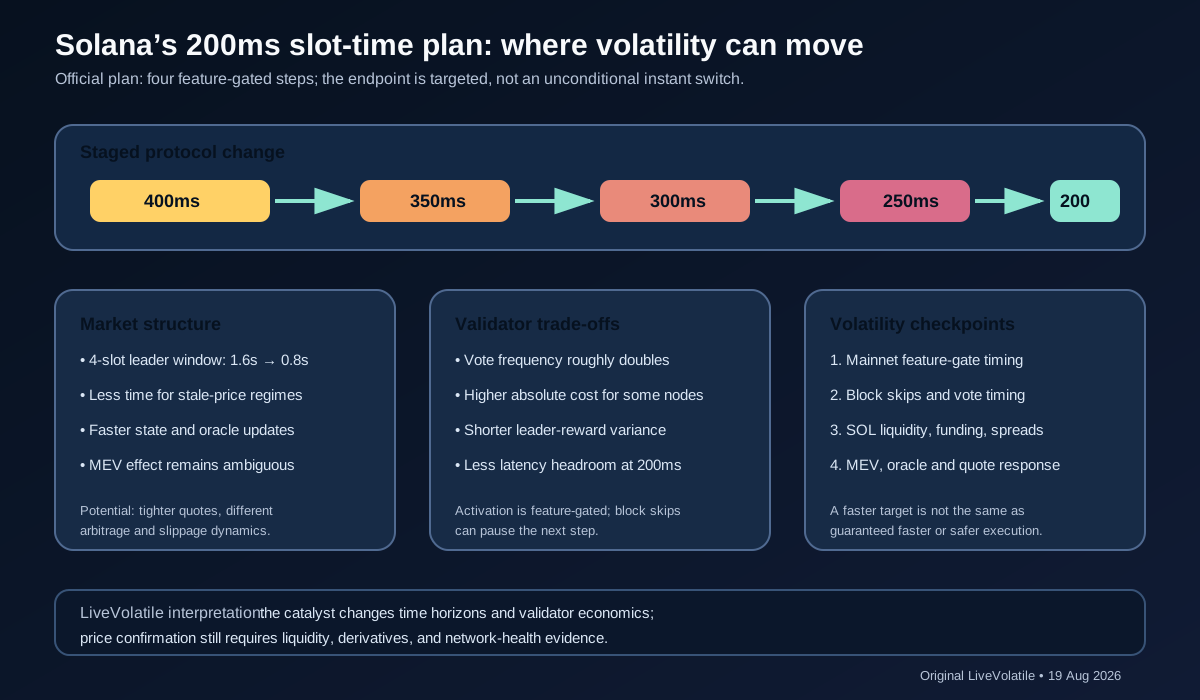
Visual credit: Original LiveVolatile editorial diagram, created August 19, 2026. It is based on the Solana Foundation’s Reduced Slot Times upgrade page and the Foundation’s market-structure and validator-economics analysis.
What Solana is actually changing
The Solana Foundation’s upgrade documentation says the network currently uses a 400ms target slot time and plans four reductions of 50ms each. Each step has its own feature gate and activates in a later epoch than the prior step. The stated endpoint is:
| Stage | Target slot time | What to verify |
|---|---|---|
| Current baseline | 400ms | Existing block production, vote timing, and skip-rate baseline |
| Step 1 | 350ms | Feature-gate activation and mainnet health |
| Step 2 | 300ms | Whether replay and voting retain enough timing margin |
| Step 3 | 250ms | Block skips, leader handoffs, and validator participation |
| Endpoint | 200ms | Sustained performance, economics, and application behavior |
The Foundation says the network will not move to the next reduction if block-skip rates are too high. Its published schedule is explicitly tentative and subject to change. That makes the activation process itself part of the market story: a delay may signal caution, while a clean step could strengthen confidence in Solana’s latency roadmap.
This is also different from claiming that every transaction will confirm in exactly 200ms. Slot duration is one component of inclusion, replay, voting, congestion, RPC performance, and finality. Users can experience different results depending on network conditions and application design.
Why the four-slot leader window matters
Solana’s documentation says the leader span remains four slots. At 400ms, that represents roughly 1.6 seconds of continuous leader control; at 200ms, it would represent 800ms. That halves the wall-clock time in which one leader can maintain a particular execution regime before another leader takes over.
That matters because block producers determine when transactions are included and how they are ordered within their blocks. A shorter leader window does not eliminate delayed execution or ordering advantages, but it compresses the time over which a slow or unusually aggressive regime can persist.
The Foundation’s August 19 analysis frames this as a market-structure change rather than merely a speed upgrade. Information can enter canonical state more frequently, and applications that depend on freshness—such as oracle consumers and market makers—get a finer time signal. The result may be lower stale-price exposure, but the size of that benefit depends on actual latency, liquidity, fees, and cross-venue response.
What it could mean for SOL volatility
1. Less stale-price exposure, not zero execution risk
When an on-chain quote lags an external market, arbitrageurs can trade against the stale price. Shorter slots reduce the wall-clock interval in which that mismatch can persist, all else equal. That could reduce one source of loss for liquidity providers and make quote updates more timely.
“All else equal” is doing important work. External venues, RPC paths, validators, oracle publishers, and traders do not all respond at the same speed. A faster slot target cannot remove congestion, bad quotes, thin books, failed transactions, or poor slippage settings.
2. MEV changes are ambiguous
A shorter reaction window can make some sandwich or latency-sensitive strategies harder to execute. But lower timing alone does not determine MEV profitability. If transactions still leave meaningful slippage, if competition concentrates among faster searchers, or if ordering advantages persist, some extraction can remain.
For traders, watch realized spreads, failed or reverted transactions where available, priority fees, and the relationship between SOL price moves and on-chain activity. Do not infer “less MEV” from the 200ms headline without measuring the execution environment after each step.
3. Faster information can amplify short-horizon reactions
More frequent state updates can improve price discovery, but it can also make the market react more quickly to liquidations, oracle changes, and crowded positioning. A system that incorporates information faster can still experience sharp volatility when liquidity is thin or leverage is high.
That is why the relevant risk question is not simply whether Solana becomes faster. It is whether usable liquidity, quote quality, and validator performance improve alongside the clock.
Validator economics are a second volatility channel
At a 200ms target, validators would process and vote on roughly twice as many slots per unit of wall-clock time. The Foundation’s analysis says this can make validator revenues more predictable by reducing block-reward variance, while also increasing voting costs and exposing differences in stake, hardware, geography, and latency.
The trade-off is material for network reliability. The Solana upgrade page says the four-step process can pause if block-skip rates climb. The August 19 analysis also says current vote timing and leader-handoff tails leave limited latency headroom at the endpoint, making mainnet monitoring essential.
| Stakeholder | Possible benefit | Risk to monitor |
|---|---|---|
| Traders and searchers | Less stale-price time; faster state updates | More competition and faster short-horizon reactions |
| Liquidity providers | More timely quotes; potentially lower LVR | More frequent repricing and infrastructure demands |
| Validators | More frequent leader opportunities; lower reward variance | Roughly doubled vote frequency and tighter timing margin |
| Stakers | Potentially more predictable validator performance | Delegation may shift toward better-capitalized operators |
| Applications | Finer execution and oracle cadence | Assumptions about slot timing may break during staged rollout |
This is not a prediction that smaller validators will fail or that SOL will rally. It is a reason to track validator participation and network health as part of the asset’s volatility setup.
The four checkpoints traders should monitor
- Activation evidence: Check the official feature-gate and epoch announcements. A roadmap target is not proof that the next stage is live.
- Block skips and vote timing: Rising skips, missed votes, or stressed leader handoffs would weaken the bullish interpretation of faster slots.
- Liquidity and derivatives: Compare SOL spot depth, spreads, funding, open interest, and liquidations before and after each step.
- Application behavior: Monitor oracle freshness, priority fees, failed transactions, quote updates, and MEV-related execution changes where data is available.
LiveVolatile’s SOL market coverage, crypto volatility guide, and volatility tools can provide context, but they do not replace live exchange, validator, or protocol data.
FAQ
Is Solana already running 200ms slots?
The official upgrade page describes 200ms as the endpoint of a staged, feature-gated rollout. It does not support treating the entire roadmap as an instantaneous, unconditional mainnet activation.
What is SIMD-0525?
SIMD-0525 is the Solana improvement proposal formally associated with reducing the target slot time from 400ms to 200ms in four steps. The official upgrade page links to the proposal and describes the staged implementation.
Will 200ms slots automatically make SOL less volatile?
No. Faster state updates may reduce some stale-price exposure, but volatility also depends on leverage, liquidity, market-wide risk, oracle behavior, fees, and network performance. Faster execution can sometimes transmit information and forced flows more quickly.
Could shorter slots change MEV?
Yes, but the direction is uncertain. Shorter reaction windows may reduce some latency-sensitive strategies, while slippage, ordering, and competition can preserve other forms of MEV. Post-activation measurements matter more than a simple forecast.
Why do validators matter to SOL traders?
Validator timing and participation affect block production, voting, application reliability, and confidence in the rollout. If the network pauses a stage because health metrics deteriorate, the schedule itself can become a volatility catalyst.
Conclusion
Solana’s 400ms-to-200ms plan is a meaningful market-structure catalyst because it changes the time available for leaders, arbitrageurs, market makers, and validators to act. The clearest potential benefit is less wall-clock time for stale-price regimes. The main risks are tighter validator timing, higher vote frequency, changing MEV competition, and a market that prices the endpoint before the network proves each stage.
The disciplined trade is to separate the roadmap from the activation, and the activation from the outcome. For SOL, confirmation should come from network health, liquidity, derivatives, and application-level execution—not from the promise of a smaller number in a protocol document.
Risk disclaimer: This article is for informational and educational purposes only. Crypto assets are volatile and may lose some or all of their value. Protocol roadmaps can change, be delayed, or pause during rollout. Nothing here is financial, legal, or investment advice.
Sources
- Solana Foundation: Reduced Slot Times — official upgrade scope, four staged reductions, feature gates, tentative schedule, and activation conditions; accessed August 19, 2026.
- Solana Foundation: Lowering Slot Time and Validators Economic — official analysis of leader windows, stale-price arbitrage, MEV, vote frequency, and validator economics; published August 19, 2026.
- Solana SIMD-0525 proposal — proposal context and staged 400ms-to-200ms design; accessed August 19, 2026.
Image credits: Original LiveVolatile SVG diagram at /images/articles/solana-200ms-slot-time-market-structure-map-2026-08-19.svg; no third-party image used.
— Marcus Reynolds, Senior Crypto Volatility Analyst