SEC Regulation Crypto Assets Proposal: What It Changes and Why Volatility Traders Should Wait
Direct answer: The SEC proposed a new Regulation Crypto Assets framework on August 18, 2026, creating tailored securities-offering pathways for certain investment contracts involving crypto assets. The proposal includes a one-time exemption for offerings of up to $5 million over four years, a second pathway for up to $75 million in each 12-month period, a conditional safe harbor tied to the end of essential managerial efforts, and possible preemption of certain state securities-law registration requirements. It is important market-moving policy news—but it is not a final rule, a blanket token exemption, or an immediately usable safe harbor.
That distinction is the main volatility takeaway. The announcement can reprice expectations for U.S. token fundraising and market access today, while the actual eligibility tests, disclosure burden, timing, comments, and later revisions remain unresolved.
Key takeaways
- The SEC’s Press Release 2026-76 confirms a proposed, tailored regime for certain crypto-asset investment contracts.
- The proposal describes two offering exemptions: $5 million during a four-year period and $75 million during each 12-month period.
- Both routes would require principles-based narrative disclosures; the larger route would also require financial statements and ongoing reporting.
- A conditional safe harbor could apply when an issuer has completed or permanently ceased essential managerial efforts it represented or promised to take.
- Qualifying offers, sales, and some secondary transactions could receive preemption from state registration and qualification requirements.
- The public comment period is scheduled to remain open for 60 days after publication of the proposing release in the Federal Register.
- Traders should treat the proposal as a regulatory catalyst, not proof that any specific token will qualify or that a final framework will arrive unchanged.
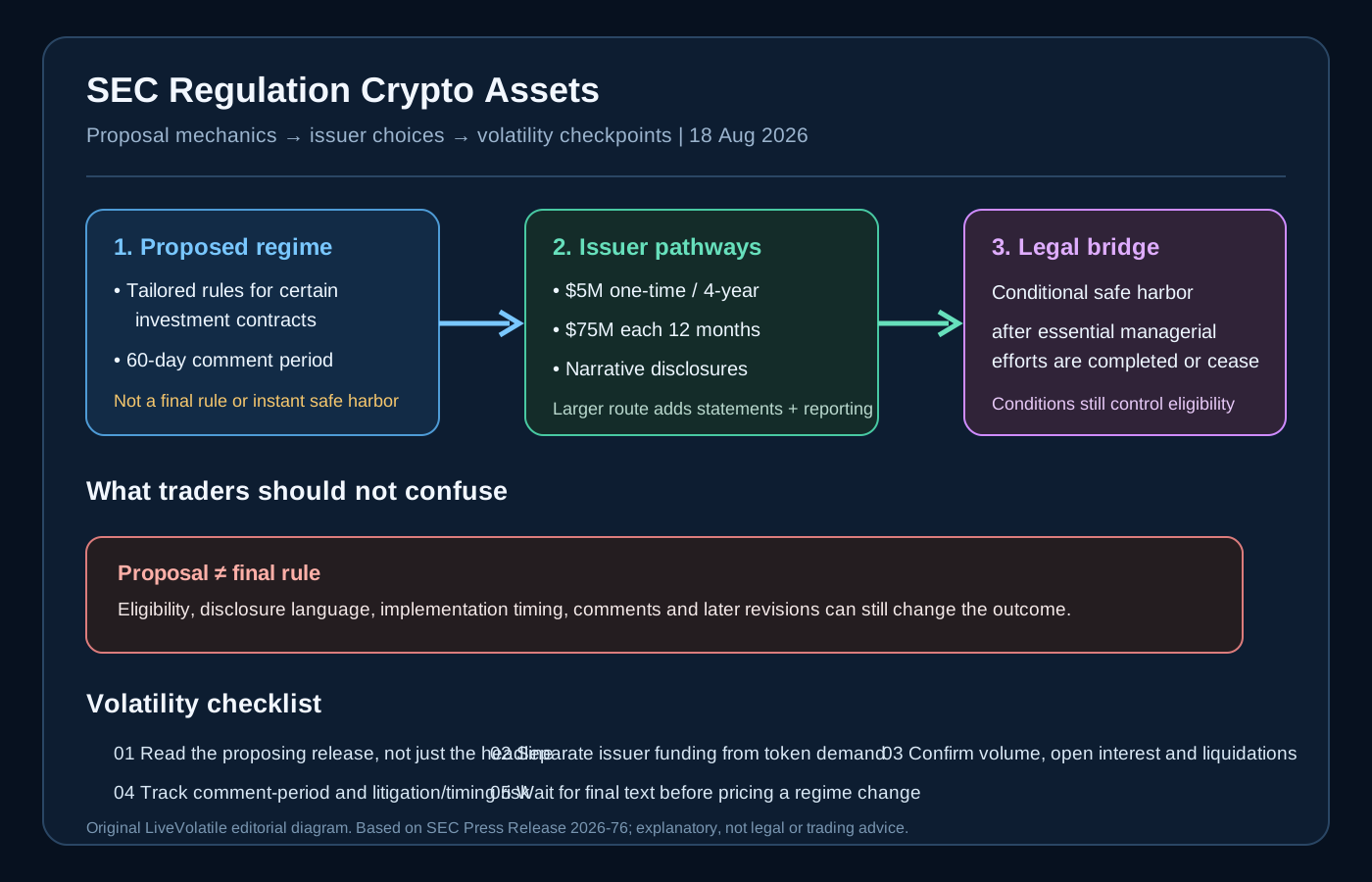
Visual credit: Original LiveVolatile editorial diagram based on SEC Press Release 2026-76, published August 18, 2026. It explains the proposal’s mechanics and market-risk checkpoints; it is not legal advice or a forecast.
What the SEC proposed
The SEC’s official announcement says the proposal would create a “clear and fit-for-purpose framework” for certain investment contracts involving crypto assets. The agency presents it as a follow-on to its March 2026 interpretation of how federal securities laws apply to crypto assets and related transactions.
The proposal has four market-relevant components.
1. A $5 million, four-year pathway
The first exemption would permit offerings of up to $5 million during a four-year period. The SEC describes it as a one-time exemption. The announcement does not mean every project can automatically raise that amount: the issuer, asset, offering structure, disclosure, and other conditions would determine eligibility.
2. A $75 million annual pathway
The second exemption would permit offerings of up to $75 million during each 12-month period. In exchange for the larger capacity, issuers would have to provide financial statements and meet ongoing reporting requirements, in addition to the principles-based narrative disclosures required under both exemptions.
For markets, that creates a potentially meaningful distinction between a smaller startup route and a more demanding, recurring capital-formation route. It does not establish that projects will use either route, that investors will accept the disclosures, or that exchanges will list assets issued under them.
3. A conditional safe harbor
The proposal would create a conditional safe harbor from the term “investment contract” in the Securities Act and Exchange Act definitions of “security.” If its conditions are satisfied, a crypto asset would be treated as not subject to an investment contract for those definitions.
The word conditional matters. The SEC’s announcement ties the safe-harbor concept to an issuer completing or permanently ceasing all essential managerial efforts that it represented or promised it would take. Projects and investors would still need to assess the conditions and evidence required by the actual proposing release and any final rule.
4. State-law preemption for qualifying transactions
The SEC also says the proposed rules would preempt state securities-law registration and qualification requirements for offers and sales issued under a Regulation Crypto Assets exemption, as well as certain secondary-market transactions. That could reduce one layer of compliance complexity for qualifying activity, but it is not equivalent to eliminating federal obligations or guaranteeing market access.
Why this is different from the August 14 event
The SEC’s August 14 meeting was a procedural catalyst: commissioners considered whether to issue a proposal. The August 18 announcement is the more substantive event because the agency has now published the core terms it wants the market and public to examine.
But the process is still not complete:
| Stage | Confirmed meaning | Volatility risk |
|---|---|---|
| Proposal announced | The SEC has released a proposed framework | Headline repricing and sharp sector moves |
| Federal Register publication | Starts the formal comment countdown | Timing may differ from the press-release date |
| 60-day comment period | Issuers, investors, states, and other stakeholders can respond | Provisions may be challenged or narrowed |
| SEC review and possible revision | Staff and commissioners assess the record | Final timing and conditions remain uncertain |
| Final rule, if adopted | Binding requirements become effective according to the published rule | Only then can firms assess actual reliance |
The market should therefore distinguish “the SEC proposed rules” from “crypto issuers can now use the rules.” The second statement is not supported by the announcement.
What it could mean for crypto volatility
A proposal can affect prices through expectations before it affects any issuer’s balance sheet. The most immediate channels are:
Regulatory-risk repricing
A credible U.S. pathway for certain offerings may reduce the discount investors assign to domestic token projects, crypto venture funding, and compliance-heavy market infrastructure. A narrower reading, an unexpectedly burdensome disclosure regime, or a delayed final rule could produce the opposite reaction.
Token-specific narratives
Tokens associated with U.S. development, issuance, staking, or long-running securities-law debates may move more than BTC or ETH. That does not mean the proposal changes the legal status of any named token. Traders should not convert a general framework into a project-specific conclusion without checking the proposal’s definitions and conditions.
Leverage and liquidity
Policy headlines often travel through derivatives. A large move in price is more fragile when it is driven by thin spot liquidity, crowded funding, rising open interest, or forced liquidations. The LiveVolatile market monitor, liquidations dashboard, and Bitcoin volatility calculator can help frame the reaction, but live exchange data should be checked before making decisions.
Crypto-equity and infrastructure proxies
Issuers, exchanges, custodians, brokerages, and crypto-finance firms may respond differently from tokens. A rule that lowers fundraising friction could benefit some businesses while increasing disclosure and reporting costs for others. Correlated moves should not be treated as proof that the proposal has already changed cash flows.
Three scenarios traders should model
Supportive interpretation: Markets view the exemptions and safe harbor as workable. Crypto-related assets may rally, but confirmation still requires breadth, volume, and follow-through.
Narrow interpretation: The framework exists, but conditions, reporting, and eligibility requirements limit immediate use. Early gains could fade as traders read the text more closely.
Process-risk interpretation: Comments, revisions, litigation, publication timing, or congressional action delay the practical effect. A headline rally can reverse if the market had priced a faster or broader regime than the process supports.
A disciplined response is to record the announcement, then separately monitor price, spot volume, open interest, funding, basis, liquidations, and sector breadth. One green candle is not evidence of a durable regulatory regime shift.
What remains unknown
The press release gives the market the headline architecture, but it does not answer every implementation question. Important items to verify in the full proposing release and later documents include:
- The precise issuer and asset eligibility tests.
- Required narrative disclosures and their delivery timing.
- Financial-statement and ongoing-reporting details for the $75 million route.
- The exact conditions and evidentiary standard for the safe harbor.
- Resale and secondary-market restrictions.
- The Federal Register publication date and comment deadline.
- How the proposal interacts with the SEC’s March interpretation, CFTC coordination, and any future congressional legislation.
Until those details are available and tested through the rulemaking process, “regulatory clarity” is an expectation—not a completed market structure.
FAQ
Is Regulation Crypto Assets a final SEC rule?
No. The SEC announced proposed rules. The proposal must go through publication and public comment, and it may be revised or not adopted.
Can any crypto project now raise $75 million under the SEC proposal?
No. The $75 million amount is part of a proposed exemption with conditions, including financial statements and ongoing reporting. The proposal is not an automatic authorization for every project.
Does the safe harbor make every token a non-security?
No. The announcement describes a conditional safe harbor for assets meeting its conditions. It does not create a blanket exemption for all tokens.
When does the 60-day comment period start?
The SEC says the period will remain open for 60 days following publication of the proposing release in the Federal Register. The press-release date and the formal publication date should not be assumed to be identical.
Why could crypto prices move before a final rule?
Markets price expected future access to capital, compliance costs, listings, and legal risk. Those expectations can move tokens and related equities immediately, even though the final legal outcome remains uncertain.
Conclusion
The SEC’s Regulation Crypto Assets proposal is a substantial U.S. crypto-policy catalyst because it puts concrete offering pathways and a conditional safe-harbor concept on the table. The $5 million and $75 million thresholds, disclosure requirements, state-law preemption, and comment process give traders more to analyze than a speech or meeting notice did.
The right conclusion is still measured: this is a proposed framework, not a final permission slip. The highest-quality volatility read will come from the actual proposing text, the comment record, implementation details, and whether price moves are confirmed by liquidity and derivatives data.
Risk disclaimer: This article is for informational and educational purposes only. Crypto assets are volatile and may lose some or all of their value. Regulatory proposals can change, be delayed, challenged, or fail to become final rules. Nothing here is financial, legal, or investment advice.
Sources
- SEC Press Release 2026-76: SEC Proposes New Regulation Crypto Assets — official announcement, proposal components, thresholds, safe-harbor description, state-law preemption, and comment-period statement; accessed August 18, 2026.
- SEC Press Releases — official listing confirming the August 18, 2026 release and release number 2026-76; accessed August 18, 2026.
Image credits: Original LiveVolatile SVG diagram at /images/articles/sec-regulation-crypto-proposal-volatility-map-2026-08-18.svg; no third-party image used.
— Marcus Reynolds, Senior Crypto Volatility Analyst