XRP Below $1 as Jeonbuk Bank Adopts Ripple Payments: Why Adoption Has Not Lifted the Token
Direct answer: XRP fell below $1 on August 18, 2026, even as Ripple announced that South Korea’s Jeonbuk Bank will deploy Ripple Payments for cross-border business remittances. The partnership is evidence of institutional adoption of Ripple’s payment infrastructure, but it is not proof that the bank’s flows will buy or use XRP. Ripple’s announcement describes stablecoin settlement without naming the asset, while CoinDesk reported that XRP had fallen to about $0.98 and that the deployment’s settlement token was still unclear.
That distinction is the central volatility signal. Traders should separate three questions: whether a bank is adopting Ripple’s rails, which asset settles the transfers, and how XRP is positioned in spot and derivatives markets.
Key takeaways
- Jeonbuk Bank is the first South Korean regional bank identified by Ripple as deploying Ripple Payments for cross-border business transfers.
- Ripple says the service is intended to support near-real-time, around-the-clock settlement, but its August 18 release does not specify whether XRP or RLUSD will be used for the bank’s flows.
- CoinDesk reported XRP below the widely watched $1 level, its weakest major-token performance over the period it examined, despite Ripple’s partnership announcement.
- Adoption of Ripple’s infrastructure can be bullish for the company or its stablecoin without creating immediate structural demand for XRP.
- The practical XRP volatility watch is the combination of the $1 level, spot volume, funding, open interest, liquidations, and confirmation of the actual settlement asset—not the partnership headline alone.
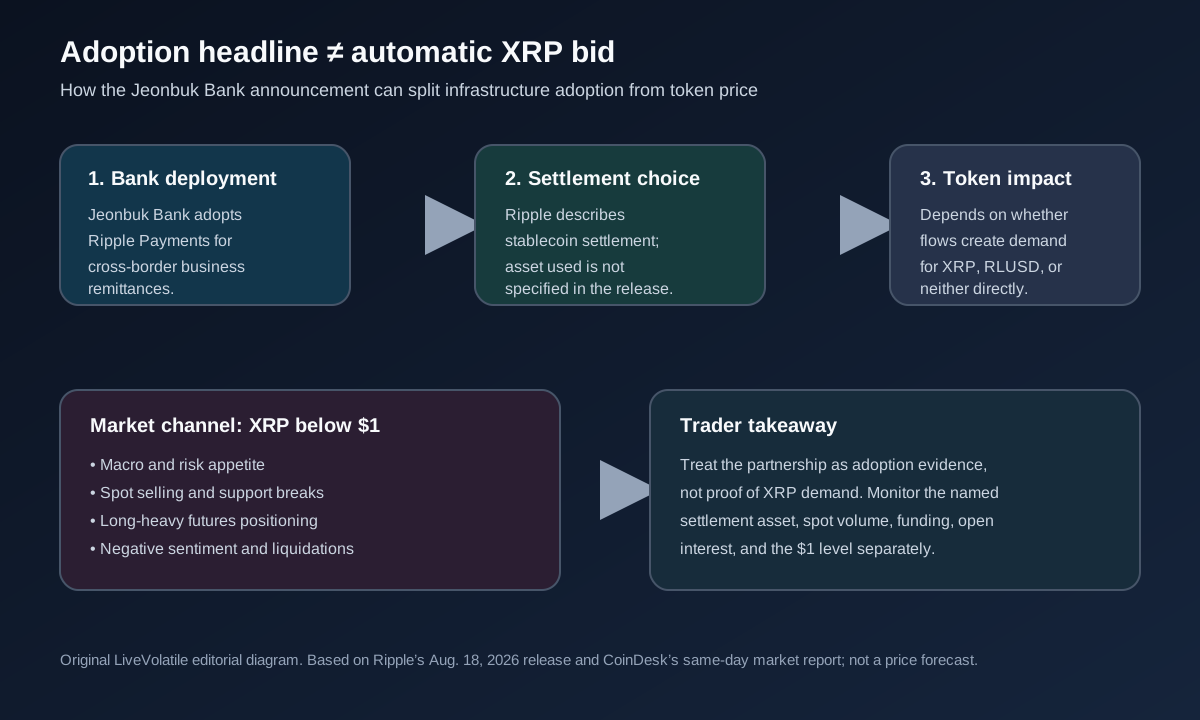
Visual credit: Original LiveVolatile editorial diagram, based on Ripple’s August 18, 2026 press-center announcement and CoinDesk’s same-day market report. It is an explanatory model, not a price forecast.
What Ripple announced about Jeonbuk Bank
Ripple’s press center lists an August 18 announcement titled “Ripple and Jeonbuk Bank Partner to Modernize Cross-border Payments for Korea’s Regional Banking Sector.” The announcement positions the relationship around business remittances and the modernization of regional-bank payment infrastructure.
Jeonbuk Bank is headquartered in Jeonju and serves businesses in South Korea’s southwest. Ripple’s stated use case includes cross-border transfers for businesses such as importers, exporters, technology startups, and online content creators. The intended benefit is operational: payments can be routed continuously and settle faster than traditional correspondent-bank processes.
That is meaningful infrastructure news. A bank choosing a payment network can create future transaction volume, distribution, compliance learning, and customer access. It can also strengthen Ripple’s credibility with other financial institutions evaluating digital-asset payment systems.
But infrastructure adoption is not the same as token demand. The market needs more information before it can translate this partnership into a specific XRP-flow thesis.
The missing detail: XRP, RLUSD, or another settlement path?
The source-backed fact is narrower than many social posts may suggest. Ripple and CoinDesk describe stablecoin-enabled or stablecoin settlement, but neither source establishes that Jeonbuk’s production flows will require XRP. CoinDesk reported that it had asked Ripple which asset the deployment uses and had not immediately received a reply.
There are at least three possible structures:
| Possible path | What it could mean for XRP | What traders must verify |
|---|---|---|
| XRP is used as a bridge asset | Could create transaction-related demand, although the size, frequency, and net market impact would still matter. | Confirmation from Ripple, Jeonbuk Bank, product documentation, or observable settlement data. |
| RLUSD is the settlement asset | Could increase use of Ripple’s dollar-pegged token without requiring the same type of XRP exposure. | The named asset, minting/redemption arrangements, and live product details. |
| A stablecoin or fiat route uses Ripple infrastructure but not XRP directly | Supports the payment-rail thesis while leaving XRP demand largely dependent on separate market factors. | Banking implementation details and any public technical or regulatory disclosures. |
The correct editorial conclusion is therefore conditional: the partnership strengthens the case that Ripple is expanding institutional payment distribution, but it does not yet establish a new XRP demand curve.
Why XRP can fall on positive Ripple news
XRP is a traded asset with its own supply, positioning, liquidity, and macro sensitivity. Ripple is a company associated with XRP, but the two are not interchangeable market exposures.
CoinDesk reported that XRP briefly moved below $1 to roughly $0.98, its lowest level since November 2024 according to that report. It also described XRP as underperforming major tokens over the period examined. At the same time, the report said futures open interest was about $2.78 billion and that long positions outnumbered shorts on major venues. Those figures are time-sensitive market observations, not permanent conditions, so traders should recheck them before acting.
A positive corporate announcement can fail to lift a token when:
- The announcement does not specify token usage. Traders may discount adoption that benefits a payments product but has no confirmed XRP requirement.
- The broader market is risk-off. Rates, yields, oil, equity futures, and Bitcoin liquidity can dominate a single altcoin headline.
- Long positioning is crowded. If many traders are already positioned for a rebound, a failure to rally can trigger stops and liquidations.
- A technical level becomes a focal point. A break below $1 can turn a round-number support area into a source of forced selling or defensive hedging.
- The market has priced a partnership narrative before the announcement. The headline may confirm expectations rather than create a new surprise.
This is why “Ripple adoption” and “XRP price” should be tracked as related but separate data series.
A practical volatility framework for XRP traders
The Jeonbuk announcement creates a monitoring checklist rather than a guaranteed trade setup.
1. Confirm the settlement asset
Look for a follow-up from Ripple or Jeonbuk Bank that names XRP, RLUSD, another stablecoin, or a fiat settlement arrangement. Do not infer XRP usage merely from the Ripple brand or the presence of the XRP Ledger.
2. Watch spot confirmation around $1
A brief move below a round number is less informative than sustained acceptance below it. Traders can compare spot volume, exchange breadth, and closes across multiple venues. A recovery without volume may be less convincing than a quieter reclaim accompanied by broader spot participation.
3. Track leverage, not just sentiment
Funding rates, open interest, basis, liquidation clusters, and long-short imbalances help explain why XRP may move sharply even when the underlying news is unchanged. High open interest and crowded longs can amplify downside; a large flush can later reduce leverage without proving a fundamental reversal.
4. Separate Ripple-company catalysts from XRP catalysts
Bank partnerships, custody products, stablecoin issuance, and payment integrations may matter to Ripple’s business. XRP-specific catalysts include confirmed transactional use, changes in exchange access or liquidity, regulatory developments directly affecting XRP, and measurable network activity. Each should be evaluated on its own evidence.
5. Compare XRP with the market
If XRP falls while Bitcoin and large-cap peers hold steady, token-specific positioning may be important. If most risk assets fall together, the Jeonbuk announcement may simply be overwhelmed by macro conditions. The LiveVolatile market monitor and XRP volatility coverage can be used alongside live exchange data.
What would change the thesis?
The adoption-versus-token disconnect would narrow if credible evidence showed that Jeonbuk’s production transfers use XRP at meaningful scale, require recurring XRP liquidity, or produce observable activity that cannot be explained by a stablecoin-only route. Even then, traders would need to estimate the flow relative to XRP’s existing daily liquidity and derivatives positioning.
The thesis would weaken if the bank’s implementation uses RLUSD or fiat rails without a direct XRP role, if the service remains a limited pilot, or if the announcement is not followed by an operational launch. A partnership announcement establishes intent and relationship; it does not by itself establish transaction volume, revenue, or token-price impact.
FAQ
Does Jeonbuk Bank’s Ripple partnership mean XRP will rise?
No. It is institutional adoption of Ripple Payments, but the public announcement does not specify that XRP will settle the bank’s flows. XRP’s price also depends on liquidity, leverage, macro conditions, and market expectations.
Is Ripple Payments the same as using XRP?
No. Ripple Payments is a payment product. The asset used for settlement can vary by implementation. Verify the named asset rather than assuming that a Ripple partnership requires XRP.
Why is the $1 level important for XRP volatility?
Round numbers can become widely watched support or resistance areas. A break can attract momentum traders, stops, and liquidation flows, but the level itself is not a fundamental valuation measure.
What should traders monitor next?
Monitor a confirmation of the settlement asset, implementation timing, spot volume around $1, funding and open interest, liquidation data, and whether XRP outperforms or underperforms the wider crypto market.
Conclusion
Jeonbuk Bank’s adoption of Ripple Payments is a credible institutional-infrastructure development, but the XRP takeaway is more limited. The public evidence supports a Ripple distribution and cross-border settlement story; it does not yet prove that Jeonbuk’s flows will create direct XRP demand.
For volatility analysis, the useful question is not whether the headline sounds bullish. It is whether the implementation creates measurable XRP exposure while the token is already testing a major round-number level amid leveraged positioning. Until the settlement asset and live flow details are confirmed, treat the partnership as adoption evidence—not as an automatic XRP price catalyst.
Disclaimer: This article is for informational and educational purposes only. It is not investment, financial, legal, or tax advice. Crypto assets are volatile and can result in partial or total loss. Verify current market data and primary-source updates before making decisions.
Sources
- Ripple Press Center — Ripple and Jeonbuk Bank Partner to Modernize Cross-border Payments for Korea’s Regional Banking Sector — publisher: Ripple; dated August 18, 2026; announcement listing and partnership framing.
- XRP sinks below $1 for first time since 2024 even as Korean bank adopts Ripple Payments — publisher: CoinDesk; published August 18, 2026; XRP price, market positioning, and settlement-asset uncertainty reported at publication time.
The inline diagram is an original AI-free LiveVolatile editorial SVG created for this article. It uses no third-party image.