Gnosis Chain’s Ethereum Economic Zone Move: What GNO Traders Need to Watch
Short answer: GnosisDAO approved GIP-153 on Aug. 20, 2026, directing Gnosis Chain toward a ZK-proven Ethereum Economic Zone (EEZ) rollup. The proposal would retire the chain’s independent validator set, settle activity to Ethereum, preserve existing addresses and xDAI gas, and potentially unlock about 350,000 staked GNO, described in the proposal as roughly 27% of circulating supply. The transition is not live yet: the proposal targets genesis around late 2026 or early 2027, subject to technology readiness. For GNO traders, the key risks are supply becoming liquid, changed staking economics, launch uncertainty and the market’s response to a less decentralized operating model.
Key takeaways
- GIP-153 passed with 123,158 GNO in favor, 115 against and 151 abstaining; reported turnout was 123,425 GNO against a 75,000-GNO quorum.
- The approved direction is a transition from standalone Layer 1 to an Ethereum-settled EEZ rollup, not an immediate chain shutdown or token migration.
- The proposal says users, balances, contract state and xDAI gas would continue, while the independent validator set would be sunset.
- Approximately 350,000 staked GNO could become unlocked under the proposed transition. That is a future liquidity risk, not proof that the tokens are already being sold.
- The launch date, interim proving setup, sequencing arrangements and final liquidity response remain open variables.
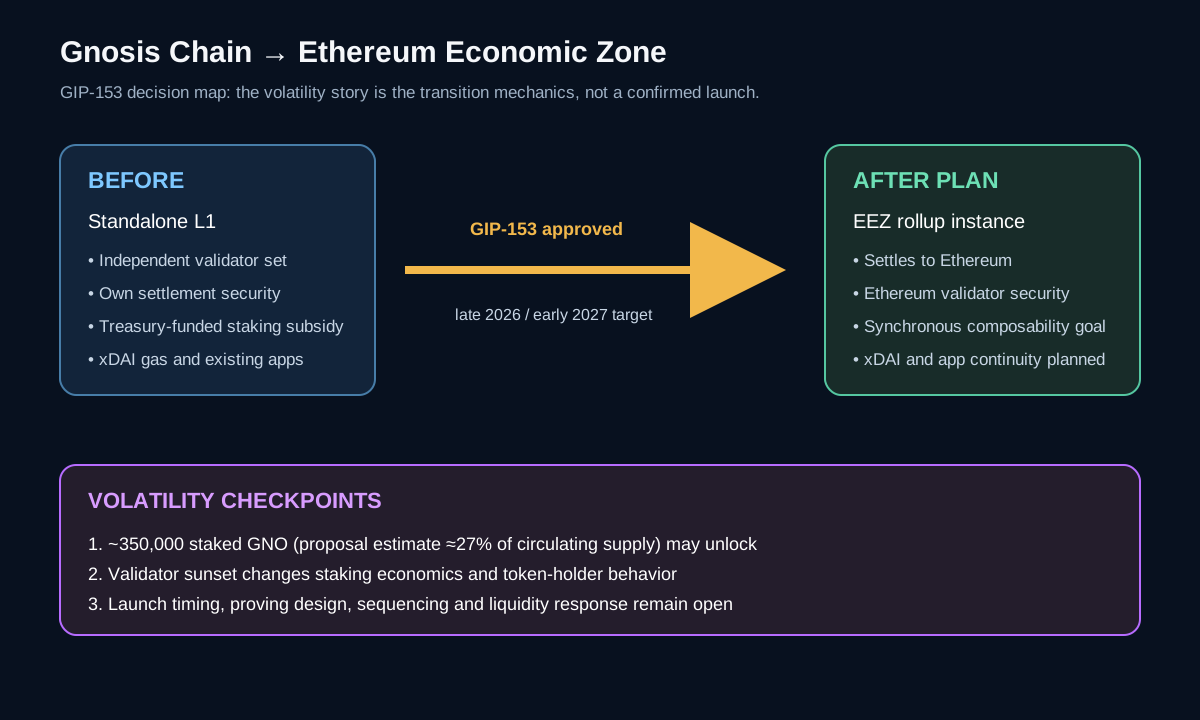
Original LiveVolatile editorial SVG. It visualizes only claims supported by the GIP-153 proposal, the Gnosis Chain site and Cointelegraph’s report.
What did GnosisDAO approve?
GIP-153 asks GnosisDAO to align on moving Gnosis Chain from a standalone Layer 1 into a ZK-proven EEZ rollup instance that settles natively on Ethereum. The Gnosis forum proposal describes the change as a strategic direction decision. It does not present a new chain that users must migrate to immediately.
Cointelegraph reported that the vote passed with 123,158 GNO supporting the proposal, 115 opposing it and 151 abstaining across 54 voters. Turnout reached 123,425 GNO, above the 75,000-GNO quorum. Gnosis Chain’s official post is the primary confirmation of those vote figures; the forum proposal supplies the technical and economic details.
The distinction between approval and deployment matters. The proposal targets genesis around the turn of 2026/27, while the report says the timing depends on EEZ technology being ready. Until a formal launch, migration or unlock schedule is published, traders should treat the vote as a catalyst and repricing event—not as confirmation that the new architecture is operating.
What changes, and what is meant to remain continuous?
Under the proposal, Gnosis Chain would settle transactions on Ethereum and inherit Ethereum’s validator-backed settlement security. The independent Gnosis Chain validator set would be sunset. At launch, Gnosis Ltd would operate the composer that orders transactions, builds blocks and submits them for proving and settlement, according to the proposal.
The proposal also says users and decentralized applications would keep their addresses, balances and contract state, with xDAI remaining the fee token. That continuity reduces one common migration risk: a forced user-by-user asset move. It does not eliminate market risk. Exchange integrations, index methodology, staking products, liquidity providers and wallet infrastructure may still need to update their assumptions as the transition approaches.
The proposed benefit is synchronous composability: a contract on the Gnosis instance could call an Ethereum mainnet contract and use the result in the same atomic transaction. The proposal says the first iteration would use an interim proving setup, likely TEE-based, with the concrete mechanism selected during technical specification, before moving toward real-time ZK proving as the EEZ specification develops. That conditional language is important. The long-term design is not the same as a fully deployed production guarantee today.
Why the proposed GNO unlock matters for volatility
The GIP-153 proposal says roughly 350,000 GNO currently staked—about 27% of circulating supply—would be unlocked when the validator set is sunset. The figure is a proposal estimate and should not be read as a confirmed exchange inflow, immediate sell pressure or new token issuance.
It still creates a meaningful watchpoint because staking can restrict liquidity and shape holder behavior. If tokens become liquid, some validators may sell, hedge, rotate into other assets or continue holding without staking rewards. The market impact depends on the release timing, holder concentration, exchange and OTC access, treasury policy and broader crypto conditions.
| Catalyst | What is verified | Volatility question | What to monitor |
|---|---|---|---|
| DAO approval | GIP-153 passed with the reported vote totals | Was the decision already priced in? | GNO volume, spreads and derivatives positioning |
| Validator sunset | Proposed consequence of moving settlement to Ethereum | Will former stakers sell or reallocate? | Official timeline and staking-contract notices |
| Approx. 350k GNO unlock | Stated in the GIP-153 proposal | How quickly could liquidity return? | Unlock mechanics, wallets and venue depth |
| EEZ genesis | Targeted around late 2026/early 2027, conditional on readiness | Does delay extend uncertainty? | Technical specifications and launch updates |
| New settlement model | Ethereum settlement and proposed proving path | Does the market reward composability or discount centralization? | Sequencer, prover and security disclosures |
The central trade-off: Ethereum security versus decentralization
The proposal is unusually direct about the trade-off. Gnosis would gain Ethereum settlement and closer access to Ethereum liquidity and composability, but it would no longer rely on a large independent validator set as the core security model. Launch sequencing would also be centralized under the proposed design, although the proposal limits a misbehaving sequencer’s stated power to delaying or excluding transactions rather than forging finalized state or stealing funds.
That trade-off can create two opposing market narratives. One group may value the route to Ethereum settlement, atomic composability and reduced dependence on conventional bridges. Another may discount GNO or Gnosis Chain activity because validator independence and censorship resistance are changing. Neither narrative is a verified price forecast. The useful trading question is which milestones convert a governance thesis into measurable usage, fees, liquidity and security assurances.
Four GNO volatility checkpoints
1. The official implementation schedule
Watch for a technical specification, contract addresses, testnet or mainnet dates, and explicit instructions for stakers. A headline saying “Gnosis becomes an L2” is not enough to establish when risk changes.
2. Unlock mechanics and holder concentration
The proposal’s 350,000-GNO figure needs a distribution schedule and operational details. Track whether the tokens unlock at once, in stages, or through a validator wind-down process. Wallet concentration and exchange deposits will matter more than the headline percentage alone.
3. Proving and sequencing disclosures
The interim proving design, prover threshold, composer controls and any forced-inclusion or censorship-resistance path can change how the market values the architecture. Treat “ZK-proven” as a roadmap description until the relevant production mechanism is documented and live.
4. Liquidity and fee evidence after launch
The strategic case depends on activity. Monitor transaction fees, stablecoin and DeFi liquidity, cross-zone usage, bridge dependence and app retention. A technically elegant transition can still disappoint if it does not attract users or create fee capture.
LiveVolatile readers can use the crypto volatility dashboard, the risk-management guide for volatile trading, and the spot-versus-futures risk framework to structure monitoring. These are research resources, not trade signals.
What should traders avoid assuming?
Do not assume the vote means a live migration, an immediate GNO unlock or a guaranteed price reaction. Do not treat the proposed 27% circulating-supply figure as a forecast of sell pressure. Do not assume every exchange, staking provider or wallet will update at the same time.
Also avoid collapsing the EEZ framework, Gnosis’s proposed instance and Ethereum’s broader Layer 2 ecosystem into one claim. The forum proposal describes EEZ as a framework co-led by Gnosis and ZisK, while Gnosis EEZ would be a Gnosis-operated instance with GNO economics and xDAI gas. Keeping those layers separate makes the risk analysis more precise.
FAQ
Is Gnosis Chain already an Ethereum Layer 2?
No. GnosisDAO approved the direction to transition toward an EEZ rollup, but the proposal targets a future genesis around late 2026 or early 2027 and makes timing conditional on technology readiness.
Will users need to migrate their GNO or applications?
The proposal says addresses, balances, contract state and xDAI gas would continue. Final operational instructions have not been established by the sources reviewed for this article, so users should wait for official implementation notices.
What happens to Gnosis validators?
The proposal says the independent validator set would be sunset as settlement moves to Ethereum. The bridge validator set is proposed to be repurposed to operate provers, but the implementation details remain part of the transition work.
Is 350,000 GNO being sold now?
No such conclusion is supported. The proposal says approximately 350,000 staked GNO could be unlocked as a consequence of the transition. Timing, distribution and holder behavior are not the same as confirmed selling.
Could this make GNO more volatile?
Yes, the vote and future unlock create identifiable volatility catalysts, but direction and magnitude are uncertain. Watch official milestones, liquidity, holder behavior and evidence of network activity rather than relying on a single price target.
Conclusion
GnosisDAO’s GIP-153 approval is a meaningful market-structure event because it changes the proposed source of security, the role of validators and the future liquidity profile of staked GNO. The opportunity is Ethereum settlement and synchronous composability; the risks are implementation delay, centralized launch operations, changed decentralization and a potentially liquid pool of formerly staked tokens.
For now, the cleanest framework is to separate what has happened from what is planned: the governance vote is verified, the transition is not yet live, and the approximate 350,000-GNO unlock is a future design consequence rather than an active sell order. That distinction is where the next volatility signals will emerge.
This article is for informational purposes only and is not investment, legal or technical advice. Crypto assets are volatile. Verify official contracts, schedules and venue notices independently before taking action.
Sources and credits
- GIP-153: Should Gnosis Chain transition into the Ethereum Economic Zone?, Gnosis Forum, created July 22, 2026; accessed August 22, 2026.
- Gnosis Chain official site, accessed August 22, 2026.
- GnosisDAO approves Gnosis Chain for Ethereum Economic Zone, Cointelegraph, published August 20, 2026.
- Gnosis Chain official GIP-153 result, accessed August 22, 2026.
- Inline visual: Original LiveVolatile editorial SVG, created August 22, 2026 from the verified sources above; no third-party image rights asserted.
— LiveVolatile Research Desk