BitMart Trading Halt on August 26: What the Wind-Down Means for Crypto Liquidity and Volatility
Direct answer: BitMart’s official July 26, 2026 announcement says the exchange will discontinue spot, futures and other trading services at 01:00 UTC on August 26. It recommends that users close positions and submit withdrawal requests before 05:00 UTC on August 26, while warning that requests can face identity, security, sanctions, Travel Rule, source-of-funds and network reviews. BitMart says withdrawals remain available during the wind-down; the notice does not say that withdrawals are universally blocked.
The immediate crypto-market risk is therefore operational and venue-specific: forced position management, settlement uncertainty, thinner liquidity and a possible increase in scam attempts. This announcement alone does not prove a Bitcoin crash, a global exchange contagion event or insolvency.
Key takeaways
- BitMart announced an orderly wind-down on July 26, 2026.
- New registrations and deposits were being suspended from the announcement date, and new spot orders were no longer accepted as part of the transition.
- Spot, futures and other trading services are scheduled to stop at 01:00 UTC on August 26.
- BitMart recommends submitting withdrawals before 05:00 UTC on August 26, but says processing can take longer because of reviews, network conditions and high request volume.
- Remaining futures positions may be settled using applicable mark-price, index-price or settlement rules.
- The best volatility signal is not the shutdown headline by itself; it is whether affected pairs show worsening depth, spreads, basis, funding or cross-venue price gaps.
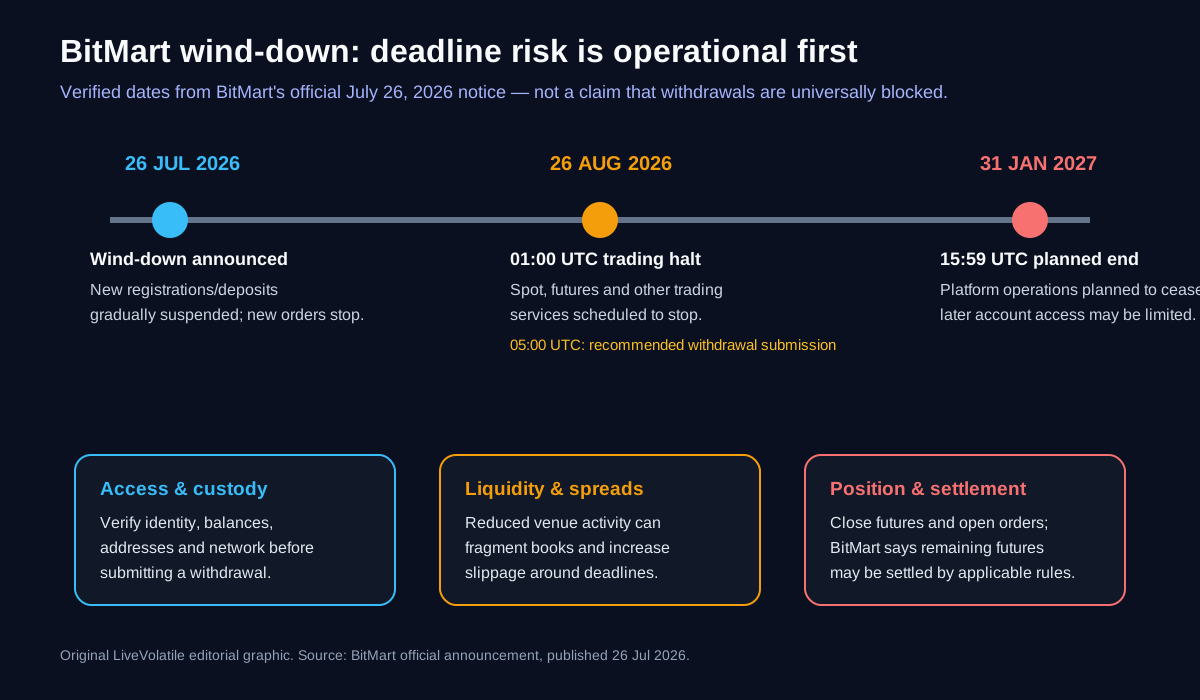
Visual credit: Original LiveVolatile editorial SVG created from BitMart’s official orderly-cessation notice, published July 26, 2026. It explains verified deadlines and monitoring points; it is not a screenshot of the exchange and does not imply that every withdrawal is delayed or blocked.
What BitMart announced
BitMart said it had decided to commence an orderly wind-down after evaluating its operating conditions, market environment and future strategic direction. The exchange’s notice set out a staged timetable rather than announcing an immediate disappearance of the platform.
According to the official notice, BitMart began gradually stopping new-user registration and cryptocurrency and fiat deposits at 01:30 UTC on July 26. It also said futures accounts would enter reduce-only mode, new spot orders would stop being accepted, and copy trading, grid trading, API trading and other automated services would be discontinued in stages.
The next hard deadline is the trading halt: 01:00 UTC on August 26. At that point, BitMart says spot, futures and other trading services will be discontinued. The notice says futures positions still open at that time may be settled according to the mark price, index price or other applicable settlement rules, with detailed arrangements to be announced separately.
BitMart separately recommends that users submit withdrawal requests before 05:00 UTC on August 26. That is a recommended processing deadline, not a promise that every request submitted before it will be completed on-chain by that time.
Withdrawal access is not the same as completed settlement
The most important wording distinction is between a withdrawal request, a completed review and a blockchain transaction. BitMart says withdrawals remain available after the wind-down announcement, but some requests may receive additional review.
The notice lists possible checks involving identity and KYC information, login devices and account security, withdrawal addresses, blockchain risk, source of funds, trading history, Travel Rule compliance and sanctions screening. It also says the exchange may request proof of identity, address, source of funds or ownership of a withdrawal address.
BitMart warns that processing time can vary with the asset, blockchain network conditions and verification status. High withdrawal volume, extra documentation, congestion and compliance reviews can extend processing. A submitted request therefore should not be described as an asset already transferred to a self-custody wallet.
For users, the practical lesson is simple: do not wait for the final hour, verify the network and destination address, complete identity verification, download account records and use only official BitMart channels. BitMart also warns that impersonation scams may increase during the wind-down. It says staff will not request passwords, authentication codes, private keys, recovery phrases or an “expedited processing fee.”
How an exchange wind-down can transmit into volatility
A platform shutdown does not automatically create market-wide selling. Its effects depend on the exchange’s share of liquidity, the assets traded there, the number of open derivatives positions and how quickly users migrate.
| Transmission channel | What can happen | What would confirm it |
|---|---|---|
| Position closure | Traders close spot or derivatives exposure before the halt | Falling open interest, rising volume and pair-specific imbalance |
| Settlement uncertainty | Remaining futures positions are marked or settled under exchange rules | Official settlement details, basis changes and liquidation data |
| Withdrawal rush | Many users request transfers simultaneously | Queue growth, longer processing notices and support-volume warnings |
| Liquidity migration | Market makers and traders move to other venues | Wider spreads, thinner depth and cross-venue price differences |
| Scam activity | Fake support accounts target stressed users | Official fraud warnings plus reports of impersonation attempts |
These are market-structure mechanisms, not predictions. The official notice establishes the deadlines and review conditions; it does not establish the size of any resulting market move.
What traders should monitor before and after the halt
1. BitMart-specific order-book conditions
Track bid-ask spreads, depth near the mid-price, trade size and slippage for pairs that were heavily used on BitMart. A falling price on one venue is more meaningful if it appears with widening spreads and a persistent premium or discount versus several independent venues.
2. Futures open interest and funding
The scheduled halt matters more for users with open derivatives positions than for a trader holding an asset in a spot wallet. Watch open interest, funding and basis before the deadline. A sharp fall in open interest can reflect orderly de-risking, while abrupt liquidations or basis dislocations can signal forced positioning.
3. Cross-venue price gaps
Compare BitMart prices with deep spot markets and reputable derivatives venues. A temporary gap can be a data or liquidity issue, not an arbitrage opportunity: transfers may be restricted by network, compliance or processing delays. Traders should not assume they can buy on one venue and withdraw or hedge through another without checking the operational path.
4. Asset-specific concentration
The effect will not be uniform across Bitcoin, ether and smaller tokens. A pair with little alternative liquidity can experience larger spreads and more slippage when a venue stops accepting orders. Market-wide BTC or ETH volatility should be attributed to the shutdown only if independent venues show a matching change in volume, depth or derivatives positioning.
5. Official updates, not social-media screenshots
Use BitMart’s Help Center, official app and registered-email notices for deadlines and account instructions. Do not rely on unattributed screenshots claiming that withdrawals are frozen, that a paid priority queue exists or that a private wallet can “unlock” funds. The exchange’s own notice explicitly warns against those patterns.
Is BitMart’s wind-down proof of broader exchange stress?
No. It is evidence of a specific platform’s announced operational exit. It may become a broader liquidity story if market makers withdraw, users are unable to move assets, a major token has concentrated exposure or another venue reports related stress. None of those broader conclusions is supported by the July 26 announcement alone.
The distinction matters because crypto headlines often compress three different events into one: a company’s decision to stop trading, an individual user’s withdrawal delay and a systemic solvency problem. They require different evidence. This article supports the first event and describes the operational risks around the second; it does not claim the third.
Use the LiveVolatile markets monitor, liquidations dashboard and volatility tools to compare venue-specific signals with broader market conditions.
FAQ
When will BitMart stop trading?
BitMart’s official notice says spot, futures and other trading services will be discontinued at 01:00 UTC on August 26, 2026.
When should users submit withdrawals?
BitMart recommends submitting withdrawal requests before 05:00 UTC on August 26, 2026. It says requests may require review and processing times may vary, so users should act earlier rather than treat the deadline as a guarantee.
Are BitMart withdrawals already blocked?
The official notice says withdrawals remain available after the announcement. It also says individual requests can face compliance, security, documentation or network-related review. That is different from a verified universal withdrawal freeze.
Could the shutdown crash Bitcoin?
The announcement alone does not support that conclusion. The likely immediate effects are venue-specific. A broader move would require confirmation across independent spot markets, derivatives, liquidity and cross-venue pricing.
What should futures users do?
Review the applicable BitMart notices, close positions within the stated timetable and understand how any remaining positions may be settled. Do not assume an open position will remain active after the 01:00 UTC trading halt.
Conclusion
BitMart’s August 26 trading halt is a time-sensitive operational event, not a standalone market-direction forecast. The official notice gives users a clear reason to review balances, positions, identity verification, withdrawal networks and account records before the deadline. For volatility traders, the key question is whether the wind-down produces measurable changes in venue depth, spreads, open interest, funding, basis or cross-market pricing.
The disciplined interpretation is narrow: BitMart is winding down trading operations, and its own procedures warn that high request volume and manual review can affect processing. Treat the event as a venue-liquidity and execution-risk checklist—not as proof of global exchange contagion.
Risk disclaimer: This article is for informational and educational purposes only. Crypto assets and securities are highly volatile and may lose some or all of their value. Nothing here is financial, legal or investment advice.
Sources
- Important Notice Regarding the Orderly Cessation of BitMart Operations — BitMart Help Center, published July 26, 2026; official timeline, trading halt, withdrawal guidance, review conditions and fraud warning.
- BitMart Exchange — official platform domain; use only official account and support routes during the wind-down.
Image credits: Original LiveVolatile SVG at /images/articles/2026-08-25-bitmart-winddown-liquidity.svg, based on the official BitMart announcement cited above. No third-party image is reproduced.
— LiveVolatile Research Desk